
How to Start an Online Music Teaching Business in South Africa
Your musical ability can become more than an occasional lesson or informal side income. With a focused niche, a clear teaching offer and reliable online systems, you can build a practical music teaching business that serves students locally and internationally.
What this article will help you decide
This guide will help you assess whether online music teaching suits your skills, select a realistic niche, design an offer, choose a delivery model, set sensible prices and start looking for your first students.
It does not promise quick or guaranteed income. The aim is to help you build and test a professional service one practical step at a time.
Online music teaching is more than a Zoom lesson
Music teaching has traditionally depended on physical proximity. The student travelled to a teacher, the lesson took place in a room, and income depended on how many individual sessions the teacher could fit into a week.
Online delivery changes those limits. A piano teacher in Pretoria can teach a learner in Cape Town. A South African vocal coach can work with an adult student in the United Kingdom. A music producer can teach beginner software skills through screen sharing, while a composer can offer structured coaching in songwriting, arranging or transcription.
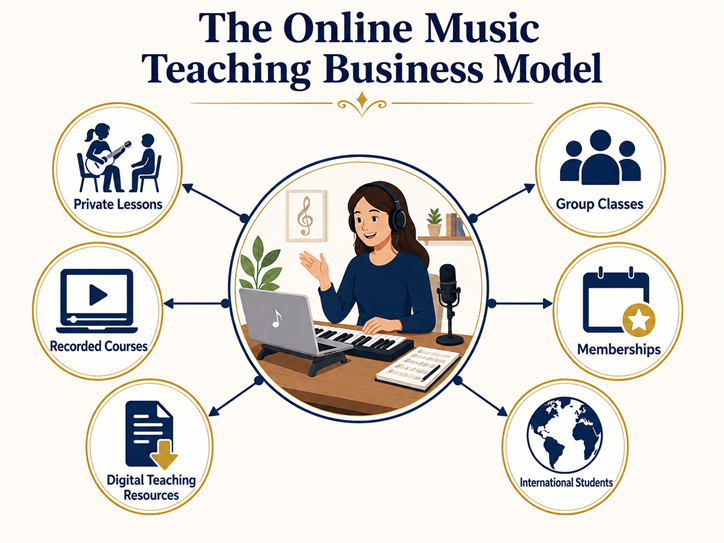
The opportunity is not limited to live private lessons. Online music education can include:
Live teaching
One-on-one lessons, small groups, workshops and goal-based coaching delivered through video.
Reusable resources
Practice plans, exercises, sheet music, demonstration recordings and structured student workbooks.
Scalable products
Pre-recorded courses, memberships, group programmes and downloadable learning materials.
A growing market, but not a guarantee
A February 2026 industry estimate from Mordor Intelligence valued the global online music education market at approximately USD 4.61 billion in 2026 and forecast growth to USD 9.36 billion by 2031.
Market forecasts should be treated as directional evidence rather than certainty. They indicate broader demand for flexible digital music learning, but they do not guarantee that an individual teacher will attract students or achieve a particular income.
External reference: Mordor Intelligence: Online Music Education Market . Accessed July 2026. Market estimates may be revised.
This opportunity fits into a wider question many people are asking: is making money online in South Africa actually real? The honest answer is that real digital income usually comes from solving a clear problem for a defined customer—not from chasing effortless “passive income”.
Is online music teaching right for you?
You do not necessarily need to be a famous performer, have a large following or own professional studio equipment. However, you do need to be honest about what you can teach and the level at which you can teach it.
Students are not only paying to watch you perform. They are paying for guidance, explanation, feedback, encouragement and a clear path towards improvement.
The abilities that matter most
- Competence in the instrument or musical subject you teach
- The ability to explain a skill in small, logical steps
- Patience when a student struggles or repeats a mistake
- Clear verbal and written communication
- Reliability, preparation and punctuality
- Basic willingness to use online tools
- Comfort with giving constructive feedback
- Realistic expectations about gradual business growth
Potential online teachers include private music teachers, school teachers, working musicians, church musicians, composers, arrangers, conductors, vocal coaches, retirees with substantial experience and university students who have developed a teachable skill.
You do not have to teach advanced students
Beginners often represent the broadest and most accessible market. Someone who can patiently guide a new learner through foundational skills may create more value than an impressive performer who cannot explain what they are doing.
Still uncertain which digital-income path fits your experience? Read How to Choose Your First Digital Income Path in South Africa before investing heavily in equipment, branding or a course platform.
Choose a niche before you build the business
“I teach music online” is difficult to market because it does not tell a prospective student whether you understand their specific goal.
A focused niche provides a clear answer to three questions:
- Who do you teach?
- What musical skill do you help them develop?
- What meaningful result are they working towards?
A simple positioning formula
“I help [specific student] learn [specific musical skill] so that they can [desired result].”
Example: “I help adult piano beginners learn through a calm, step-by-step programme so that they can confidently play their first complete songs.”
Possible online music teaching niches
Instrument teaching
- Adult beginner piano
- Acoustic guitar basics
- Beginner bass guitar
- Violin exam preparation
- Practice-pad drumming
Voice and performance
- Vocal confidence
- Worship and gospel singing
- Audition preparation
- Performance coaching
- Stage confidence
Creative and technical skills
- Songwriting
- Composition
- Music arrangement
- Music transcription
- Beginner music production
Use South African musical experience as a differentiator
South African teachers do not always need to copy generic international offers. Knowledge of worship music, gospel, African rhythm, local exam requirements, school music programmes or culturally specific styles can create a distinctive teaching position.
A niche is not a permanent restriction. It is a starting point that makes your first offer easier to explain and test.
Before building a full website or recorded course, use the validation principles in Build Proof Before You Build Big . Speak to potential students, test your wording and see whether people are prepared to pay for the proposed result.
Compare the main online music teaching models
You do not need to launch every delivery method at once. In most cases, private lessons are the simplest way to understand student needs. Group programmes, recorded material and memberships can be introduced after repeated needs become visible.
| Model | Best suited to | Main advantage | Main limitation | Good starting stage |
|---|---|---|---|---|
| Private live lessons | Beginners, personalised support and specialist coaching | Direct feedback and strong student relationships | Income remains closely tied to available hours | Ideal first model |
| Small group classes | Students with similar levels and shared goals | Higher revenue per teaching hour | Less individual attention and more coordination | After refining a repeatable lesson process |
| Pre-recorded course | Foundational, repeatable skills | Can be sold without repeating every live lesson | Requires trust, production work and marketing | After validating student demand |
| Hybrid programme | Students needing personal help and reusable resources | Balances support, structure and scalability | Requires an organised content and delivery system | Strong second-stage model |
| Membership | Ongoing learning, community and regular practice | Potentially more predictable recurring revenue | Members expect consistent new value and engagement | After building an audience and resource library |
Start with the smallest workable model
A common mistake is spending months recording a large course before teaching enough real students. Live teaching gives you direct evidence of what learners misunderstand, what they value and what language they use to describe their problems.
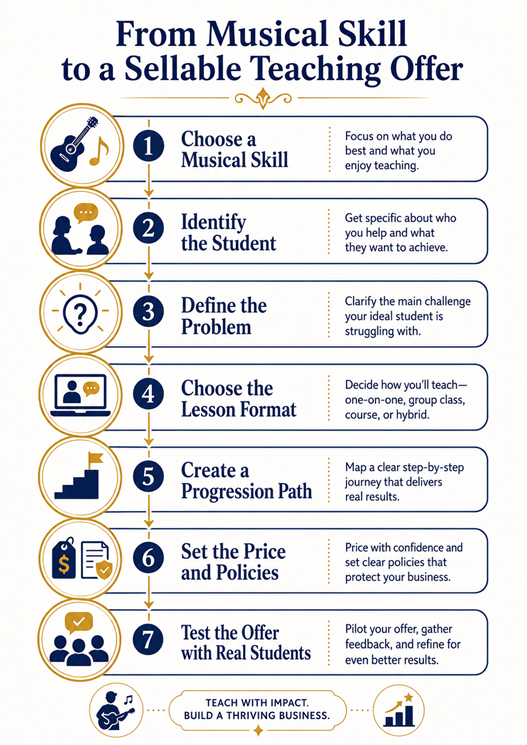
Turn your musical skill into a clear offer
A prospective student should not have to guess what happens after they contact you. Your offer should describe the learner, delivery format, lesson frequency, included support and the progress the programme is designed to help them make.
This is the difference between selling “music lessons” and selling a structured learning journey.
Example: Eight-Week Beginner Guitar Programme
Designed for
Adult beginners who own an acoustic guitar but do not know how to begin practising effectively.
Delivery
One 45-minute private online lesson each week for eight weeks.
Included resources
A chord guide, weekly practice plan, demonstration recordings and progress feedback.
Intended outcome
The ability to change between foundational chords, keep a simple rhythm and play selected beginner songs.
Every offer should clarify:
- The target student and starting level
- The musical problem or goal
- Lesson format and duration
- Number and frequency of sessions
- Resources and support included
- The expected learning progression
- The full price and payment terms
- Cancellation and rescheduling rules
For a wider explanation of packaging skills into something customers can understand, visit Your First Online Offer: What Can South Africans Sell Online?
Price for sustainable teaching, not desperation
Pricing is difficult because teachers often compare themselves with the cheapest visible option. This can lead to rates that do not cover lesson preparation, administration, payment fees, cancellations, equipment, tax or the emotional energy required to teach well.
A price should consider more than the minutes spent on a video call. It may also need to cover:
- Lesson planning and follow-up.
- Student messaging and progress tracking.
- Worksheets, exercises and demonstration recordings.
- Scheduling and payment administration.
- Platform and currency-conversion fees.
- Equipment, connectivity and software.
- Tax and professional-advice costs.
Four practical pricing approaches
Single-lesson pricing
Easy to explain and useful for assessment sessions, but it offers limited commitment and less predictable income.
Lesson packages
Four-, eight- or ten-lesson packages create a clearer progression path and encourage students to commit long enough to experience progress.
Monthly programmes
A fixed monthly fee can include a defined number of lessons, resources and progress support. Access boundaries must be explicit.
Tiered options
A basic, standard and premium option can serve students with different support needs without reducing the value of the main service.
Do not publish unsupported income promises
You can show readers or prospective teachers how to calculate possible revenue from a price and number of students. Label these figures as examples, not predictions. Actual results depend on demand, conversion, retention, available hours and operating costs.
Start with equipment that is good enough to teach
Equipment matters, especially in music, but it is easy to overspend before proving that students want the offer.
A practical starting setup
Video and sound
- Computer or capable tablet
- Reliable webcam
- Clear microphone
- Headphones where appropriate
Teaching environment
- Stable internet connection
- Useful camera angle
- Adequate front lighting
- Quiet, uncluttered background
Business tools
- Video-meeting platform
- Calendar and booking system
- Payment method
- Student and lesson tracker
Adapt the setup to the instrument
A piano teacher may need a camera angle that shows the keyboard and the teacher’s hands. A guitar student needs to see both fretting and picking. A vocal coach needs intelligible sound and enough visual detail to observe posture and breathing. A music production teacher may depend more heavily on screen sharing and audio routing.
Upgrade from evidence, not insecurity
Start with the equipment you already own where it provides a clear and reliable lesson. Upgrade the weakest part of the experience after paid students reveal what genuinely needs improvement.
Make each online lesson feel structured and useful
A successful online lesson is not simply a conversation with an instrument nearby. Students need to understand what they are learning, why it matters, how to practise it and what progress should look like.
Example structure for a 45-minute lesson
Review
Check the previous practice task and identify what improved or remained difficult.
Teach
Introduce one main concept or technique using a clear demonstration.
Apply
Ask the student to perform the skill while you observe, correct and simplify where necessary.
Practise
End with a specific, manageable practice task and a clear measure of progress.
Retention comes from visible progress
Students may enjoy a teacher personally but still stop paying when lessons feel random. Use milestone sheets, practice plans, short recordings, progress reviews or staged learning levels to help the student see what has changed.
Retention is also influenced by reliability. Starting on time, preparing properly, following up as promised and applying policies consistently are part of teaching quality.
How to find your first online music students
Your first students are unlikely to appear simply because you created a social-media profile. Begin with direct, credible channels where people already know your work or can easily understand your teaching ability.
1. Start with your existing network
Inform previous students, parents, colleagues, schools, churches, community groups, choirs and fellow musicians that you have created a specific online offer. Avoid vague messages such as “I am available for music lessons.” Describe exactly who the programme is for.
2. Publish useful teaching content
Content should demonstrate how you think and teach. Useful topics include:
- Common mistakes made by beginners.
- Short demonstrations of a foundational skill.
- Practice methods for busy adults.
- Simple explanations of difficult music theory.
- Advice for parents supporting a young learner.
- Answers to frequently asked student questions.
3. Build partnerships
Consider relationships with instrument retailers, schools, churches, choirs, homeschooling groups, community centres and music organisations. A trusted referral can carry more weight than a large number of generic social-media impressions.
4. Offer a structured introduction
Instead of providing a complete free lesson, offer a short consultation, skill assessment or goal-setting session. Use it to determine fit, explain the teaching process and recommend the appropriate paid option.
5. Track your evidence
Record where enquiries came from, which messages led to responses, which objections were raised and why students enrolled or declined. This turns marketing into a learning process.
Many capable South Africans remain stuck because they wait for complete confidence before testing anything. The article Why Most South Africans Don’t Start Earning Online explains why small, evidence-producing actions are more useful than endless preparation.
Local students versus international students
Online teaching removes geographic limits, but a larger market also introduces more complexity. You do not have to pursue international students immediately.
Serving South African students
- Shared or similar time zones
- Familiar local payment methods
- Relevant cultural and educational context
- Easier local referrals and partnerships
- Pricing must remain realistic for the target audience
Serving international students
- Access to a substantially larger market
- Potential to charge in foreign currency
- More competition and comparison
- Time-zone and scheduling complexity
- Payment, fee, tax and currency considerations
A practical approach is to validate the lesson system with a manageable group of students before expanding into several countries, currencies and time zones.
Compete through fit, specialisation, professionalism and teaching quality—not only through a lower exchange-rate-based price.
Treat the teaching activity like a real business
Professional administration protects both the teacher and the student. Even a small side business should have clear records, policies and communication.
Business basics
- Record all income and business expenses.
- Issue clear invoices or receipts.
- Separate personal and business records where possible.
- Monitor tax and registration obligations.
- Use written payment and refund terms.
Student protection
- Use secure, reputable teaching platforms.
- Obtain appropriate consent when teaching minors.
- Keep communication with children transparent.
- Clarify whether lessons may be recorded.
- Protect student information and recordings.
Protect your teaching materials
Clearly state whether students may download, copy or share lesson recordings, worksheets, arrangements, backing tracks and course materials. Use original content or obtain the necessary permissions for third-party material.
Common mistakes that weaken an online teaching business
Trying to teach everyone
Broad positioning makes the offer difficult to explain and forces the teacher to compete with every other general music teacher.
Buying before validating
Expensive cameras, microphones, branding and software do not create demand for an unclear offer.
Underpricing from fear
Unsustainable rates can create a full diary without creating a healthy business.
Teaching without a pathway
Random lessons make it difficult for students to recognise progress or understand why they should continue.
No cancellation policy
Frequent last-minute changes can quickly undermine income, scheduling and professional boundaries.
Expecting instant scale
Courses and memberships usually become more useful after the teacher has learned from live students and built trust.
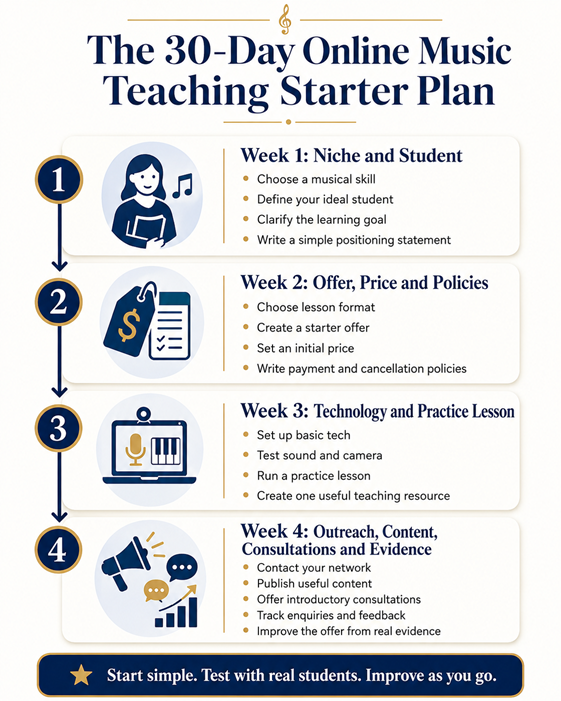
A practical 30-day online music teaching starter plan
The objective of the first month is not to create a large online school. It is to produce enough evidence to know whether your niche, offer and teaching process make sense.
Week 1: Choose your direction
- Select one primary musical skill.
- Choose one type of student.
- Define one achievable outcome.
- Write your positioning statement.
Week 2: Build the starter offer
- Choose lesson length and frequency.
- Create a four- or eight-lesson pathway.
- Set an initial price.
- Write payment and cancellation terms.
Week 3: Test the teaching system
- Conduct a practice online lesson.
- Test sound, framing and connectivity.
- Create one useful practice resource.
- Ask for honest feedback.
Week 4: Look for real students
- Contact relevant people in your network.
- Publish three useful teaching posts.
- Offer a limited number of consultations.
- Track enquiries and improve the offer.
Measure progress by evidence
Useful first-month evidence includes conversations with potential students, enquiries, trial consultations, paid bookings, objections, lesson feedback and signs of student progress. Followers and page views are secondary unless they lead to meaningful action.
Once you achieve the first sign of traction, use From First Digital Income to What Works to decide what to repeat, improve or stop.
Start with one student and one clear outcome
A sustainable online music teaching business does not begin with an expensive studio, a complete course library or thousands of followers. It begins with one teachable skill, one clearly defined student and one offer that helps that person make meaningful progress.
Your first objective is to prove that you can attract an appropriate student, deliver a useful lesson and create visible improvement. Once that process works, you can strengthen the offer, improve your systems, introduce group teaching or package repeated lessons into reusable resources.
Start small, keep accurate records and build from what the market demonstrates—not from what online success stories promise.
About this guide

Written by Douw Steyn
Douw Steyn is a South African business author and the founder of GigsZA and How To Books ZA. His work focuses on practical ways for South Africans to start small businesses, develop digital-income opportunities and build systems around skills they already possess.
He is the author of How to Start an Online Music Teaching Business, a practical guide covering online teaching models, niche selection, pricing, lesson delivery, marketing, student retention and long-term growth.
How this article was prepared
This article was developed from the structure and practical principles in How to Start an Online Music Teaching Business. The article has been adapted into a standalone introduction for South African readers and supplemented with a current external market reference.
No income figures in this article should be interpreted as a promise. Readers are encouraged to test demand with a small offer before making substantial financial commitments.
Sources and further reading
- Douw Steyn, How to Start an Online Music Teaching Business, first edition, 2026.
- Mordor Intelligence, Online Music Education Market Size and Forecast , published February 2026 and accessed July 2026.
- GigsZA Digital Income South Africa Hub .
Frequently asked questions
Do I need a music degree to teach music online?
Not every online music teaching niche legally or practically requires a formal music degree. However, you must possess genuine competence in the subject you teach and describe your background honestly. Qualifications may be particularly important where students require formal exam preparation or specialist instruction.
Can I start teaching with basic equipment?
Yes, provided the student can hear instructions and musical examples clearly, see relevant technique and maintain a reliable connection. Upgrade equipment after real teaching experience reveals the most important weakness.
Which musical subjects work well online?
Piano, guitar, voice, music theory, songwriting, composition, arrangement and music production can all be delivered online. Instrument positioning, audio quality and lesson structure must be adapted to the subject.
How much should I charge for an online music lesson?
There is no universally correct price. Consider your experience, niche, lesson duration, preparation, resources, administration, student market, platform fees and tax obligations. Test a sustainable starting rate and review it as demand and value develop.
Should I offer a free first lesson?
A short consultation or assessment can help determine fit without giving away a complete lesson. Explain what the introductory session includes and guide suitable students towards a defined paid package.
How can I find my first students?
Start with previous contacts, schools, churches, community networks, fellow musicians and relevant online groups. Publish useful teaching content and clearly describe the type of student your offer serves.
Can I teach international students from South Africa?
Yes. You will need to manage time zones, international payments, transaction fees, currency conversion, clear communication and applicable South African tax or business obligations.
Can online music teaching become a full-time business?
It can develop into a substantial business, but no income level is guaranteed. Growth generally requires a clear niche, reliable teaching, consistent student acquisition, strong retention and, eventually, delivery models that are not limited entirely to one-on-one hours.
Related GigsZA guides
Use these resources to choose, validate and improve a practical digital income path.