
Remote Work Safety Guide
Remote Work Scams in South Africa: How to Spot Fake Jobs Before You Apply
Learn how to recognise fake recruiters, WhatsApp job scams, upfront-fee traps, identity theft risks and suspicious online work offers before they cost you money, time or personal information.
A fake remote job does not always look fake. It may use a professional logo, a real company name, a polished advert or an official-sounding job title.
It may appear on LinkedIn, Indeed, Facebook, WhatsApp, Telegram, email or a professional-looking website. Some scams ask for money immediately. Others first ask for trust, then personal documents, banking details or unpaid work.
Remote work is not the problem
South Africans genuinely work remotely in customer support, administration, virtual assistance, bookkeeping, content, research, sales support, tutoring and many other roles.
The danger is that scammers copy the language and appearance of legitimate remote employers.
The goal is not to become afraid of every online job. The goal is to build a reliable filter that helps you separate legitimate opportunities from weak offers, poor-quality jobs and deliberate scams.
New to remote work? Start with the Remote Work in South Africa beginner reality check before applying widely.
Understanding the risk
Why remote work scams are so common
Remote recruitment often happens entirely online. An applicant may never visit an office or meet a hiring manager in person. Interviews, assessments, contracts and onboarding may all happen through email, video calls, forms and messaging platforms.
This convenience also makes legitimate recruitment easier to imitate. A scammer can copy a logo, create a free email account and post a fake vacancy without having a registered business or real role to offer.
Job seekers are under pressure
Someone who urgently needs income may act quickly when offered immediate work or guaranteed acceptance.
Online identities are easy to copy
Logos, company names, recruiter photographs and testimonials can be copied from real organisations.
Remote work crosses borders
Applicants may not know what a normal hiring process looks like in another country.
The more informal the recruitment channel, the stronger your independent verification should be.
A practical decision framework
The remote work scam triangle
Many online job scams contain three connected elements. If all three are present, treat the opportunity as high risk.

They promise fast or unusually easy income
The advert may promise R1,000 per day from your phone, a large monthly salary for two hours of work or guaranteed income with no experience.
They ask for trust before providing proof
You may be accepted without an interview or told to trust an unknown recruiter because the company is supposedly international.
They want something valuable too early
This may include money, ID documents, banking details, passwords, remote access or a large amount of unpaid work.
Before you apply, pay or share documents
15 warning signs that a remote job may be fake
You must pay to apply
The payment may be called a registration, administration, training, placement or activation fee.
The pay is unusually high for simple work
Be cautious when basic typing or online tasks supposedly pay far more than similar entry-level roles.
The duties are unclear
Vague phrases such as “simple tasks” or “message processing” do not explain what value you will provide.
You are accepted immediately
Instant acceptance without a proper application review, interview or skills discussion is suspicious.
The recruiter communicates only through WhatsApp
Messaging apps are not proof of fraud, but the risk rises when there is no official email or verifiable company profile.
The email address is free or misspelled
Watch for Gmail accounts or domains that differ from the real company address by one letter or number.
The vacancy is missing from the official website
Search for the company’s careers page independently instead of trusting only the recruiter’s link.
You are asked for personal documents too early
A certified ID, bank letter, tax number or proof of address should not usually be required during the first conversation.
You must buy equipment from a specific supplier
Equipment scams often involve headsets, laptops, software, courier fees or starter packs.
You must deposit money to unlock tasks
Real work should not require deposits to access higher-paying tasks or withdraw supposed earnings.
The interview happens only through text
Text-only interviews make it easier for impersonators to avoid questions and hide their identity.
The recruiter creates urgency
“Only five spaces remain” or “pay today” is designed to prevent careful checking.
The advert focuses more on earnings than duties
Screenshots, testimonials and lifestyle claims do not replace a proper job description.
The unpaid test is commercially useful
A complete article, spreadsheet, marketing plan or batch of product descriptions may simply be free work.
The opportunity becomes less clear when questioned
A legitimate employer should be able to clarify the company, role, salary and process.
Quick comparison
Genuine remote job vs suspicious remote job
| Recruitment area | More credible process | Suspicious process |
|---|---|---|
| Company identity | Clear website, contact details and public business presence. | Vague identity or copied company branding. |
| Job duties | Specific responsibilities and expected outcomes. | Vague online tasks or typing work. |
| Selection process | Application review, interview and relevant assessment. | Immediate acceptance without screening. |
| Communication | Company email and scheduled professional calls. | Unknown WhatsApp number only. |
| Payment direction | The employer pays the worker. | The applicant must pay first. |
| Documents | Requested during verified onboarding. | Requested during the first conversation. |
| Decision time | Reasonable time to ask questions. | Pressure to act immediately. |
| Test work | Short and relevant assessment. | Large commercially useful unpaid task. |
A repeatable safety process
The 10-minute remote job verification check

-
Search for the company independently
Find the official website, contact page, careers page, LinkedIn presence and real staff profiles.
-
Search for the exact vacancy
Check whether it appears on the company’s own careers page or verified recruitment channel.
-
Verify the recruiter
Look at the name, employment history, company connection and email domain.
-
Examine the website and email domain
Check for substituted letters, extra hyphens, numbers or unusual domain endings.
-
Compare the salary with the work
Ask whether the pay makes sense for the duties, experience and working hours.
-
Look for money requests
Stop if you are asked for a registration, training, equipment or release fee.
-
Check what information is requested
Ask whether the information is necessary at that stage of the hiring process.
-
Ask direct questions
Ask about the official vacancy, hiring manager, duties, salary, reporting line and contract.
-
Search distinctive wording from the advert
Scammers often reuse the same scripts across several websites and groups.
-
Pause before taking a risky action
Do not pay, install software or share sensitive documents while you feel rushed.
Continue your search safely
Where to find legitimate remote jobs in South Africa
Learn how to search job boards, company career pages and remote platforms more effectively.
Protect your identity
What personal information is safe to share?

Stage 1
Early application
- Name
- Professional email address
- Phone number
- CV
- LinkedIn profile
- Relevant portfolio samples
Stage 2
Interview process
- Work history
- Skills and qualifications
- Availability
- Expected salary
- Equipment and internet capability
Stage 3
Verified onboarding
- Identity document
- Bank confirmation
- Tax information
- Proof of address
- Signed employment documents
Never share these with a recruiter
- Online banking password
- Bank card PIN
- One-time password or OTP
- Email password
- Authentication codes
- Copies of both sides of your bank card
How the warning signs appear
Five remote work scam examples
Scenario 1
The R350 registration fee
A remote administration role offers R12,000 per month. The applicant is accepted without an interview and told to pay R350 for onboarding.
Warning: payment before a verified job offer.Scenario 2
The WhatsApp data-capturing job
The advert promises R850 per day and phone-only work. The applicant must pay for a work file.
Warning: vague work, high pay and an upfront fee.Scenario 3
The fake international recruiter
A supposed overseas employer offers a large salary without a proper interview and requests passport and bank details.
Warning: sensitive information too early.Scenario 4
The task-platform deposit
A worker receives a small first payment, then must deposit R500 to unlock better tasks.
Warning: deposits disguised as employment.Scenario 5
The unpaid freelance test
A client requests a full content plan, spreadsheet or batch of product descriptions as a free assessment.
Warning: commercially useful unpaid work.Act quickly without panicking
What to do if you think you have been scammed
If you paid money
- Stop all further payments.
- Contact your bank immediately.
- Save transaction references and screenshots.
- Ask whether the payment can be stopped or disputed.
- Do not pay anyone promising guaranteed recovery.
If you shared personal documents
- Record exactly what was shared.
- Save all messages and adverts.
- Watch for unusual account activity.
- Be alert for follow-up identity scams.
If you shared a password
- Change the password immediately.
- Change it anywhere else where it was reused.
- Enable two-factor authentication.
- Sign out of unknown devices.
If you installed software
- Disconnect the device from the internet.
- Remove unknown remote-access tools.
- Run reputable security checks.
- Change important passwords from a trusted device.
Common questions
Frequently asked questions
Are all work-from-home jobs scams?
No. Many South Africans work remotely in legitimate employment and freelance roles. The employer, duties, payment and hiring process should still be verified.
Should I pay a registration fee for a remote job?
Treat any fee required merely to apply, register or secure a position as a major warning sign.
Is a job fake if the recruiter uses WhatsApp?
Not automatically. However, WhatsApp alone does not prove that the recruiter or employer is legitimate.
When is it safe to share my ID?
Identity documents are more appropriate during formal onboarding after the employer, role and written offer have been verified.
Can a LinkedIn or Indeed job still be fake?
Yes. Established platforms reduce some risks but cannot guarantee every advert or recruiter is genuine.
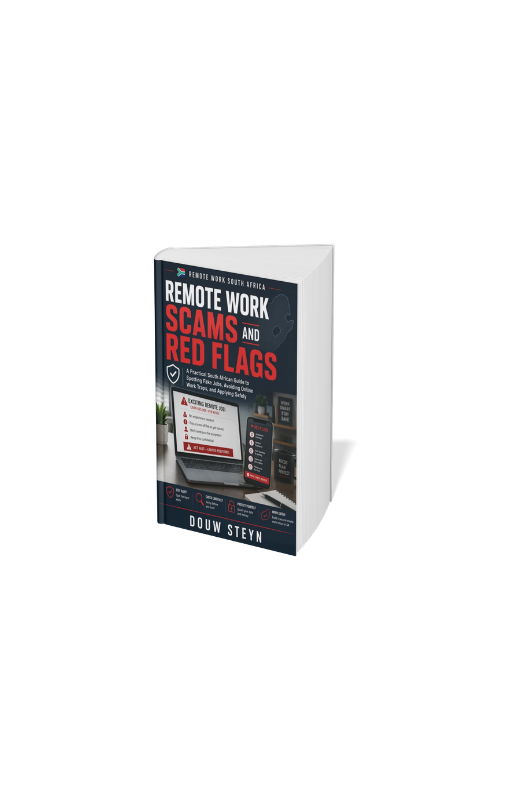
Recommended Guide
Search with hope, but verify with discipline
Get the complete South African guide to fake recruiters, payment traps, identity risks, task scams, suspicious interviews and safer remote job searching.
- Recognise common remote-work scam patterns
- Check recruiters, vacancies and companies
- Protect your money and personal information
- Respond calmly after a suspected scam
Remote Work South Africa
Remote Work Scams and Red Flags
A practical guide to spotting fake jobs, avoiding online work traps and applying more safely.
Get the Digital GuideHow this article was prepared
Experience
Built around the remote job-search problems South African applicants regularly encounter.
Expertise
Covers verification, safer applications, recruiter checks and personal-information protection.
Authority
Forms part of the GigsZA Remote Work South Africa guide series.
Trust
Uses clear cautions, an official external reference and no quick-money promises.
Important disclaimer
This article is provided for general educational and informational purposes only. It is not legal, financial, cybersecurity, employment, banking or professional advice.
Scam methods, recruitment practices, job platforms, payment systems and reporting procedures change over time. Always verify an employer independently before paying money, sharing documents, installing software or accepting work.