
Digital Income South Africa
Your First Online Offer: What Can South Africans Sell Online?
You do not need a big product, a large audience, or a perfect business to begin. Your first online offer only needs to solve one clear problem for one clear type of person.
- Five realistic offer types
- South African examples
- A simple test before you build

The question that stops many beginners
“What can I actually sell online?”
Many South Africans like the idea of earning online, but the moment they ask what they could sell, everything becomes unclear. They imagine that they need a large product, a professional brand, a full website, a big social media following, or an original business idea nobody has seen before.
Yet useful offers often begin with things people already know or can do: organising documents, writing clearly, explaining a process, creating a checklist, improving a CV, researching information, designing a simple template, or helping a small business complete a task.
Your skills, work experience, life experience, practical knowledge, and problem-solving ability may already contain the beginning of an offer. The challenge is to package one useful part clearly enough that another person can understand it, value it, and take the next step.
Your first online offer does not need to be big. It needs to be clear, useful, and testable.
Start with a simple definition
What is an online offer?
An online offer is a clear thing you provide, deliver, or sell using digital tools. It could be a service, digital product, template, checklist, guide, consultation, training session, document review, downloadable resource, package of knowledge, or simple done-for-you task.
An offer is more than an idea such as “I want to do graphic design” or “I want to sell an eBook.” It explains who you help, which problem you address, what the buyer receives, and why that result is useful.
Example
I help South African beginners compare online income ideas by providing a simple readiness checklist, so they can choose one realistic path before spending money.
Why your first offer should be small
Beginners often overbuild. They try to create a full course, a long eBook, a complete website, or a complicated digital product before they know whether people want the result. That can consume weeks of effort and create costs before the idea has produced a meaningful response.
A small offer is easier to explain, deliver, and improve. It lets you test demand, learn what people actually need, receive useful feedback, and make the first sale feel more realistic. If the offer gets little interest, you can change it without abandoning months of work.
Small does not mean weak. Small means testable.
A practical map
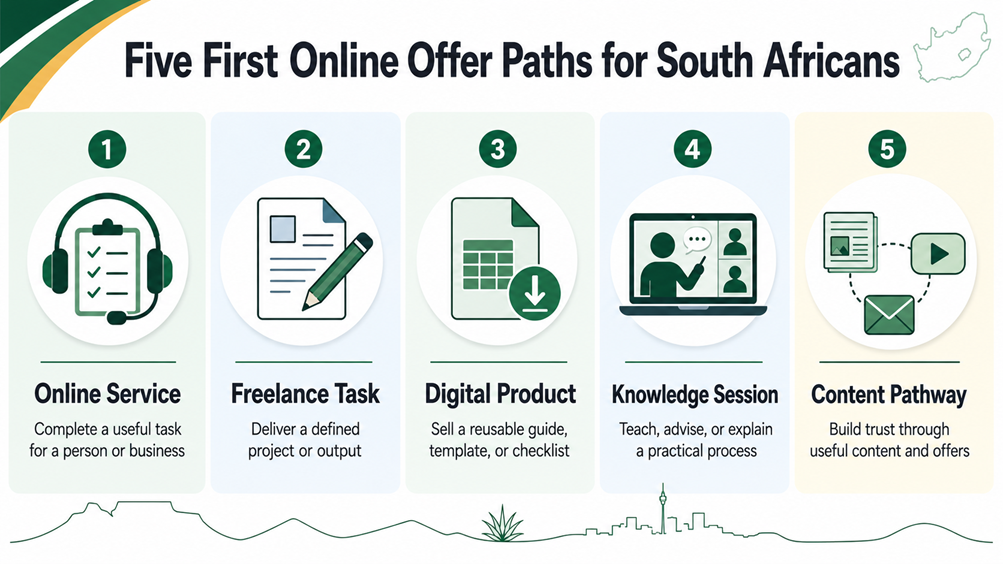
Five types of things South Africans can sell online
You do not need to use all five models. Choose the category that best matches your current skills, resources, confidence, and access to potential buyers.
Option 1
Sell a practical online service
An online service is often the simplest first offer because you do not need to create a product in advance. You use an existing ability to help a person or business solve a problem.
People with workplace experience, admin ability, writing skills, support skills, or practical business knowledge.
Someone asks for an example, sends you a task, requests a price, or wants to know how the service works.
First simple offer
I help small business owners turn messy notes into a clear one-page service description they can use on WhatsApp, Facebook, LinkedIn, or their website.
Explore Turning Skills into an Online Service Business and How to start a profitable wedding planning business.
Option 2
Sell a freelance skill
Freelancing usually means selling a specific skill on a task or project basis. The buyer is not purchasing your general availability. They are purchasing a defined output such as an article, edited video, presentation, spreadsheet, set of captions, or translated document.
People who can deliver a defined task and are willing to build a small portfolio of relevant samples.
Someone asks for a sample, requests a quotation, or offers you a small paid project.
First simple offer
I write short, practical blog posts for South African small businesses that need helpful content but do not have time to write it themselves.
Related guide: Starting a Resume Writing Business Online.
Option 3
Sell a digital product
A digital product is a file or resource that someone can buy, download, and use. It can be delivered repeatedly, but it still needs to solve a specific problem. “Passive income” language can make digital products sound effortless; in reality, useful products require research, creation, testing, marketing, and customer support.
People who can organise knowledge, steps, examples, or useful tools into a resource that is easy to use.
People download a free sample, join a list, request a paid version, click the product page, or make a first purchase.
First simple offer
A downloadable checklist for South Africans who want to compare digital income ideas before spending money.
See How to Create and Sell Your First eBook Online and Selling Templates, Guides and Digital Downloads.
Option 4
Sell knowledge in a simple format
Many people have valuable knowledge but do not recognise it as sellable. It may come from employment, business, technical work, studies, creative practice, parenting, life experience, or solving a difficult problem repeatedly.
Knowledge can become a paid consultation, 60-minute practical session, mini workshop, beginner lesson, step-by-step guide, small email course, resource list, or focused problem-solving call. The value is not that you know everything. It is that you can help the right person understand or do something more effectively.
People who can explain a process clearly, help someone make a decision, or help a beginner avoid common mistakes.
Someone asks for advice, books a session, joins a waiting list, or asks when your next workshop will take place.
First simple offer
I offer a 60-minute online session to help beginners choose one realistic digital income path based on their skills, time, tools, and starting point.
Continue with How to Launch a Simple Online Course.
Option 5
Build offers through useful content
Some people prefer to begin by writing, explaining, teaching, or publishing. Helpful articles, YouTube videos, LinkedIn posts, newsletters, comparison guides, tutorials, resource pages, product reviews, and affiliate recommendations can build trust around a topic.
Content is usually a slower route to income because attention and trust take time. However, it can support digital products, services, affiliate links, email offers, consultations, and books. The content should connect naturally to a problem and a useful next step.
People who can publish consistently, answer real questions, and build useful topic coverage over time.
Search impressions, clicks, comments, email signups, product clicks, affiliate clicks, or direct reader questions.
First simple offer
I publish practical guides for South Africans who want to start earning online without hype, and I offer downloadable checklists and beginner guides.
Make the offer understandable
What should your first offer include?
A clear first offer should answer five questions:
- Who is it for? Name the person or type of buyer.
- What problem does it solve? Focus on one meaningful need.
- What does the buyer receive? Describe the actual deliverable.
- How does it help them? State the practical benefit.
- What is the next step? Tell them how to enquire, book, download, or buy.
Choose from where you are
How to choose what to sell first
Start with what you already know
Review your past jobs, current skills, problems you have solved, tools you can use, documents you can create, processes you understand, and topics you can explain simply. Notice what people already ask you to help with. Familiar skills can often produce a faster, more confident first test than a completely new field.
Start with a problem, not a product
Do not begin with “I want to sell an eBook.” Begin with “What problem can I help someone solve?” The answer may lead to an eBook, but it may also reveal that a checklist, template, service, or short consultation would be more useful and easier to test.
Start with a buyer you understand
Your offer becomes easier to shape when you understand the person you want to help. This could be job seekers, small business owners, freelancers, students, home-based entrepreneurs, service providers, creators, parents, career changers, or beginners exploring online income.
A simple first-offer decision table
| What you have | Possible first offer |
|---|---|
| Admin experience | Virtual assistant starter package |
| Writing ability | Blog post, profile, or email writing service |
| Design ability | Canva template pack or social media design service |
| Business experience | Consultation, checklist, or process guide |
| Teaching ability | Mini workshop or beginner lesson |
| Technical confidence | Setup service, tutorial, or digital toolkit |
| Research skill | Research summary or curated resource list |
| Experience solving a problem | Practical guide, checklist, or coaching session |
| Existing audience | Downloadable resource or focused paid offer |
| No audience yet | Small service test with relevant people you can reach |
Protect your reputation
What South Africans should be careful of selling online
A first offer should be honest, specific, and deliverable. Avoid vague “make money online” advice without credible experience, copied products, fake passive-income systems, and promises about results you cannot control.
- Do not use income screenshots as proof of what a buyer will achieve.
- Do not choose a product only because it is currently popular.
- Do not sell something you cannot deliver to a reasonable standard.
- Do not create a full course before testing the demand for the lesson.
- Do not price far ahead of the trust and proof you have built.
- Do not describe your buyer as “everyone.”
Trust grows when your promise is smaller than your ability to deliver, not larger.
Keep the first transaction manageable
How to price your first online offer
There is no universal first price. Pricing depends on the value of the result, the time and complexity involved, the buyer, your costs, and the proof you already have. A custom service for a business and a short downloadable checklist should not be priced in the same way.
For an early test, keep the offer small, affordable, clear, low-risk, and easy to deliver. A document review, starter template, short consultation, basic service package, paid pilot, or low-cost guide can help you test whether the problem and promise matter.
Collect a real signal
How to test your first online offer
You do not need a dramatic launch. You need a clear test with relevant people and a way to record what happens.
- Write the offer in one sentence. Use the formula above.
- Choose one type of buyer. Avoid testing with a random audience.
- Create one simple sample or description. Show what the person receives.
- Share it with 5-10 relevant people. Ask for reactions and questions.
- Publish it once. Use LinkedIn, WhatsApp, Facebook, or email where appropriate.
- Track behaviour. Record replies, clicks, downloads, questions, and enquiries.
- Improve the wording. Use repeated questions to make the offer clearer.
- Offer a small paid version. Test whether interest can become a transaction.
You do not need to launch loudly. You need to test clearly.
For a more detailed test process, read Build Proof Before You Build Big.
A practical South African example
Thabo turns an ordinary workplace skill into an offer
Thabo works in a small office and is good at organising documents. He wants to earn online but thinks he has nothing special to sell. After listing the tasks he handles confidently, he realises he can help small service businesses improve their quotations, service descriptions, and client follow-up messages.
Instead of building a website or creating a complicated product, he writes one offer: “I help small service businesses create a clear one-page service sheet they can send to clients on WhatsApp.”
He shares the offer with five local business owners. Two ask for examples, and one pays for a small first job. Thabo now has a real customer conversation, a sample of completed work, and feedback he can use to improve the next version.
His first offer did not come from a complicated business idea. It came from a useful skill he already had.

Common mistakes with a first online offer
- Making the offer so broad that nobody knows what you actually do
- Trying to sell to everyone instead of one understandable buyer
- Using clever but unclear language
- Building the full product before testing the small version
- Hiding the price forever and never testing real buying intent
- Copying competitors instead of understanding the customer problem
- Offering too many unrelated services or products at once
- Selling a product when a small service would be faster to test
- Creating a full course before testing a guide, session, or workshop
- Waiting until everything looks perfect before asking for a response
Check before you share
The first-offer checklist
- Is the buyer clear?
- Is the problem clear?
- Is the practical outcome clear?
- Is the delivery simple enough for a first test?
- Can I explain the offer in one sentence?
- Can I test it without spending much money?
- Can someone understand exactly what they receive?
- Can I deliver it confidently?
- Can I improve it after receiving feedback?
Interest is the beginning
What to do after your first offer gets interest
Ask interested people what they need most and which part of the offer matters to them. Improve the wording, make the product or service page clearer, and build a simple repeatable delivery process. Where appropriate, ask satisfied customers for a truthful testimonial.
You can then create a related checklist, guide, or template; add the offer to your website or shop; and begin building a small email list. The goal is to decide whether to continue, improve, narrow, or expand based on evidence.
The first offer is not the final business. It is the first proof-building step.
Next in the pathway: From First Digital Income to What Works.
Digital Income South Africa
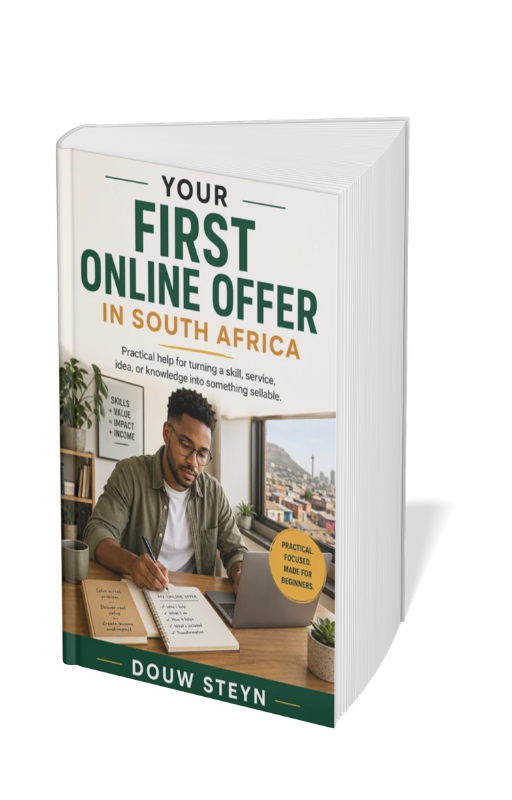
Your First Online Offer in South Africa
Turn a skill, service, idea, or knowledge into something simple you can sell online. This practical eBook helps South Africans shape a clear first offer before spending too much time, money, or energy building the wrong thing.
Free practical resource
Still unsure what you can sell?
Use the Digital Income Readiness Checklist to compare your skills, time, tools, confidence, and possible income paths before creating your first online offer.
Download the Free Checklist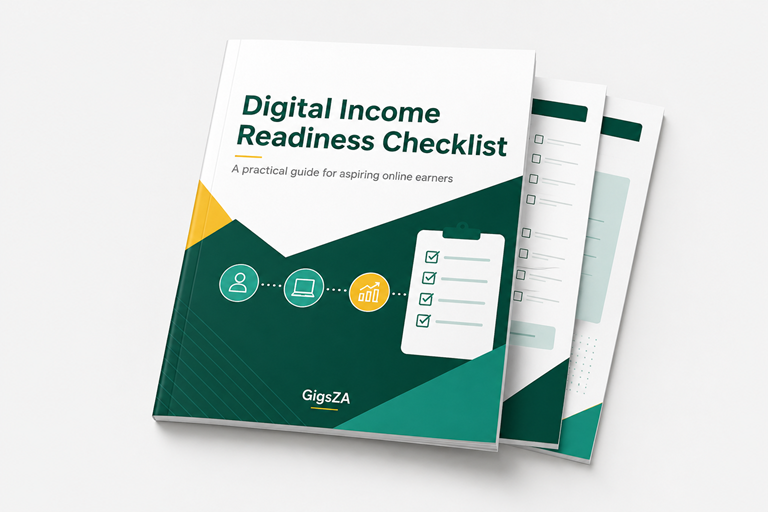
Questions beginners ask
FAQs about creating your first online offer in South Africa
What is the easiest first online offer to start with?
For many beginners, the easiest first offer is a small service based on a skill they already have. This could be writing, admin support, document formatting, basic design, research, CV help, or a simple consultation.
Do I need a website before selling my first online offer?
No. A website can help later, but your first test can start with a clear offer description, a PDF sample, a WhatsApp message, a LinkedIn post, email outreach, or a simple product page.
Should I start with a service or a digital product?
Start with a service if you need feedback or income sooner and can deliver a useful task. Start with a digital product if you can package a clear problem into a guide, checklist, template, or worksheet and you have a way to reach likely buyers.
How much should I charge for my first online offer?
Keep the first offer small, clear, and manageable. The price should reflect the result, your time, the buyer, your delivery costs, and your current proof. A low-cost guide and a custom business service should not be priced the same way.
How do I know if my first offer is worth continuing?
Look for real signals: replies, questions, downloads, clicks, sample requests, enquiries, bookings, or a first sale. If nobody responds, improve the buyer, problem, wording, or offer before building more.
Final thoughts
You probably have more to offer than you think. The first step is not to create the largest possible product. It is to notice a problem you understand, package one useful form of help, and explain it clearly.
Start with a small service, task, resource, session, or product. Test it before investing too much. Pay attention to questions and behaviour, then improve what receives genuine interest.
Your first online offer does not need to impress everyone. It needs to help one clear type of person solve one clear problem.