
Digital Income South Africa
From First Digital Income to What Works: What to Do After Your First Sign of Progress
A first reply, download, enquiry, click, signup, or sale is encouraging. It is also information. Learn how to understand the signal, improve what you tested, and decide whether to continue, stop, or build.
- Understand early proof signals
- Improve before expanding
- Build only what starts working

The next question
The first sign of progress can be surprisingly confusing
Getting your first sign of progress online feels good. Someone replies to your message. A visitor clicks a product page. A potential customer asks a question. A reader downloads your checklist. Your first subscriber joins your list. Perhaps someone even buys.
Then the excitement settles and a new question appears: What now? Should you build a website, add more products, increase the price, run ads, create a course, or change the entire offer? The temptation is to treat one positive result as permission to build everything at once.
A calmer response is usually more useful. Your first sign of progress is not the finish line, and it is not proof that the whole business model works. It is feedback from the real world. Your next task is to understand what happened, improve the offer, and try to make the signal happen again.
Your first sign of progress is not the finish line. It is feedback. Use it to decide what to improve next.
Look beyond income
What counts as a first sign of progress?
Not every early win is a sale. At the beginning, useful progress includes any behaviour showing that someone noticed your idea, cared enough to respond, or moved closer to taking action.
What Counts as Progress?
These signals are not equally strong. A click tells you less than an enquiry, and an enquiry tells you less than a payment. Even so, each can teach you something about the topic, audience, wording, offer, or next step.
Progress is not only money. Progress is evidence that your idea has started interacting with the real world.
Do not overreact to one signal
One sale matters. One enquiry matters. One relevant search click matters. But a single result still needs interpretation. It may reflect a genuine need, strong wording, the right audience, personal trust, good timing, or a combination of these factors.
Avoid building a large website after one sale, adding five offers before understanding the first one, or spending money on advertising before you know whether the message can work again. At the other extreme, do not abandon a promising idea because a second sale does not arrive immediately.
Keep the first result in proportion. Record it, learn from it, and run another small test. A useful signal should lead to a better question, not an uncontrolled expansion.
Classify the evidence
The first question: What type of progress did you get?
Different signals suggest different next actions. Classifying what happened helps you avoid treating attention as buying intent or treating a sale as guaranteed recurring income.
| Type of progress | What it may mean | Useful next step |
|---|---|---|
| Clicks | The topic or headline attracts attention. | Check whether visitors continue to the next action. |
| Downloads | The free resource may solve a real beginner problem. | Follow up and ask what help they need next. |
| Replies | Your message connected with someone. | Continue the conversation and clarify the problem. |
| Questions | People need clarity or are considering the offer. | Improve the offer wording or FAQ. |
| Price enquiries | There may be genuine buying intent. | Give a clear package, price, and next step. |
| Signups | People want more but may not be ready to buy. | Build trust with useful follow-up content. |
| First sale | The offer has real potential. | Deliver well and learn why the buyer chose it. |
| Repeat interest | The underlying need may be stronger than expected. | Test the offer with more people like them. |
| No second response | The first signal may have been weak or poorly followed up. | Review the audience, message, and process. |
Different proof signals require different next steps.
Test direction, not scale
The second question: Can the signal repeat?
A first sale or enquiry proves possibility. The more useful question is whether a similar result can happen again with the same kind of person. Repeatability begins to show direction.
Can I get another reply, download, enquiry, or sale?
Can I attract the same type of person again?
Can I explain the offer more clearly the second time?
Can I deliver the result without stress or confusion?
One sale is proof of possibility. Repeated interest is proof of direction.
What to do after a reply or enquiry
An enquiry is not pressure to make a complicated sales pitch. It is an opportunity to understand a real problem in the potential buyer’s own words.
- Respond quickly and clearly. Acknowledge the enquiry and avoid vague language.
- Ask what they need help with. Let the person describe the problem before you prescribe a solution.
- Confirm the specific problem. Repeat the need in plain language so both sides understand it.
- Explain the offer simply. State what you provide, what they receive, and what happens next.
- Record their questions. Repeated questions reveal what your offer page or message still needs to explain.
Do not treat an enquiry as pressure. Treat it as information.
What to do after a checklist download or email signup
A download or signup means someone gave you attention or permission to continue the conversation. It does not automatically mean they are ready to buy, so avoid following a helpful free resource with an immediate stream of sales messages.
- Send a useful follow-up email.
- Ask one simple question about their biggest obstacle.
- Link to the next relevant article or practical resource.
- Offer one small next step rather than a large commitment.
- Track whether people open, click, reply, or move to the offer page.
- Use common replies to improve the resource and your future content.
A signup is not the end of a funnel. It is the beginning of a trust-building conversation.
Use the strongest signal well
What to do after your first sale
Your first sale deserves celebration, but its greatest value is not only the income. It gives you market information that assumptions cannot provide.
Study the buyer
- Who bought, and what problem were they trying to solve?
- Where did they first discover you?
- What did they read or click before buying?
- Why did this offer feel useful enough to pay for?
- Could you reach more people with a similar problem?
Study the experience
- Did the product or service deliver what was promised?
- Was payment and delivery smooth?
- Which questions or uncertainties appeared?
- What can you improve before the next buyer arrives?
- Would feedback or a testimonial be appropriate?
Deliver well before chasing more customers. Improve the product page or offer wording, record the source of the sale, and try to create a second sale from the same type of audience. The first sale is income; the lesson inside it can be worth more.
What to do after Google impressions or content clicks
For a content website, early progress may appear in Google Search Console before it appears in your bank account. A page may begin receiving impressions for relevant searches, earn its first clicks, send visitors to another article, or move a reader towards a checklist or product page.
Identify the search terms creating impressions and check whether the page answers that intent.
If impressions rise but clicks remain weak, review the title, opening, and meta description.
Add useful internal links and a clearer call to action leading to the next logical step.
Write the next supporting article and connect it to the relevant hub page.
Search progress is slow proof. Treat it as directional feedback, not instant success or failure. A relevant impression says Google is testing the page. A click says the result attracted someone. The next question is whether the page helped that person move forward.
Strengthen the first win
Improve before you expand
Starting something new can feel more exciting than improving what already exists. Yet most early wins grow through focused improvement, not rapid expansion. Before creating another product, service, or article series, strengthen the signal you already received.
Do not multiply confusion. Improve the signal that already exists.
A practical decision framework
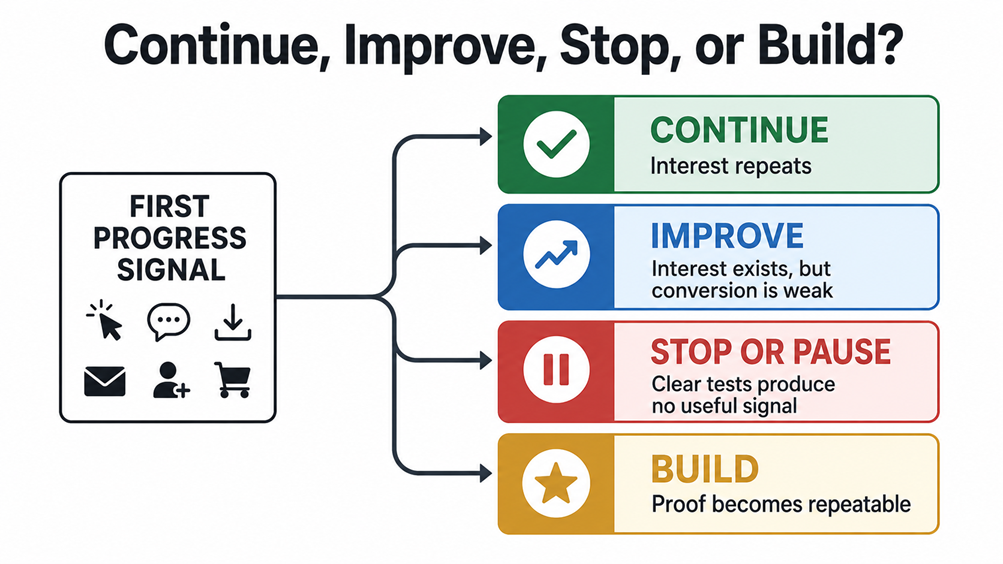
Continue, improve, stop, or build?
A serious beginner does not continue every idea forever. Use the evidence to choose what deserves your next block of time, attention, and money.
Keep testing the direction
Continue when questions repeat, downloads grow, the offer is easy to explain, and the idea fits your skills and capacity.
Strengthen the weak point
Improve when people show interest but do not buy, ask the same clarifying questions, or click without taking the next step.
Protect your resources
Pause when several clear tests produce no useful response, the audience is unreachable, or delivery costs more than the signal justifies.
Develop repeatable proof
Build deeper when interest repeats, the audience is clear, delivery is manageable, and the offer can become a useful system or pathway.
What “build what works” actually means
Building what works does not mean trying to create a large business overnight. It means controlled growth based on evidence. You repeat the useful signal, understand the buyer, improve the offer, and make delivery easier before adding complexity.
Each step should make the proven idea more useful, easier to explain, or easier to deliver. Build depth around evidence rather than width around every interesting possibility.
A practical South African example
Lerato lets a checklist reveal the next offer
Lerato creates a free checklist for small business owners who struggle to explain their services clearly online. She shares it on LinkedIn and in two relevant WhatsApp groups. Ten people download it. Three reply to say they struggle with writing service descriptions, and one asks whether Lerato can improve a WhatsApp Business profile.
Instead of creating a full online course, Lerato makes one small paid offer: WhatsApp Business Profile Cleanup for Local Service Providers. She tests it with the first customer, notes the questions that arise, improves the wording, and offers the package to another small group.
The checklist was not the final business. It revealed a service opportunity.

What not to do after first progress
Make learning visible
Create your simple progress log
Memory is unreliable, especially when you are testing several messages, pages, and offers. A simple weekly log helps you separate what happened from what you hoped would happen.
| Date | What I tested | Signal received | What I learned | Next action |
|---|---|---|---|---|
| 12 June | Checklist CTA | 8 downloads | Beginners want a starting tool. | Add a follow-up email. |
| 14 June | Service offer post | 2 enquiries | The offer wording is clear. | Create a basic package. |
| 18 June | Product page | Clicks, no sales | The CTA or value may be weak. | Improve the page copy. |
You cannot build what works if you do not track what happened.
When to turn progress into a product
A service can become a product when the same questions repeat, you solve the same problem several times, and the process can be documented. Products can also serve people who need help but cannot afford a complete done-for-you service.
Products often follow repeated service or content proof. Begin with the question people already ask, not with the format you happen to want to create.
When to turn progress into content
Questions, objections, and enquiries are useful content research. If several people ask, “How much should I charge?”, that can become an article. “Do I need a website?” can become a practical guide. “What can I sell?” can become a checklist. “How do I start safely?” can lead readers to the Digital Income South Africa hub.
Useful content should answer the next question, link to the next step, and help the reader make a decision. Your audience’s words can shape a connected pathway instead of a collection of unrelated posts.
Move from choosing to building
Connect proven progress to the right Bootstrap guide
Digital Income South Africa helps you choose and prove a direction. Once the direction becomes clearer, the relevant Bootstrap guide can help you build it properly.
Continue through the Digital Income South Africa pathway
Recommended guide
From First Digital Income to What Works
Want the full step-by-step guide for deciding what to continue, improve, stop, or build? This eBook helps South Africans understand early progress signals and turn useful feedback into a clearer next move.
Get the eBook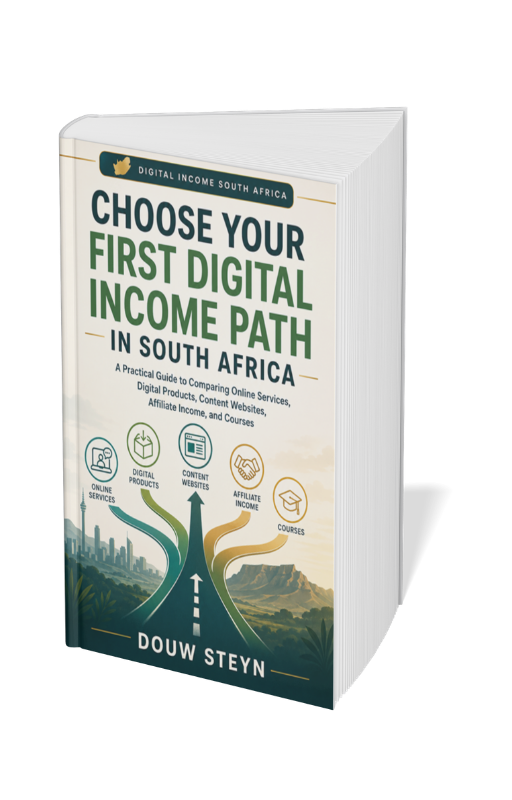
Free practical tool
Not sure what your next step should be?
Use the First Progress Decision Checklist to identify your proof signal, assess repeatability, and choose your next small action.
Download the Free Checklist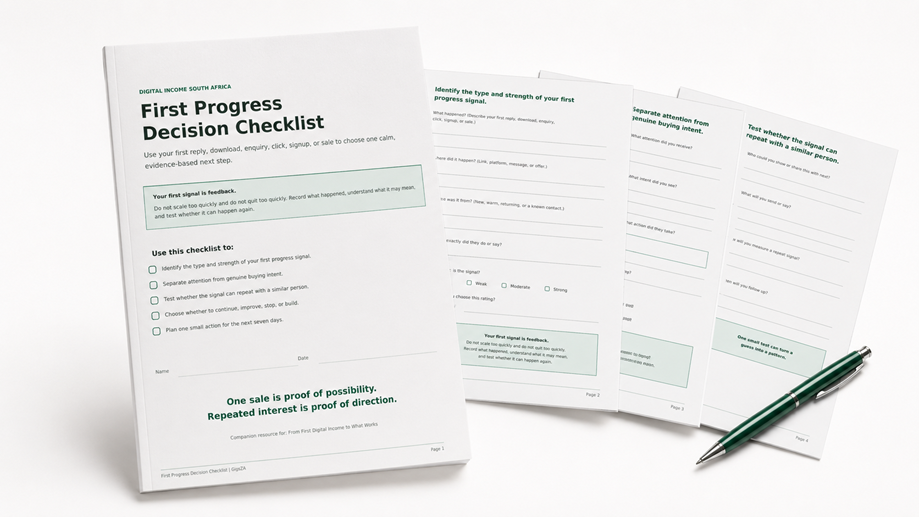
Questions beginners ask
FAQs about what to do after first digital income progress
What counts as first digital income progress?
Progress can be a reply, enquiry, download, signup, product-page click, booked call, price question, first sale, or repeat request. A sale is the strongest signal, but earlier actions can still show useful direction.
What should I do after my first online sale?
Deliver well, record where the buyer came from, understand why they bought, improve the offer page or message, and try to create a second sale from the same type of audience before expanding too quickly.
Should I build a bigger business after one sale?
Not immediately. One sale proves possibility, but repeatable interest gives better direction. Improve the offer, test again, and build only after the signal becomes clearer.
What if I get clicks or downloads but no sales?
Clicks and downloads suggest attention or trust, but not necessarily buying intent. Review the offer, price, next step, product page, and follow-up message to see where interest is dropping off.
How do I know whether to continue, improve, stop, or build?
Continue when interest repeats. Improve when people show interest but do not act. Pause or stop when repeated tests produce no useful signal. Build when the audience is clear, the offer is manageable, and proof repeats.
Final thoughts
Your first progress is something to understand
First progress is valuable, but it needs interpretation. Do not scale too quickly, and do not quit too quickly. Study who responded, what they wanted, where they came from, and whether the same signal can happen again.
Improve before you expand. Track what happens. Build around repeated evidence instead of whatever feels most exciting today.
Your first sign of progress is not proof that everything is solved. It is proof that something is worth understanding. Slow down, study the signal, improve the offer, and build only what shows signs of working.