
Digital Income South Africa
Build Proof Before You Build Big: How to Test an Online Income Idea
Before you build a full website, product, course, or service business, test whether anyone cares. A small proof point can help you learn what people need without wasting limited time, money, or confidence.
- Designed for South African beginners
- Low-cost tests you can complete quickly
- Clear signals for deciding what comes next

The expensive mistake
Many beginners build too much before they know what people want
Many South Africans assume the first step to earning online is to build a website, design a logo, open an online store, buy software, or create a complete product. Those things may become useful later, but they are often too much too soon.
A polished business can still fail to solve a meaningful problem. A 90-page eBook can receive no downloads. A full course can launch to an empty room. A beautiful service page can attract visitors without producing a single enquiry. The work may be good, but the builder has learned too late that the idea, audience, offer, or message needed to change.
The goal is not to avoid building. The goal is to build in the right order.
Start with evidence
What does “proof” mean in digital income?
Proof is a real signal that your idea matters to someone other than you. It does not always mean an immediate sale. At an early stage, someone may reply to your message, ask for more details, join a waiting list, download a checklist, click a product page, ask about the price, book a call, or ask when the offer will be available.
These actions are more useful than private excitement because they come from the market. They help you replace assumptions with information. A compliment from a friend may feel encouraging, but a question from a potential customer tells you more. A first payment tells you even more.
Proof is not a feeling. Proof is behaviour.
Why building big too early is risky
Testing matters everywhere, but it is especially valuable when money and time are limited. Internet access, subscriptions, software, advertising, design, payment tools, and hosting can turn a simple idea into a growing monthly expense before it earns anything.
There is an emotional cost too. When a person spends months building something and receives silence, the disappointment can feel personal. The result is not only wasted money. It may be a loss of confidence and a belief that earning online is not possible for them.
Small tests reduce that risk. They let you learn while the cost of being wrong is still low. They also make it easier to separate productive action from activity that merely looks like progress.
The difference between an idea and a tested idea
| An idea | A tested idea |
|---|---|
| Sounds good to you | Gets a response from someone else |
| Lives in your notebook | Has been shown to a real person |
| Feels exciting | Produces a measurable signal |
| Is based on an assumption | Is shaped by feedback |
| Can grow in your head | Can improve through testing |
An idea only becomes useful when it meets the market. Testing does not remove uncertainty, but it gives you better information for deciding whether to continue, improve, simplify, or change direction.
Build less, learn sooner
Start with the smallest testable version
You do not need to create the complete version first. Reduce the idea to something a real person can see, understand, try, or buy. Make the test small enough to complete and clear enough to measure.
| Full idea | Small test version |
|---|---|
| Full online course | Free or paid 60-minute workshop |
| eBook | One-page checklist or outline |
| Digital template pack | One sample template |
| Freelance service | One starter package |
| Consulting service | One paid problem-solving session |
| Niche website | One useful article or landing page |
| Email newsletter | One signup page and first issue |
| Affiliate content site | One helpful comparison article |
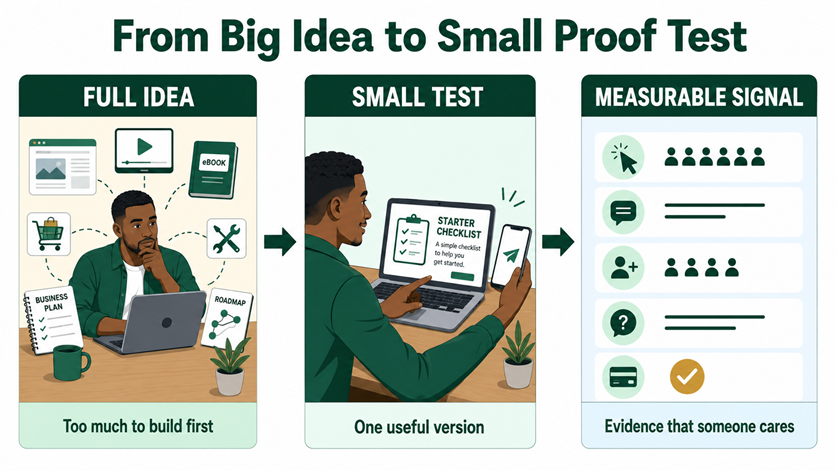
The evidence ladder
The five proof signals to look for
Not all proof is equal. A click is useful, but it is weaker than a price enquiry. A price enquiry is encouraging, but it is weaker than payment. Look for the signal that matches the stage of your test.
Attention proof
People click, read, watch, save, or spend time with the idea.
Page views, search impressions, post saves, watch time, repeated questions
Engagement proof
People respond, comment, ask questions, or explain their situation.
Comments, replies, DMs, WhatsApp messages, email responses
Trust proof
People give you permission to continue the conversation.
Email signups, downloads, waitlist joins, call bookings
Intent proof
People ask about price, delivery, availability, features, or next steps.
“How much?”, “Can you help me?”, “When is it available?”
Payment proof
Someone pays, pre-orders, books, or buys a smaller version.
First sale, paid trial, consultation, template, or service task
Payment proof is strongest, but earlier signals can still show you what to clarify, develop, or test next.
Choose the right test
How to test a service idea
Services are often one of the quickest ideas to test because you can offer a useful outcome before building a large system. This can work for freelance writing, virtual assistance, admin support, CV or LinkedIn help, consulting, basic design, social media support, and AI-assisted services.
- Define one problem you can solve for a specific person.
- Package a starter offer with a small, clear result.
- Write one paragraph explaining who it helps and what they receive.
- Share it with 5-10 relevant people rather than a random audience.
- Track replies and objections without trying to defend the idea.
- Offer one low-risk trial and improve the offer from what you learn.
Example starter offer
I help small business owners turn messy notes into a clear one-page service description they can use on their website, WhatsApp, or social media.
Related guides: Turning Skills into an Online Service Business, How to Start a Virtual Assistant Business, and Starting a Freelance Writing Business Online.
How to test a digital product idea
An eBook, checklist, guide, template, planner, worksheet, or mini toolkit should solve a recognisable problem. Before producing the complete product, create a title, a short promise, and a one-page outline or sample. Share it with the intended audience and ask what still feels unclear or missing.
A free sample can test attention and trust. A small paid version tests intent more strongly. For example, before writing a 90-page eBook about earning online, create a Digital Income Readiness Checklist for South Africans. Downloads and responses provide early evidence that the problem matters.
Continue with How to Create and Sell Your First eBook Online, Selling Templates, Guides and Digital Downloads, or Building a Small Digital Product Portfolio.
How to test a content website idea
A content website does not need to begin as a giant site. Choose one narrow audience problem and publish one strong article that answers it well. Submit the page to Google Search Console, share it on LinkedIn or by email, and watch for impressions, clicks, time on page, internal-link clicks, signups, product clicks, and reader questions.
Add related articles when the topic begins to show traction. Search proof can be slow, so do not judge a content idea after a few days. A page may first earn impressions, then clicks, and only later produce signups or sales.
Related reading: Build a Niche Website That Makes Money, Starting a Simple Content Website That Earns, and SEO for Bootstrap Online Businesses.
How to test an online course idea
Building every lesson before proving demand is a costly gamble. Test the teaching idea first with a free webinar, paid workshop, short live session, three-part email series, mini guide, learner survey, or waitlist.
Registrations show attention. Attendance and questions show engagement. Requests for a recording or another module show continuing interest. A paid workshop provides stronger proof that people value the outcome.
A full course should usually come after evidence that people want to learn the process.
How to test an affiliate or recommendation idea
Affiliate marketing is not simply posting links. It depends on trust, relevance, and useful content. Start with one audience problem, identify a product or tool that genuinely helps, and create one comparison, tutorial, or practical guide.
Share the content where that audience already pays attention. Track link clicks, product questions, signups, commission, repeat visits, and email interest. These signals reveal whether people trust your guidance enough to take the next step.
Take action this week
A simple 7-day proof test
The purpose of this test is not to build a successful business in seven days. It is to collect enough information to make a better next decision.
Choose one idea
Write it in one sentence.
Define the audience
Name the specific person who needs help.
Create a small offer
Promise one useful, manageable result.
Write the message
Create one LinkedIn post, WhatsApp message, or email.
Share the offer
Reach 5-10 relevant people or publish it once.
Track the signals
Record replies, clicks, questions, objections, and interest.
Choose the next step
Continue, improve, simplify, change, pause, or stop.
Example
“I want to help South African job seekers improve their LinkedIn profiles.” The audience could be unemployed graduates, retrenched workers, or professionals applying for remote roles. The small offer could be a one-page profile review with three practical improvements.
Read the evidence
What to measure during your test
| Signal | What it may mean |
|---|---|
| No response | The offer may be unclear, badly timed, aimed at the wrong audience, or not urgent enough. |
| Questions | People are curious but need more clarity. |
| Price questions | There may be buying intent. |
| Clicks but no enquiries | The topic attracts attention, but the offer may be weak. |
| Signups | People want more, but may not be ready to buy. |
| First sale | Strong proof worth exploring further. |
| Repeat request | A possible signal of a recurring need. |
How to interpret silence
No response does not automatically mean the idea is bad. You may have reached the wrong audience, used a weak headline, described the offer poorly, chosen the wrong channel, asked for too much trust, or made the benefit too broad.
If nobody responds, do not immediately judge yourself. First judge the offer, audience, message, and channel.
Silence is feedback, not a personal failure. Change one important variable and test again so that you can learn what affected the result.
What to do when you get proof
Proof means the idea deserves another controlled step, not immediate expansion. Improve the offer, make the promise clearer, create a better product page, publish a supporting article, build a small email list, or produce the first paid version. You can also test the same offer with a second audience to learn where it fits best.
What to do when you do not get proof
Rewrite the offer, narrow the audience, ask better questions, try a different channel, simplify the product, or test a more urgent problem. You may also pause the idea and choose a different path. That is a useful result: a failed test is cheaper than a failed full build.
A local example
Nomsa tests the direction before building the product
Nomsa wants to create a digital product for South African small business owners. Instead of writing a full eBook, she creates a one-page checklist called “Before You Post Your Service Online.” She shares it with several local service providers and publishes a short LinkedIn post.
Three people ask whether she can help rewrite their service descriptions. That response reveals something important: the stronger first offer may be a small service rather than a digital product. Nomsa can now complete a few paid service projects, learn the language and problems customers use, and later turn that experience into a better guide or template.
The test did not only validate the problem. It improved the direction.

Common mistakes when testing an online income idea
- Asking only friends who may be too polite to give honest feedback
- Testing with people who are not part of the intended audience
- Building too much before showing anyone the offer
- Confusing likes and compliments with buying intent
- Changing the idea before enough relevant people have seen it
- Ignoring questions, objections, and repeated points of confusion
- Testing several unrelated ideas at the same time
- Hiding the price so long that payment intent is never tested
- Treating a quiet response as a judgement of personal ability
The better first question
Do not ask whether it can become a big business yet
“Can this become a big business?”
“Can I get one small signal that this solves a real problem?”
Recommended guide
Build Proof Before You Build Big
Want the full practical process? This eBook helps South Africans test a small online offer before spending too much time, money, or energy building a full product, course, website, or business.
Get the eBook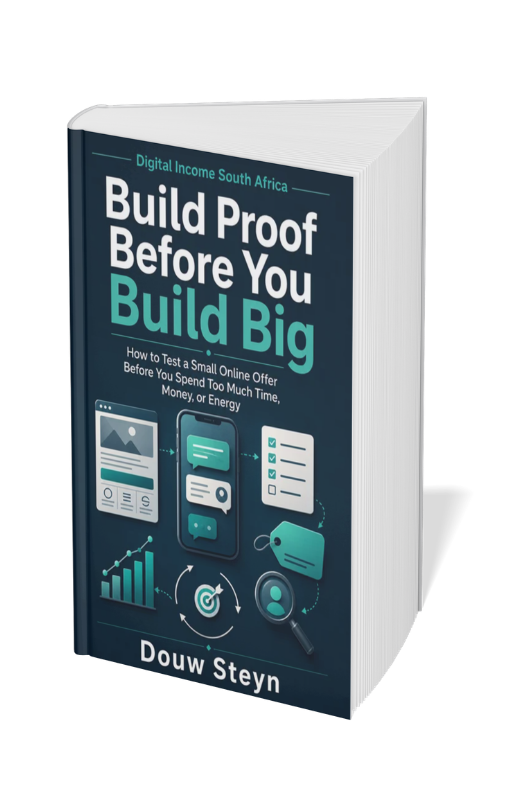
Free practical resource
Download the Digital Income Readiness Checklist
Before you build your full idea, use the free checklist to assess your skills, starting point, income path, and first proof test.
Download the Free Checklist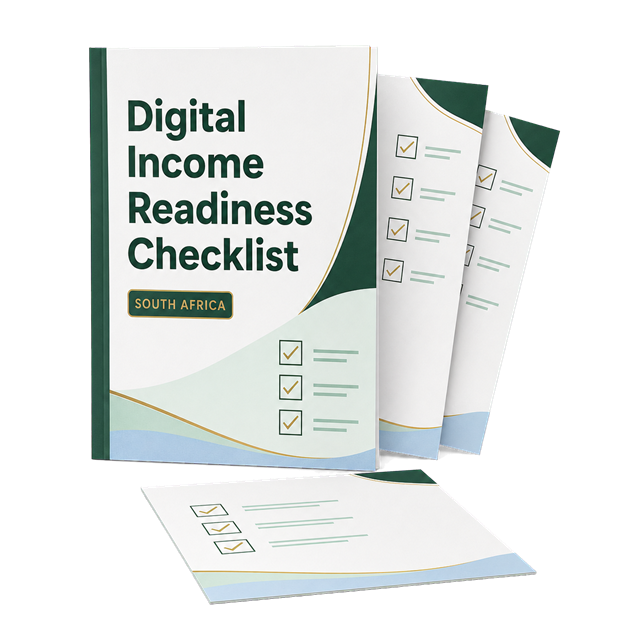
Questions beginners ask
FAQs about testing an online income idea
What does it mean to build proof before building big?
It means testing whether people respond to a small version of your idea before you spend heavily on a full website, product, course, funnel, or business system.
What is the best proof for an online income idea?
A payment, booking, pre-order, or paid trial is the strongest early proof. Before that, useful signals include replies, price questions, downloads, signups, link clicks, call bookings, and specific questions.
Can I test an idea without a website?
Yes. You can test with a WhatsApp message, LinkedIn post, email, simple PDF, one-page offer description, free checklist, sample template, or small paid pilot.
How long should I test before deciding?
A simple seven-day test can provide early feedback, but some ideas need more time. The key is to define what you are measuring before you start: replies, clicks, questions, signups, enquiries, or sales.
What should I do if nobody responds?
Do not assume the whole idea is useless. Review the audience, message, offer, timing, channel, price, and clarity. Change one important variable and test again with a relevant audience.
Final thoughts
Start smaller than feels impressive. Test before spending too much. Remember that proof is behaviour and silence is feedback. Build more only after you have learned something useful from a real audience.
Your first proof matters more than perfect confidence. A reply, enquiry, signup, download, price question, or small payment can give you the evidence needed to take the next sensible step.
Build proof before you build big. Your first goal is not to create a perfect online business. Your first goal is to find one real signal that someone cares.
