
Business Management South Africa
Business Plan Writing Using AI: How South Africans Can Build a Plan That Still Sounds Real
AI can help you write a business plan faster. But if the plan sounds generic, ignores South African realities, or uses numbers you cannot defend, it will not help you much when a bank manager, landlord, supplier or investor starts asking practical questions.
Here is the trap: you open an AI tool, type “write me a business plan for a small business in South Africa”, and within seconds you get something that looks polished.
It has headings. It has paragraphs. It sounds confident. It may even mention growth, innovation, customer service and market opportunity.
But then someone serious reads it.
A bank manager asks how you calculated your monthly sales. A landlord asks how you will afford rent during the first three months. A supplier asks why they should give you stock on 30-day terms. An investor asks what happens if customers pay late.
Suddenly the AI-written plan starts to wobble.
The problem is not AI. The problem is using AI as if it can replace the work of understanding your business. It cannot. AI can help you think, organise, draft and test your business plan. But it cannot replace your proof, your customer knowledge, your costs, your local reality or your judgement.
The new rule for business plan writing using AI: let AI assist the thinking, but never let it invent the evidence.
Need a business plan that sounds fundable, not fake?
Use a practical South African guide that shows you how to build a clearer, more realistic business plan with AI support, stronger numbers and less generic wording.
The mistake most people make with AI business plans
Most people start with the wrong prompt.
They type something like:
“Write me a business plan for a cleaning company in South Africa.”
The AI tool does what it was asked to do. It writes a plan. But because the user gave almost no facts, the tool fills the gaps with safe, general language.
That is how you end up with phrases like:
“Our company will deliver innovative cleaning solutions to meet growing demand in the market.”
It sounds acceptable until you ask one simple question:
What does that actually mean?
Compare that with this:
“We provide once-off and weekly office cleaning services to small professional firms in Randburg that need reliable cleaners after hours, proper invoices, and flexible monthly contracts without hiring permanent cleaning staff.”
The second version sounds less fancy, but it is far stronger. It tells the reader who the customer is, what problem is being solved, where the business operates, and why someone might pay.
That is what a serious business plan needs. Not big words. Not startup theatre. Not “market-leading solutions.” It needs clarity.
What AI should actually do when you write a business plan
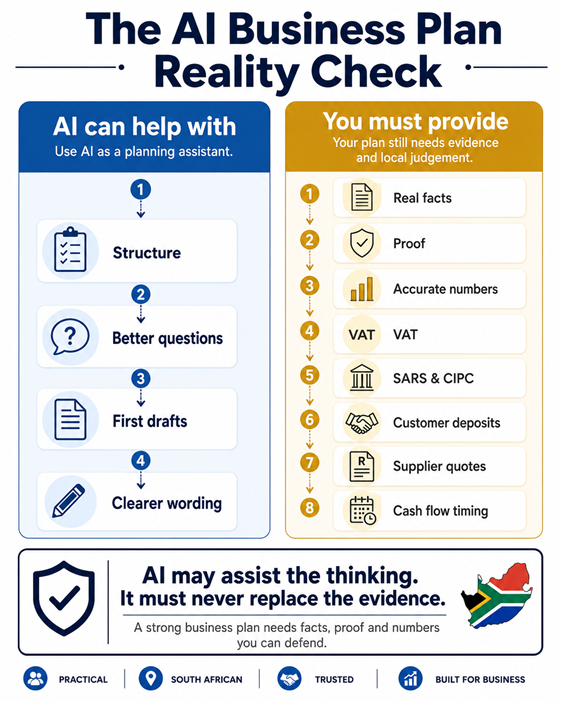
AI is useful when you treat it like a planning assistant, not like a business owner.
A good AI workflow does not begin with “write the plan.” It begins with “ask me better questions.”
Use AI to challenge the idea
Before you write the plan, ask AI to test your thinking.
Prompt to use:
Act as a cautious South African business mentor. Ask me 20 questions I must answer before writing a business plan for a mobile car wash in Durban.
This is useful because it forces you to think before you decorate the document. You may realise that you have not decided who your best customer is, how much petrol you will use, whether customers pay upfront, or how many jobs you can realistically complete in a day.
Use AI to find weak spots
Once you have written a rough section, ask AI to review it like a sceptical reader.
Prompt to use:
Read this business plan section and tell me what a South African bank manager, landlord or supplier would still not understand.
This helps you spot vague claims before someone else does.
Use AI to improve structure, not invent facts
AI is good at turning rough notes into a readable structure. It is not reliable enough to invent your prices, competitors, customer demand, compliance position or financial projections.
Feed it your facts first. Then ask it to organise them.
Prompt to use:
Turn these rough notes into a clear business plan section. Keep it practical and South African. Do not add facts, claims or numbers I did not provide.
AI business plan vs real business plan: what changes?
The difference is not whether AI was used. The difference is whether the final plan can survive practical questioning.
| Plan element | Weak AI-only version | Stronger AI-assisted version |
|---|---|---|
| Target customer | “Everyone who needs cleaning services.” | “Small offices and sectional-title complexes in Randburg that need after-hours cleaning and proper monthly invoices.” |
| Market demand | “There is high demand in the market.” | “We tested the offer with 12 local businesses, received 5 quote requests, and converted 2 trial jobs.” |
| Pricing | “Our pricing will be affordable and competitive.” | “Our minimum job price is R650 because labour, transport, cleaning materials and admin time cost approximately R430 per visit.” |
| Cash flow | “Revenue will grow monthly.” | “Clients pay on invoice within 7 days. Jobs above R2,000 require a 50% deposit to protect working cash.” |
| Risk | “We will manage risks effectively.” | “Main risks are late payment, staff absence, fuel increases and equipment failure. We will use deposits, backup contractors and a monthly repair buffer.” |
| Compliance | “The business will comply with all regulations.” | “The business will register with CIPC, maintain SARS records, issue invoices, follow POPIA basics for customer information, and check municipal requirements where relevant.” |
The South African reality your AI plan must include
A business plan written for South Africa must smell like South Africa. It must understand the pressure of late payments, fuel costs, VAT, supplier terms, deposits, working capital and operating disruptions.
This is where many generic AI plans fail. They are written as if business happens in a smooth world where customers pay on time, suppliers are flexible, electricity is always available, and costs behave politely.
That is not how small business works here.
Cash flow timing
You can make a sale and still be short of cash. A catering business may pay ingredients, packaging, fuel and casual labour before the event, but only receive payment from a corporate client at the end of the month.
On paper, the job is profitable. In the bank account, the owner is stuck.
Your business plan must explain when money comes in, when money goes out, and what buffer protects the business during the gap.
VAT and real pricing
If VAT applies or may apply later, it cannot be ignored. A selling price is not the same as profit. Your plan must separate income, direct costs, overheads, tax considerations and the money you actually keep.
Compliance
A serious South African business plan should mention the relevant basics: CIPC registration where appropriate, SARS records, POPIA if customer information is stored, municipal rules, food or health requirements where relevant, and labour basics if staff are involved.
You do not need to sound like a lawyer. You do need to show that you are not careless.
Load-shedding and operating interruptions
If your business depends on refrigeration, Wi-Fi, point-of-sale devices, online bookings, machinery or production equipment, power interruptions may affect your costs and delivery promises.
A plan that ignores this may look clean, but it is not realistic.
Supplier and customer payment behaviour
Many suppliers want cash or upfront payment. Many larger customers pay later. That mismatch can hurt a small business fast.
This is why deposits, payment milestones, COD rules, stock limits and working capital buffers belong in the plan.
External reference
For official South African small business support, the South African government notes that Seda provides business development and support services for small enterprises, including information on how to write a business plan. Read the gov.za business startup guidance.
Still guessing your numbers?
Before you ask AI to polish your plan, make sure you understand pricing, costs, cash flow and break-even. Weak numbers can make even a well-written plan fall apart.
The 7 business plan sections AI can help with
AI can help you build most sections of a business plan, as long as you provide the real information first.
1. Executive summary
AI can help you compress the plan into one strong page. But do this near the end, not at the start. The summary should reflect the plan you have already built.
Include the business name, location, customer, problem, offer, revenue model, funding need and use of funds.
2. Customer profile
AI can help you turn “everyone” into a real customer segment.
A weak customer profile says: “Our customers are all South Africans who need catering.”
A better profile says: “We serve office managers in Cape Town who order small meeting platters and need reliable delivery before 10:00.”
3. Market gap
AI can suggest possible gaps, but you must verify them. Use customer conversations, trial sales, competitor pricing, Google reviews, supplier feedback and real enquiries.
4. Competitor analysis
AI can help you think about competitor categories: direct competitors, cheaper alternatives, informal providers, DIY options and larger established businesses.
But do not trust AI to know who is actually operating in your suburb or industry today. Check manually.
5. Products and services
AI can help organise your offer into packages, add-ons and clear descriptions. This is useful if you have too many scattered ideas.
6. Financial plan
AI can help explain your assumptions in plain language. But your actual numbers should come from quotes, invoices, supplier prices, rent estimates, labour costs, petrol, packaging, software, equipment and your own operating model.
7. Risk plan
AI is especially useful for risk planning because it can ask: “What could go wrong?”
In South Africa, common small business risks may include late payment, supplier increases, load-shedding, theft, unreliable transport, staff absence, customer concentration, seasonal demand and compliance problems.
A better workflow for business plan writing using AI
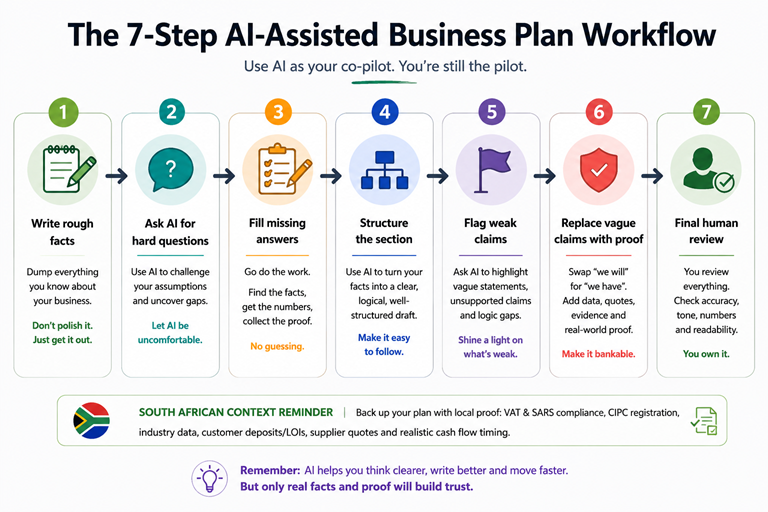
Here is a practical way to use AI without letting it weaken your plan.
Write your rough facts first
Start with notes. What do you sell? Who buys? Where do you operate? What do you charge? What does it cost? Who competes with you? What funding do you need?
Ask AI to question you
Use AI to expose gaps. Ask what a cautious lender, supplier or landlord would still want to know.
Fill in missing answers manually
Do not let AI guess your rent, fuel, supplier costs, pricing or customer demand. Get real numbers where possible.
Ask AI to structure the section
Once you have the facts, ask AI to turn them into clear business plan wording.
Ask AI to flag weak claims
Every claim should be marked as proven, needs evidence or risky assumption.
Replace vague claims with proof
Change “there is strong demand” to “we completed 18 paid trial orders in June and received 11 repeat enquiries.”
Do the final human review
Ask yourself: Would I say this in a real meeting? Can I defend every number? Does this sound like my business?
Prompts that produce better business plans
These prompts are not designed to make AI do all the work. They are designed to make your thinking sharper.
Business idea stress test
Act as a cautious South African business mentor. Review this business idea and list the assumptions that could make it fail.
Bank manager questions
Act as a South African bank manager reviewing a small business funding application. What questions would you ask before approving funding?
Customer clarity
Review this target customer description. Is it too broad? Rewrite it so it is specific enough for a practical business plan.
Cash flow reality check
Review this revenue and cost information. What cash flow risks am I missing?
Generic language detector
Highlight any wording that sounds generic, inflated or copied from a template.
Evidence checker
Mark every claim in this section as either proven, needs evidence, or risky assumption.
What not to let AI do
AI can be helpful, but it should not be allowed to create false confidence.
- Do not let AI invent your financial projections.
- Do not let AI claim market demand without evidence.
- Do not let AI create fake competitor facts.
- Do not let AI write compliance claims you have not checked.
- Do not let AI make your business sound bigger than it is.
- Do not paste confidential customer, employee or financial information into AI tools unless you understand the privacy terms.
- Do not use AI as a replacement for legal, tax, accounting, labour, funding or compliance advice.
Simple test: if you would feel nervous explaining a sentence in front of a funder, supplier or landlord, it probably needs more proof.
Build the rest of your business plan properly
A stronger AI-assisted business plan also depends on the quality of your pricing, customer understanding and management basics. These related GigsZA resources can help:
FAQ: Business plan writing using AI
Can AI write my whole business plan?
AI can draft a business plan, but you should not rely on it to create the whole plan from nothing. A useful plan needs your real customer information, pricing, costs, evidence, risks and South African operating details.
Is it acceptable to use AI for a funding business plan?
Yes, if you use it responsibly. AI can help with structure, wording, questions and clarity. But the assumptions, numbers and proof must be accurate and defensible.
What is the biggest risk of using AI for a business plan?
The biggest risk is generic confidence. AI may produce polished wording that sounds good but contains weak claims, invented assumptions or unrealistic numbers.
What should I prepare before asking AI to help?
Prepare your business idea, target customer, location, products or services, prices, expected costs, startup costs, competitors, risks, early proof and funding need.
Does a South African business plan need local details?
Yes. A South African plan should consider issues such as VAT, SARS, CIPC, POPIA, municipal rules, payment timing, load-shedding, fuel costs, deposits, supplier terms and working capital.
Practical guide
Use AI, but keep the business plan real
The strongest plan is not the one with the fanciest wording. It is the one you can defend in a real conversation with a bank, supplier, landlord or investor.
If you want a practical South African guide to building a fundable, realistic business plan with modern AI tools, start here.
Download the Business Plan eBook
Final thought
A winning business plan in the AI era is not a document that proves you know how to use AI. It is a document that proves you understand your business.
AI can help you ask sharper questions, structure your thinking and clean up your wording. But it cannot replace your proof. It cannot know your customer better than you do. It cannot feel the pressure of a late payment, a supplier increase, a broken delivery vehicle or a bank manager asking how you calculated your numbers.
So use AI. But do not hide behind it.
The plan must still sound like someone who knows the business, understands South African reality, and can explain clearly how the money will work. That is what makes it believable. That is what makes it fundable.