
Remote Work South Africa
Remote Work Skills South Africans Can Learn Fast — and How to Prove Them
Many South Africans think they need to become a coder, designer, marketer, AI expert and virtual assistant before they can even apply for remote work. That is usually where the delay starts. The real starting point is simpler: choose one useful skill path, practise it properly, and create proof that a remote employer can trust.
Let’s be honest. “Learn remote work skills” sounds helpful until the list becomes ridiculous.
Learn AI. Learn Excel. Learn Canva. Learn coding. Learn project management. Fix your CV. Build a portfolio. Start freelancing. Apply internationally. Use LinkedIn properly. Avoid scams. Build confidence. Be visible. Network every day.
At some point, upskilling stops feeling like progress and starts feeling like another full-time job.
The better question is not: What must I learn before I am ready?
The better question is: What can I learn, practise and prove fast enough to become more believable as a remote-work applicant?
Stop guessing which remote-work skills to learn first
The guide Remote Work Skills South Africans Can Learn Fast helps you choose one practical skill path, practise useful tasks, build proof, and improve your CV or LinkedIn wording without wasting months.
The Remote Work Skill Problem Is Not What People Think
Many beginners believe the problem is that they do not have enough skills. Sometimes that is true. But often the deeper problem is different: they cannot show their existing or newly learned skills in a way that feels believable to an employer.
A South African applicant may have worked in retail, admin, teaching, logistics, customer service or a family business. That person may already understand customers, records, deadlines, WhatsApp messages, stock problems, order details, complaints and follow-ups.
But when the CV says only “hardworking”, “computer literate” or “good communication skills”, the value disappears.
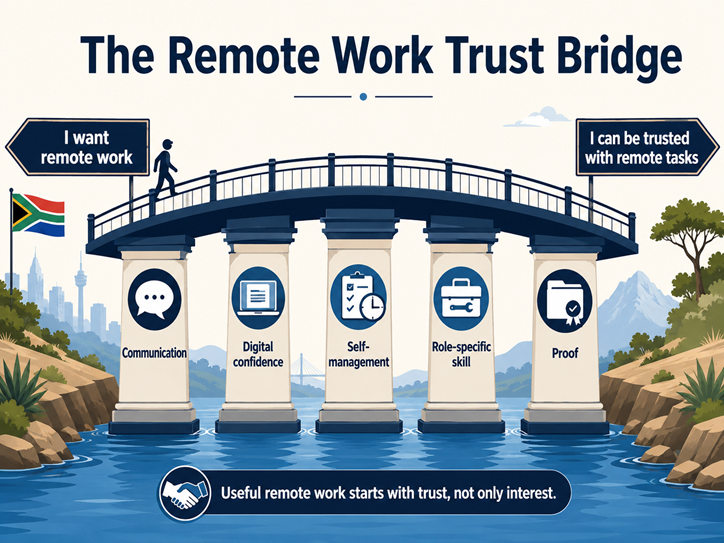
Remote work needs more than claims. It needs trust signals.
- Can you communicate clearly?
- Can you follow written instructions?
- Can you organise information neatly?
- Can you work without being watched every hour?
- Can you show a small sample of how you work?
That is why the fastest route is not to learn everything. It is to choose one practical skill path and build proof around it.
Stop Collecting Skills Like Badges
There is nothing wrong with learning. The problem starts when learning becomes a hiding place.
Some people are not really preparing anymore. They are delaying the uncomfortable part: creating something, applying, and risking feedback.
Watching ten tutorials on Google Sheets is not the same as creating one clean tracker. Saving LinkedIn advice is not the same as rewriting your profile. Reading about customer support is not the same as writing five professional customer replies.
Skills only start helping when they become outputs.
The Fastest Skills Are Usually Boring — That Is Why They Work
The fastest remote-work skills are often not exciting because they look ordinary. But ordinary tasks are exactly what many small businesses, agencies, online stores, startups and remote teams need done properly.
A business owner may not need a “digital ninja”. They may need someone who can update a spreadsheet, reply to five customers, check links, format a blog post, capture order details and send a clear end-of-day update.
Clear written updates
Progress, delays, missing information and next steps explained without confusion.
Google Docs and Sheets
Clean documents, simple trackers, shared links, filters, headings and basic file organisation.
Professional WhatsApp and email
Useful messages that are short enough to read and clear enough to act on.
Customer support replies
Polite answers, complaint handling, escalation notes and FAQ-style responses.
Online research
Finding information, checking sources, summarising details and organising findings.
AI-assisted drafting
Using AI for first drafts and checklists, then applying human judgement before sending.
The South African Starting Point Is Different
South Africans often underestimate ordinary work experience because it does not sound digital enough.
A cashier may understand customer questions, payment issues and complaint handling. A receptionist may understand scheduling, inbox messages and document flow. A teacher may understand planning, records, explaining information and follow-up. Someone who helped in a small family business may understand WhatsApp orders, stock updates, customer reminders and supplier messages.
Those are not useless experiences. They are often unconverted experiences.
The job is to translate them into remote-work language and then create proof.
Example: from local experience to remote-work wording
Weak wording: Helped with customer orders.
Better wording: Managed customer order messages, confirmed details, recorded order information, followed up on collections and kept customers updated through WhatsApp.
Proof sample: A simple order tracker, three customer reply templates and a weekly order summary.
Local realities also matter. A remote worker in South Africa must think about data, power interruptions, shared devices, noise, backup plans and professional communication during disruptions. You do not need a perfect office before you start, but you do need a realistic plan.
Experience Note
Why This Guide Takes a Practical South African View
A lot of remote-work advice sounds as if every beginner has unlimited time, perfect internet, a quiet home office, money for courses and the confidence to apply internationally from day one. That is not the reality for many South Africans.
Many people are trying to learn after work, between family responsibilities, with limited data, shared devices, load shedding interruptions, or uncertainty about which job posts are real. That is why this article focuses on small, practical proof instead of big promises.
The aim is not to make remote work sound easy. The aim is to help a beginner become more believable, more organised and more prepared before applying.
Learn One Skill Path, Not Ten Random Tools
Random learning feels productive, but it often leads to weak applications. A skill path gives your learning a direction. It connects what you practise to the kind of remote role you want.
| Skill Path | Best For | Skills to Practise First | Proof Sample to Create |
|---|---|---|---|
| Virtual Assistant | Organised people who enjoy admin, planning and follow-up | Email, calendars, Google Docs, Google Sheets, task tracking, client updates | Meeting notes template, weekly task tracker and sample client update |
| Customer Support | People with patience, service experience or call centre exposure | Written replies, complaint handling, FAQs, escalation notes and tone control | Customer reply pack with five common replies and one complaint response |
| Research Assistant | People who enjoy reading, checking details and organising information | Online research, source checking, summaries and spreadsheet organisation | Company research sheet with short summaries and source links |
| Content Support | People who enjoy writing, editing, formatting or publishing support | Proofreading, formatting, product descriptions, captions and simple Canva support | Formatted blog post sample with title, headings, links and meta description |
| Operations Support | People from logistics, retail, small business or admin environments | Checklists, order updates, supplier communication, basic reporting and trackers | Order tracker, supplier follow-up template and weekly status summary |
Comparison: Random Learning vs Proof-Based Learning
The difference is not only what you learn. It is how quickly your learning becomes visible.
| Area | Random Learning | Proof-Based Learning | Why It Works Better in Real Applications |
|---|---|---|---|
| Goal | Learn many tools because they sound useful | Choose one role direction and practise matching tasks | Employers understand your direction faster |
| Progress | Measured by videos watched or courses saved | Measured by finished samples | Proof is easier to judge than intention |
| CV wording | “Computer literate” and “fast learner” | “Created a Google Sheets tracker to organise job applications and follow-ups” | Specific wording sounds more credible |
| LinkedIn profile | Broad headline with no clear role direction | Profile aligned to admin, support, research, content or operations support | Recruiters and clients see fit faster |
| Application message | “I am willing to learn” | “I have practised customer support replies and created a short sample pack” | Shows initiative before being hired |
| Risk | Months of preparation with no evidence | Small visible proof within days or weeks | Reduces delay and builds confidence |
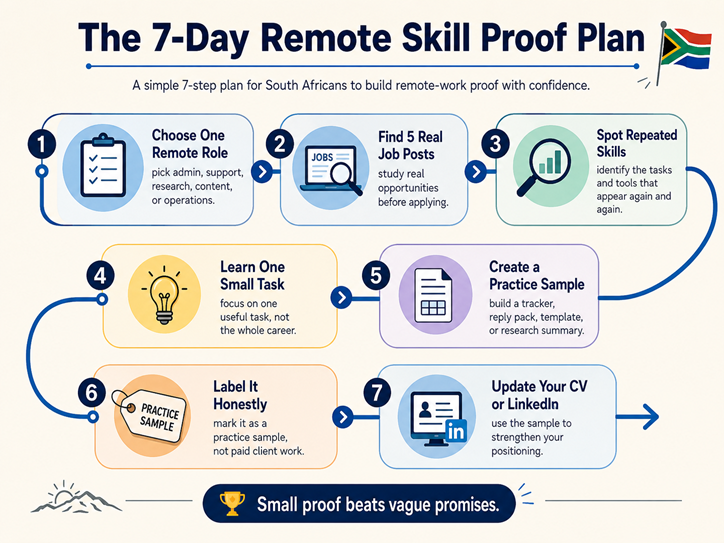
The 7-Day Proof Method
You do not need a client before you can practise. You do not need permission to create a sample. You need one realistic task and enough discipline to finish it.
Choose one remote role type
Pick admin, customer support, research, content support or operations support.
Find five real job posts
Do not apply yet. Read them like clues. Look for repeated skills and tasks.
List the repeated skills
Notice what keeps appearing: Google Sheets, written communication, task tracking, research, support replies or content formatting.
Learn one small task
Do not try to learn the whole career. Learn one task that appears in real roles.
Create a practice sample
Build a customer reply pack, task tracker, meeting notes template, research sheet or formatted content sample.
Improve and label it honestly
Use wording such as: “Practice sample created to demonstrate remote admin and communication skills.”
Add it to your CV, LinkedIn or application message
Use the sample to support your claim. Do not pretend it was paid client work.
Build one proof sample before you chase another course
The guide includes practical skill paths, practice ideas, proof-building guidance and beginner-friendly wording for South Africans preparing for remote work.
What Proof Looks Like for Beginners
Proof does not have to be fancy. It must be clear, relevant and honest. A simple sample can make a beginner sound more prepared than a long list of vague claims.
| Skill Claim | Weak Version | Better Proof |
|---|---|---|
| Admin | “I am computer literate.” | A clean task tracker with statuses, deadlines and notes. |
| Communication | “I have good communication skills.” | Three sample client updates: progress, delay and completed work. |
| Customer support | “I am a people person.” | A customer reply pack with FAQ answers and one complaint response. |
| Research | “I am good at finding information.” | A research summary with sources, notes and practical findings. |
| Spreadsheets | “I know Excel.” | A Google Sheets tracker with headings, filters and sample data. |
| AI use | “I know AI tools.” | A before-and-after AI-assisted draft showing your human edits and checks. |
The Skill Most Beginners Underestimate
Communication is the skill that makes every other skill safer.
Remote work creates distance. Distance creates uncertainty. Communication reduces uncertainty.
A short, useful update can build trust faster than a long CV.
Weak update
“I’m busy with it.”
Better update
“I have completed 12 of the 20 entries. Three records are missing email addresses, so I marked them for review. I’ll complete the remaining entries by 3 pm.”
The second message is not longer because it is fancy. It is longer because it is useful. It shows progress, identifies the problem and gives a next action.
How to Use AI Without Sounding Like Everyone Else
AI can help beginners practise faster. It can help with first drafts, checklists, summaries, customer reply examples and ideas for proof samples.
But AI does not replace judgement. A remote employer still needs accuracy, honesty, context and clear thinking. If you copy AI text without checking it, you may sound polished but unreliable.
This matters because workplace skills are changing quickly. The World Economic Forum’s Future of Jobs Report 2025 notes that the skills gap remains a major barrier for employers, while technology skills and human skills such as creative thinking, resilience and flexibility remain important.
Sources and Method Used for This Article
This article combines practical guidance from the GigsZA remote-work guide series with job-readiness principles that apply to beginner-friendly remote roles: communication, digital confidence, self-management, role-specific practice and proof-building.
- Primary guide basis: Remote Work Skills South Africans Can Learn Fast
- External reference: World Economic Forum: Future of Jobs Report 2025
- Editorial approach: The article avoids “easy money” claims and focuses on realistic skill development, honest practice samples and safer remote-work preparation.
Who This Advice Is For — and Who It Is Not For
This is useful if you:
- Want remote work but do not know which skills to learn first.
- Come from admin, retail, call centre, teaching, logistics, hospitality or small-business experience.
- Need a practical way to build proof before you have formal remote-work experience.
- Want to improve your CV, LinkedIn profile or application message with more specific wording.
- Prefer realistic guidance instead of hype about fast online income.
This is not for you if you:
- Want guaranteed remote jobs or guaranteed income.
- Are looking for shortcuts that avoid practice, proof or proper applications.
- Want advanced coding, data science or specialist technical training.
- Plan to copy AI-generated applications without checking accuracy or honesty.
- Want to pretend practice work was paid client work.
Practical Guide
Remote Work Skills South Africans Can Learn Fast
Remote work does not reward people who only collect courses. It rewards people who can show useful work clearly, honestly and reliably.
If you want a calm, practical South African guide to choosing remote-work skills, practising them and presenting them properly, this book was written for that exact starting point.
Get the Guide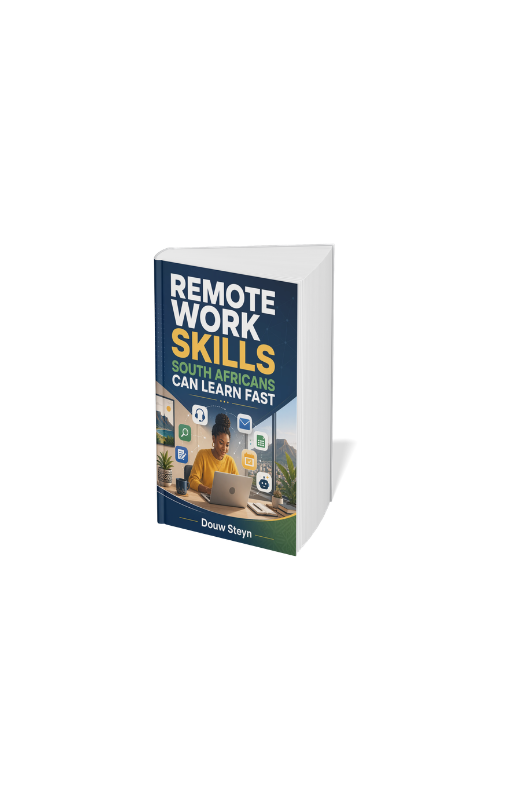
Start With One Useful Skill
You do not need to become a coder, designer, marketer, AI expert and virtual assistant all at the same time.
You need one useful starting path.
Choose a skill that appears in real job posts. Practise it in the shape of real work. Create a small proof sample. Label it honestly. Use it to improve your CV, LinkedIn profile and application message.
That is not glamorous advice. But it is useful advice.
And for many South Africans trying to move from confusion to remote-work readiness, useful is exactly where the journey should begin.
FAQ: Remote Work Skills South Africa
What remote-work skills should South Africans learn first?
Start with practical skills that appear often in beginner-friendly roles: clear written communication, Google Docs, Google Sheets, email, task tracking, customer replies, online research and basic content formatting.
Can I get remote work without advanced technical skills?
Yes, some beginner-friendly remote roles do not require coding or advanced technical skills. However, you still need practical digital confidence, communication, reliability and proof that you can complete useful tasks.
What is the fastest way to build remote-work proof?
Choose one skill path, study five real job posts, identify repeated tasks, learn one small task and create a practice sample such as a tracker, customer reply pack, research summary or formatted document.
Should I mention practice samples on my CV or LinkedIn?
Yes, but label them honestly. Do not pretend practice work was paid client work. You can say: “Practice sample created to demonstrate remote admin and communication skills.”
How does AI fit into beginner remote-work skills?
AI can help with first drafts, checklists, summaries and practice tasks. But you still need to check accuracy, improve the output and apply human judgement before using anything professionally.
Practical Disclaimer
This article is for educational and informational purposes only. It does not guarantee employment, remote-work income, interviews, freelance clients, platform approval or job offers. Remote work is competitive, and outcomes depend on your skills, experience, application quality, timing, employer requirements, internet access, communication ability and the wider job market.
Always verify job posts, companies, recruiters, payment arrangements and platform terms before applying or sharing personal information. Be careful of upfront-fee schemes, unrealistic income promises and vague “work from home” offers.