
Remote Work South Africa
Where to Find Legit Remote Jobs in South Africa
Search better, verify faster, and avoid wasting time on vague work-from-home adverts, fake recruiters, and remote jobs that are not really open to South Africans.
You can spend three hours searching for remote jobs and still end the day more confused than when you started. One advert says work from home. Another says remote, but only if you live in Cape Town. Another promises R45,000 for simple data entry. Then someone on WhatsApp says you have been selected for a job you never applied for.
The problem is not that remote work is fake. Real remote jobs do exist. South Africans work remotely in customer support, admin, sales, software support, marketing, bookkeeping, content, operations, virtual assistance, teaching, research, and logistics coordination.
The real problem is that genuine opportunities, weak adverts, commission traps, task platforms, freelance gigs, and outright scams often appear in the same search results. If you do not have a filter, everything starts to look possible. That is where people lose time, confidence, and sometimes money.
The goal is not to apply everywhere. The goal is to search better, verify faster, and apply with more confidence.
Why Remote Job Searching Feels So Noisy in South Africa
For many South Africans, remote work is not only about lifestyle. It is about transport costs, family responsibilities, safety, limited local vacancies, and the hope of earning without moving to Johannesburg, Cape Town, Durban, Pretoria, or another major centre.
That pressure makes people search quickly. They type “online jobs South Africa” or “work from home no experience” and hope something real appears. Some real options do appear. But so do copied adverts, old posts, commission-only offers, fake data entry jobs, task apps, and people asking for registration fees.
A scam wants you to rush. A real opportunity can survive questions.
The First Mistake: Searching for “Online Work” Instead of a Real Role
If you search too broadly, you invite noise. “Online work” can mean a job, a freelance project, a task platform, an affiliate scheme, a training programme, a commission-only sales offer, or a business opportunity. Those are not the same thing.
A better remote job search starts with role clarity. Search for the work you can actually do, not only the lifestyle you want.
| Weak search phrase | Why it wastes time | Better search phrase |
|---|---|---|
| online work | Too broad and often mixed with scams, task apps, and vague offers. | remote admin assistant South Africa |
| work from home | Often includes commission-only, hybrid, and poorly explained roles. | customer support work from home South Africa |
| data entry remote | High noise and scam risk, especially where pay sounds unrealistic. | operations assistant remote or order coordinator remote |
| earn from phone | Usually not a proper job search phrase and often attracts weak offers. | virtual assistant remote or appointment setter remote |
What Counts as a Legit Remote Job?
A legitimate remote job should have a real employer or client, clear duties, believable pay, a proper hiring process, and no upfront fee. It should also make practical sense for your life.
A role can be real but still unsuitable. A US-hours support job may be legitimate, but if it runs from late afternoon until after midnight South African time, it may not fit your family routine or health. A commission-only sales role may be legal, but it may be too risky if you need predictable income for rent, food, transport, data, or school fees.
Good signs
- Company name can be verified.
- Duties are clearly explained.
- Pay matches the role and skill level.
- There is an interview or proper screening step.
- No one asks you to pay to apply, train, or start.
Warning signs
- High pay for very easy work with no experience.
- Recruiter refuses to name the company.
- Communication happens only on WhatsApp or Telegram.
- You are asked for ID or banking details too early.
- You must pay a registration, training, equipment, or activation fee.
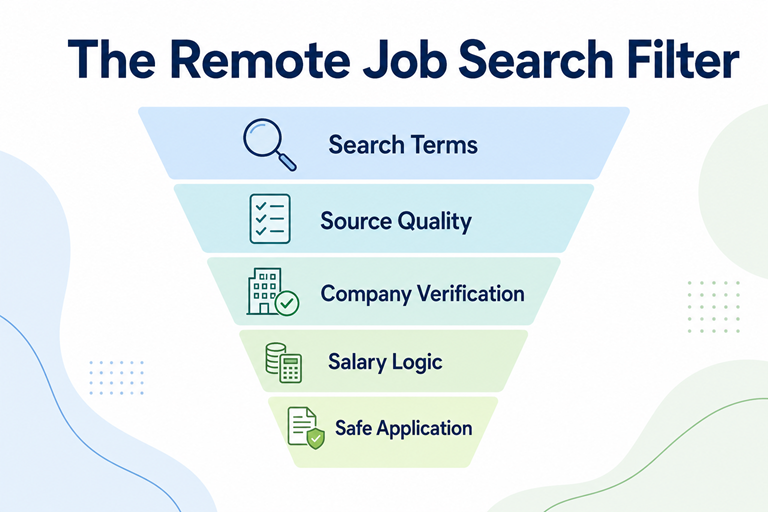
Where South Africans Should Search for Legit Remote Jobs
You do not need to search the whole internet every day. You need a small group of sources, each with a clear purpose.
1. Local South African Job Boards
Use local job boards to find South African companies offering remote, hybrid, or work-from-home roles. These are useful when you want rand-based pay, local employment terms, or roles where South African working hours matter.
Best for: admin, customer support, sales support, finance support, operations, marketing assistants, and local company roles.
2. LinkedIn
LinkedIn is not only an online CV. It is a job board, recruiter database, search engine, company research tool, and visibility platform. Use it to search specific titles, follow companies, check recruiters, and learn the language employers use in real adverts.
Best for: recruiters, alerts, company research, professional visibility, and roles where your profile must support your CV.
3. Company Career Pages
Career pages are one of the safest verification steps. If a role appears on a job board or social post, check whether it also appears on the company website. If the role is not listed there, it may still be real, but you should verify further before sending sensitive information.
Best for: checking whether a vacancy is connected to the actual employer.
4. International Remote Job Boards
International boards can open good opportunities, but read carefully. Check whether South Africans may apply, whether the time zone works, whether the role is employee or contractor, and how payment will reach your South African bank account.
Best for: support, tech, marketing, software, operations, content, and specialist roles open to EMEA, worldwide, or UTC+2 applicants.
5. Freelance Platforms
Freelance platforms can help you build proof, earn project income, and gain remote experience. But they are not the same as stable employment. You may need to quote, send proposals, handle clients, absorb platform fees, and deal with irregular income.
Best for: building samples, testimonials, confidence, and practical remote work proof.
Comparison Table: Which Search Source Should You Use?
| Source | Best use | Main risk | Verification habit |
|---|---|---|---|
| Local job boards | SA-based remote and hybrid roles. | Some listings are vague or not fully remote. | Check employer website and role details. |
| Recruiters, alerts, company research, visibility. | Fake recruiters and copied posts can appear. | Check profile history, company link, and email domain. | |
| Company career pages | Safest route for direct applications. | Not every vacancy is listed if recruiters are used. | Apply through the official careers page when possible. |
| International boards | Remote-first roles open to global or EMEA applicants. | Some roles exclude South Africa or have difficult time zones. | Check location eligibility, contract type, hours, and payment method. |
| Freelance platforms | Projects, samples, reviews, and remote proof. | Low budgets, fees, competition, and irregular work. | Check client history, scope, payment protection, and platform rules. |
Search by Role Family, Not by Hope
A focused applicant is easier to trust. If your CV says admin, your LinkedIn says content, your cover letter says sales, and your applications go to every remote job you see, employers struggle to understand what you offer.
Choose one primary path and one backup path. Then build your search terms, CV, LinkedIn headline, work samples, and application messages around those paths.
| Your background | Remote roles to search for | Proof to prepare |
|---|---|---|
| Retail, office admin, reception, school admin | Remote admin assistant, virtual assistant, office coordinator, scheduling assistant. | Calendar example, spreadsheet sample, email response sample. |
| Call centre, retail service, hospitality | Remote customer support, email support, client success assistant, helpdesk agent. | Three sample customer replies and a short support-note example. |
| Sales, retail sales, insurance, telesales | Appointment setter, sales development representative, lead generation assistant, sales support. | Follow-up script, CRM-style lead notes, short sales email sample. |
| Logistics, stock control, order admin | Operations assistant, logistics coordinator remote, order coordinator, procurement assistant. | Simple process checklist or order-tracking spreadsheet. |
| Social media, writing, Canva, content | Content assistant, social media coordinator, marketing assistant, copy assistant. | Three sample posts, one content calendar, one product description. |
| IT support, WordPress, troubleshooting, coding | IT helpdesk remote, software support, QA tester, web support assistant, junior developer. | Portfolio link, bug report example, support ticket example, small project. |
External Safety Reference
Capitec warns South Africans to be careful of fake online jobs advertised through social media and messaging channels, including WhatsApp and Telegram, especially where high pay, no interviews, no experience, or upfront payments are used as hooks. Read their guidance here: Capitec: Beware of online job scams.
This matters because a remote job search is not only a career activity. It is also a personal safety activity. Your ID, banking details, phone number, proof of address, and confidence are worth protecting.
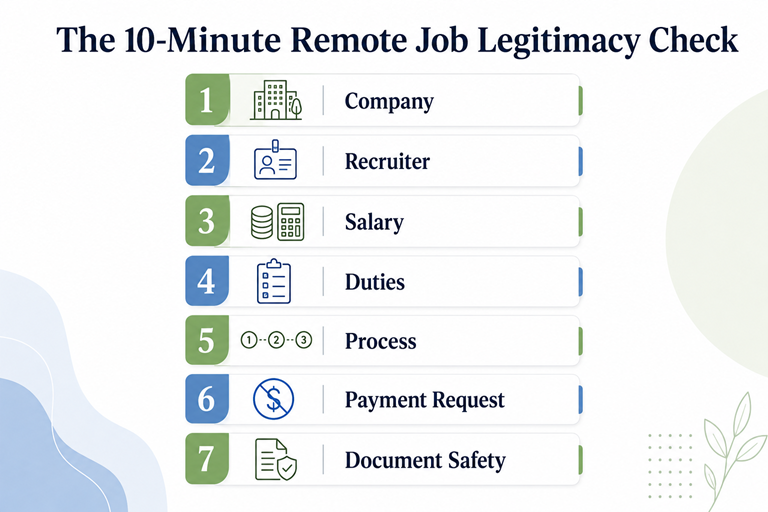
The 10-Minute Legitimacy Check
Before you apply, reply, upload documents, or agree to an interview, run a quick check. You do not need to become suspicious of every opportunity. You need to become careful enough that weak opportunities stop wasting your time.
- Read the full advert. Do not judge only by the title or salary.
- Search the company name. Look for the official website and credible online presence.
- Check the careers page. See whether the role appears on the company site or trusted hiring platform.
- Check the recruiter. Look for a real profile, company connection, and consistent work history.
- Check the email domain. Be careful with free email addresses pretending to represent formal companies.
- Judge the salary. The pay must make sense for the duties, experience level, and hours.
- Read the duties. Real work can usually be described clearly.
- Look for a proper process. Real employers usually screen, interview, test, or discuss the role.
- Refuse upfront fees. Do not pay to apply, register, train, unlock tasks, or receive equipment.
- Protect documents. Do not send ID, banking details, or proof of address before verification.
A Weekly Remote Job Search System
Random scrolling makes the search feel bigger than it is. A weekly system helps you search calmly, compare sources, and learn from your own results.
| Day | Focus | What to do |
|---|---|---|
| Monday | Local search | Search South African job boards for remote, hybrid, and work-from-home roles. |
| Tuesday | Check alerts, save suitable roles, follow companies, and review recruiter profiles. | |
| Wednesday | International boards | Search for roles open to South Africa, EMEA, worldwide, or UTC+2 time zones. |
| Thursday | Verification | Check company career pages, email domains, recruiter profiles, and salary logic. |
| Friday | Applications | Send fewer, stronger applications to verified opportunities. |
| Saturday | Proof building | Improve one CV section, LinkedIn section, work sample, or application template. |
| Sunday | Review | Update your tracker and identify which sources, keywords, and roles worked best. |
A South African Example: Thandi Stops Searching Blindly
Thandi lives in Durban and has three years of retail admin experience. At first, she searches for “online jobs South Africa” and “work from home no experience.” She finds hundreds of posts, but most are vague. Some promise fast income. Some ask her to join WhatsApp groups. One asks for a small fee to “activate” her application.
Then she changes the search. She chooses admin and customer support as her two paths. She searches for remote admin assistant, virtual assistant South Africa, customer support work from home, email support, and order coordinator remote. She saves only roles with clear duties. Before applying, she checks the company website and looks for the vacancy on the careers page.
Within two weeks, she sends fewer applications, but they are better. She is no longer just looking for remote work. She is looking for work she can verify.
What to Stop Doing
Sometimes better search results come from removing bad habits.
- Stop applying to every advert that contains the word remote.
- Stop using only vague phrases like online work or data entry.
- Stop trusting a recruiter only because they sound urgent.
- Stop sending ID documents before the company is verified.
- Stop confusing freelance projects, task apps, and business opportunities with jobs.
- Stop measuring progress only by interviews. Saved roles, verified roles, better keywords, and improved applications are also progress.
Recommended Guide
Need a Calmer Way to Search?
Where to Find Legit Remote Jobs helps South Africans search better, verify faster, avoid scams, and apply with more confidence.
View the GuideFAQ: Finding Legit Remote Jobs in South Africa
Are remote jobs in South Africa real?
Yes. South Africans do work remotely in admin, support, sales, tech, content, operations, teaching, bookkeeping, and virtual assistant roles. The challenge is separating real opportunities from scams, vague adverts, and unsuitable roles.
What is the safest place to apply for a remote job?
The safest route is usually the official company career page or a trusted hiring platform linked from the company website. If a job appears on social media, LinkedIn, or a job board, verify the employer before sending documents.
Should I pay a fee to get a remote job?
No. You should not pay a registration, training, activation, equipment, or placement fee to secure a job. Preparation costs such as internet, a headset, or a short course are different from paying someone to hire you.
Which remote jobs are realistic for beginners?
Beginner-friendly paths often include remote admin assistant, customer support, email support, virtual assistant, content assistant, appointment setter, sales support, and operations assistant roles. The right path depends on your past experience and proof.
How many remote jobs should I apply for each week?
Quality matters more than volume. A smaller number of verified, well-matched applications is usually better than sending the same generic CV to every advert. Track your applications and review which platforms and keywords produce better results.