
Why Is It So Hard to Find a Legitimate Remote Job in South Africa?
Remote jobs are real. Yet many South Africans spend months applying without receiving an interview, discover that “remote” does not mean they are eligible, or encounter offers that are misleading, underpaid or completely fraudulent.
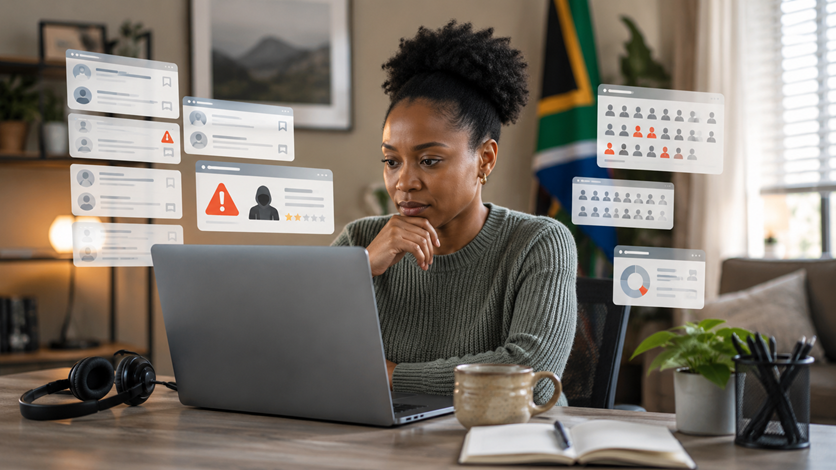
The most urgent remote-work discussion is no longer simply whether employees prefer working from home. For job seekers, the more pressing question is whether legitimate remote opportunities are genuinely accessible.
Public LinkedIn discussions reveal recurring frustration around scams, geographic restrictions, application silence, experience requirements, overwhelming competition and location-based pay.
How this article was researched
GigsZA aims to publish practical, transparent and South Africa-specific guidance. This article combines current labour-market research, official scam warnings, public professional discussions and GigsZA’s ongoing work helping readers understand remote employment.
Built around real applicant concerns
The article focuses on the questions repeatedly raised by remote-job seekers: whether vacancies are genuine, whether South Africans are eligible, why applications receive no response and whether international pay is fair.
Part of the GigsZA remote-work resource library
Douw Steyn has developed practical GigsZA resources covering remote-job readiness, CV preparation, job searching, scams, international employers, interviews and working without previous remote experience.
Supported by identifiable sources
Important factual claims are linked to recognised sources, including LinkedIn’s Economic Graph, consumer-protection information and South African government warnings about fraudulent recruitment.
Clear limits and no employment guarantees
This article provides education rather than promises. Readers are encouraged to verify every employer, recruiter, contract and payment arrangement independently before sharing information or accepting work.
Editorial transparency: This article is based on a qualitative review of publicly accessible discussions and published sources. It does not represent a statistical survey of all LinkedIn users. First published and last reviewed on 3 August 2026.
The real problem is the gap between demand and opportunity
Interest in remote employment remains strong. People want to avoid long commutes, access a wider job market, work for international companies and create more flexibility around family responsibilities.
The supply of remote positions has not kept pace with that demand. LinkedIn’s Economic Graph found that the availability of remote roles declined more sharply than job seekers’ continued preference for them.1
A position advertised as fully remote may attract applicants from several regions, countries or continents. You are no longer competing only with people who live within travelling distance of one office.
This does not mean that applying is pointless. It means that remote-job applications require a more focused strategy than applying broadly and hoping that application volume will eventually produce a result.
The first step is to distinguish between a realistic remote career path and the promise of easy online income. Read the Remote Work in South Africa: The Beginner Reality Check before deciding which roles to pursue.
“Remote” does not necessarily mean “work from anywhere”
This is one of the biggest sources of frustration in LinkedIn discussions. An applicant finds a suitable remote vacancy, reads most of the advert and only later discovers that the employer will hire people in the United States, United Kingdom or European Union—but not South Africa.
A remote position means that the employee is not required to work from the employer’s main office every day. It does not automatically mean that the employer is able or willing to hire in every country.
Employers may restrict location because of:
- Payroll and tax obligations.
- Local labour and employment laws.
- Employee-benefit requirements.
- Data security and customer-contract restrictions.
- Time-zone coverage.
- The need for occasional office or client visits.
- The cost of employing someone through a local entity or Employer of Record.
Public LinkedIn comments show that applicants do not always object to reasonable restrictions. Their stronger complaint is that restrictions are often hidden near the bottom of the advert or expressed unclearly.4
Terms worth looking for
- South Africa remote: The position is specifically open to applicants based in South Africa.
- EMEA remote: The employer accepts applicants in Europe, the Middle East and Africa, although individual country restrictions may still apply.
- Global remote or worldwide: The employer intends to consider applicants across several countries.
- Remote within the UK, US or EU: The position is remote only within the named territory.
- Remote with occasional travel: You may work from home but must be able to attend specified meetings or events.
- Independent contractor: You may not receive the same legal protections and benefits as an employee.
South Africans interested in overseas employers should also read How South Africans Can Prepare to Work for International Companies Remotely.
Job seekers are struggling to tell genuine opportunities from scams
Remote-job scams are effective because they imitate something people genuinely want. Fraudsters use professional-looking job descriptions, copied company logos, fake recruiter profiles, convincing email addresses and online interview scripts.
Some scams now begin with a small payment or apparently successful task. The victim is then instructed to deposit money to unlock additional tasks or withdraw supposed earnings.
The United States Federal Trade Commission reported that losses associated with job scams exceeded US$220 million during the first six months of 2024. It also estimated that task scams accounted for almost 40% of job-scam reports during that period.2
South Africa’s Department of Employment and Labour has also warned job seekers about fraudsters impersonating recruitment officials and demanding fees for employment opportunities.3
Common remote-job warning signs
- You receive an unexpected WhatsApp, Telegram or text message offering vague online work.
- The recruiter avoids a proper video interview.
- You are hired immediately without a meaningful discussion about your skills.
- The salary is unusually high for simple work requiring no experience.
- You are asked to buy equipment from a specified supplier.
- You must pay before starting work or withdrawing earnings.
- The recruiter uses a free email account instead of the company’s domain.
- The vacancy cannot be found on the company’s official careers page.
- The job involves receiving, transferring or converting money.
- You are pressured to act before you have time to verify the employer.
Use the detailed verification steps in Remote Work Scams in South Africa: How to Spot Fake Jobs Before You Apply.
Qualified applicants disappear inside application overload
Remote vacancies can attract large numbers of applicants quickly. Some candidates are well matched. Others apply because they are interested in working from home, even when their location, experience or skills do not meet the stated requirements.
Employers and recruiters then face an uncomfortable problem: they must identify credible candidates inside a high-volume application pool. Job seekers experience the other side of the same problem. They feel as though they are sending their CV into a system that never responds.
The applicant’s experience
“I have applied repeatedly, changed my CV and followed the advice. Why am I still being ignored?”
The employer’s experience
“We received hundreds of applications, but many applicants ignored the location, skills or experience requirements.”
Applying to more positions is not always the answer. A smaller number of carefully selected and properly tailored applications may produce better results than sending the same CV to every remote vacancy.
This is also why job seekers need to look beyond the largest international job boards. Use a combination of company career pages, specialised remote-work platforms, local job boards, professional networks and direct employer research.
Start with Where to Find Legit Remote Jobs in South Africa and the Ultimate Guide to the Best Remote Jobs for South Africans.
Entry-level remote jobs often demand proof that you can already work remotely
Many applicants face a circular problem: they need remote experience to secure the remote job that would give them remote experience.
Employers may describe a role as entry-level while still expecting the applicant to demonstrate independent work, written communication, digital confidence, deadline management and familiarity with online collaboration tools.
This does not always mean that the employer expects years of formal remote employment. It often means that the employer wants evidence that the applicant can work reliably without constant supervision.
Evidence can come from more than a previous remote job
- A portfolio showing completed work.
- A volunteer project managed online.
- Freelance or short-term assignments.
- A course project completed to a professional standard.
- Examples of written reports, spreadsheets, presentations or digital content.
- A clear description of how you planned and delivered work independently.
- References that can confirm reliability, communication and follow-through.
Read Remote Work Without Experience in South Africa and Remote Work Skills South Africans Can Learn Fast—and How to Prove Them.
Does global remote work create opportunity—or cheap labour?
One of the most emotionally charged discussions concerns international employers that hire in countries with lower living costs.
A remote position may give a South African access to income and experience that would otherwise be unavailable. However, some job seekers argue that employers use geography mainly to obtain skilled labour at the lowest possible price.
The answer is not as simple as insisting that everyone performing the same work must receive an identical global salary. Employers consider local market rates, taxes, contractor arrangements, benefits, experience, scarcity of skills and the commercial value of the role.
Applicants should nevertheless assess whether the offer is fair, sustainable and appropriate for the responsibility involved.
Before accepting an international offer, clarify:
- Whether the quoted amount is gross or net.
- Whether you will be an employee or independent contractor.
- Who pays bank, currency-conversion and transfer costs.
- Whether paid leave, sick leave, medical cover or pension contributions are included.
- Whether you must provide your own equipment, electricity, internet and backup power.
- Whether working hours include evenings, nights or public holidays.
- How often the rate will be reviewed.
- Whether the contract allows either party to end the arrangement immediately.
A salary that looks attractive after conversion into rand may be less impressive after tax, unpaid leave, equipment, banking costs and irregular working hours are considered.
Applicants blame the ATS—but the real problem is often more complicated
Applicant Tracking Systems help employers receive, organise and search applications. Automated screening can affect whether an application progresses, but the system is not necessarily the only reason for rejection.
Common reasons an application may fail include:
- The applicant is based outside the eligible country or region.
- The CV does not use the job’s relevant terminology.
- The most important experience is difficult to find.
- The applicant does not meet a non-negotiable requirement.
- The CV describes duties but provides no evidence of outcomes.
- The application does not demonstrate remote-work readiness.
- The role received more qualified applications than the employer could interview.
- The vacancy changed, was paused or was filled internally.
Repeating keywords unnaturally will not repair a weak application. Your CV must still make sense to the recruiter or manager who reads it after the initial screening stage.
A remote-work CV must function as an early demonstration of your communication, judgement and ability to present relevant information clearly. See Why Your Remote Work CV Is Not Just a CV Anymore.
When applications are producing no interviews, use Why You Are Not Getting Remote Job Interviews in South Africa—and What to Fix First to diagnose the problem before sending another large batch.
What legitimate remote employers are actually looking for
Qualifications and technical skills remain important, but remote employers also need confidence that work will continue when the employee is not physically visible.
They are therefore looking for evidence of:
Clear communication
You can write concise updates, ask useful questions and explain problems before they become emergencies.
Self-management
You can organise work, manage priorities and meet deadlines without constant reminders.
Digital confidence
You can learn and use the tools needed for meetings, documents, projects and secure online work.
Visible proof
Your CV, LinkedIn profile, portfolio and examples show what you can produce—not only what you say you can do.
Reliability
Your application, interview behaviour and references suggest that you will communicate and follow through.
Commercial awareness
You understand how your work contributes to revenue, customer service, efficiency, risk reduction or team performance.
The challenge is not to pretend that you are perfect. It is to reduce the employer’s uncertainty about hiring you.
Ten checks before you apply for a remote job
- Confirm that applicants based in South Africa are eligible.
- Find the vacancy on the employer’s official website.
- Check that the recruiter has a credible professional history.
- Verify that the email domain belongs to the employer.
- Read the requirements before changing your CV.
- Identify the three strongest reasons you match the position.
- Remove irrelevant information that hides those strengths.
- Add evidence of independent, reliable and digitally enabled work.
- Confirm the employment, contractor, salary and time-zone arrangements.
- Stop immediately if anyone asks you to pay for the job.
Need a structured starting point? Download the free Remote Work Starter Checklist for South Africans.
A more realistic remote-job application plan
When the job search feels like endless rejection, the natural reaction is to apply more widely. A better response may be to slow down, narrow the target and improve the evidence attached to each application.
Choose one or two realistic remote-job families
Do not target unrelated roles simply because they are remote. Focus on positions that connect clearly with your existing skills, experience or credible learning path.
Define your eligibility boundary
Prioritise South Africa, Africa, EMEA or genuinely global positions. Stop spending time on roles that require residence or work authorisation elsewhere.
Create a strong base CV
Build one credible master CV and then adjust the summary, skills and evidence for each well-matched vacancy.
Build proof before sending more applications
Produce a work sample, case study, portfolio item or short project that reduces doubt about whether you can do the work.
Research the employer
Understand its services, customers, working model and reason for hiring. Use that knowledge in your application and interview.
Track applications and diagnose patterns
Record the job, date, source, location eligibility, CV version, outcome and follow-up. After 15 to 20 carefully selected applications, look for patterns.
Improve one weak point at a time
If you receive no interviews, improve targeting, proof and CV clarity. If interviews do not become offers, work on examples, communication and interview preparation.
Stop treating every remote vacancy as an opportunity. Treat eligibility, credibility, fit and fairness as four filters that the position must pass before it receives your time.
Start your remote-job search with a system—not guesswork
GigsZA’s remote-work resources are designed for South Africans who need practical guidance on choosing a path, avoiding scams, preparing their CV and LinkedIn profile, finding legitimate employers and improving their chances of reaching the interview stage.
Recommended practical guides

Where to Find Legit Remote Jobs
A structured guide to finding credible opportunities, using the right platforms and reducing wasted applications.
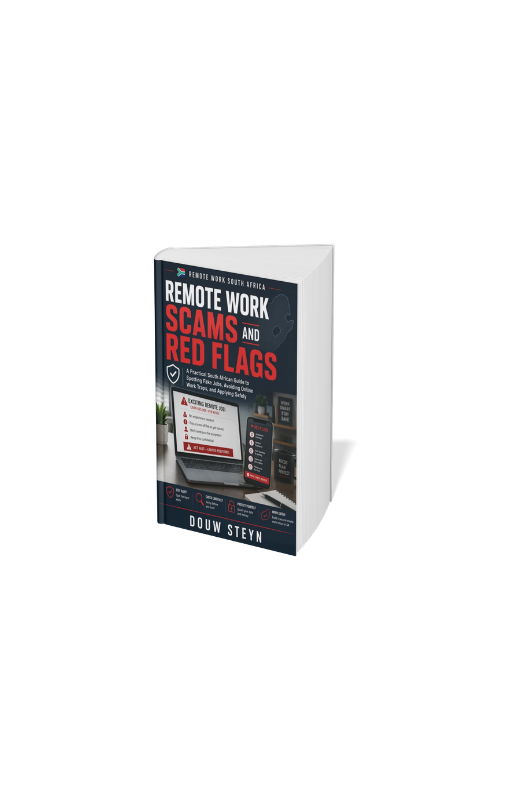
Remote Work Scams and Red Flags
Learn how fake recruiters, task scams, payment demands and fraudulent job offers operate.

The Remote Work Blueprint
A broader system for becoming remote-ready, finding opportunities, applying and building a sustainable remote career.
Continue reading
- The Remote Work Mismatch: What Job Seekers Want vs What Employers Are Hiring For
- How AI Is Reshaping Remote Work in South Africa
- Remote Work Without Experience in South Africa
- Why Your Remote Work CV Is Your First Interview
- Remote Work Skills South Africans Can Learn—and Prove
- Why You Are Not Getting Remote Job Interviews
Frequently asked questions about legitimate remote jobs
Are remote jobs real for South Africans?
Yes. South Africans work remotely for local and international employers as employees, contractors and freelancers. However, not every remote vacancy is open to applicants in South Africa, and not every online job advertisement is legitimate.
Why do international remote jobs reject South African applicants?
The employer may be unable to hire in South Africa because of payroll, tax, benefits, labour-law, security or time-zone requirements. In other cases, the applicant may not meet the role’s experience or skills requirements.
How can I tell whether a remote job is legitimate?
Verify the vacancy on the company’s official website, research the recruiter, check the email domain, insist on a proper recruitment process and never pay an application, equipment, training or withdrawal fee.
Can I get a remote job without previous remote experience?
It is possible, but you need evidence of transferable skills such as self-management, written communication, digital confidence and reliable delivery. Projects, portfolios, freelance assignments and volunteer work can help provide that proof.
Should I apply for as many remote jobs as possible?
Application volume alone is not a strategy. Prioritise positions for which you are eligible and well matched. Tailor the strongest parts of your CV and provide clear evidence that you can perform the work.
Why do I receive no response after applying?
Possible reasons include location restrictions, high applicant volume, missing requirements, weak evidence, an unclear CV or changes to the vacancy. Track your applications so that you can diagnose patterns rather than assuming that every rejection has the same cause.
What has been your biggest remote-job obstacle?
Is it scams, location restrictions, application silence, lack of experience, intense competition or unfair pay?
Share your experience in the comments. Your answer may help shape the next GigsZA article in this Remote Job Reality series.

About the author
Douw Steyn is a South African author and the founder of GigsZA. He develops practical resources to help South Africans understand remote work, digital income opportunities and the changing world of work.
Research and sources
- LinkedIn Economic Graph, The Remote Work Gap: Steady Demand, Fewer Opportunities, published 21 March 2025: read the report.
- United States Federal Trade Commission, data on online job and task scams: read the FTC release.
- South African Department of Employment and Labour, warning about fraudulent job offers and recruitment fees: read the warning.
- Public LinkedIn discussion explaining why remote positions may still carry location, payroll, legal and time-zone restrictions: view the discussion.