
Remote Work in South Africa
How South Africans Can Prepare to Work for International Companies Remotely
Working for an overseas company can open access to international experience, wider career opportunities and income paid in foreign currency. However, securing a suitable international role requires much more than finding a remote vacancy and submitting a CV.
A person living in Johannesburg, Cape Town, Durban, Pretoria or a smaller South African town can now contribute to a company based in London, Amsterdam, Toronto, Dubai, Sydney or New York without relocating.
The opportunity is real. International employers recruit people for customer support, administration, bookkeeping, finance, recruitment, sales, marketing, writing, design, technology, project coordination and many other roles that can be performed online.
However, international remote employment is often presented as a much simpler opportunity than it really is.
Many South Africans begin applying without understanding how global recruitment works, what foreign employers expect, how employment and contractor arrangements differ, how foreign income may affect their finances or whether the required working hours will be sustainable.
A foreign-currency salary is not automatically a good salary. An overseas employer is not automatically a good employer. A remote contract is not automatically secure.
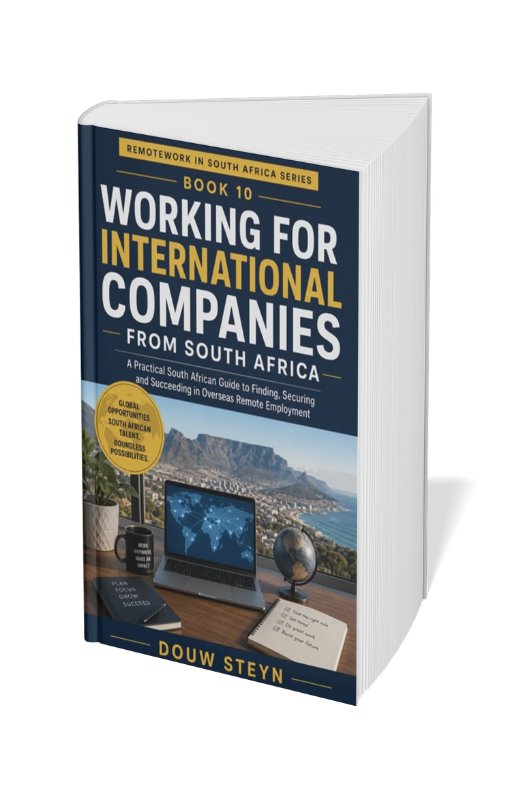
These are the practical problems addressed in Working for International Companies from South Africa: A Practical South African Guide to Finding, Securing and Succeeding in Overseas Remote Employment by Douw Steyn.
The International Remote-Work Opportunity Is Often Misunderstood
International remote employment is frequently presented as a simple process:
- Find an overseas remote vacancy.
- Submit your CV.
- Receive an offer.
- Get paid in dollars, pounds or euros.
- Earn more than you would locally.
This simplified version leaves out most of the decisions that determine whether an opportunity is legitimate, affordable and sustainable.
Before accepting an international position, you may need to establish:
- Whether you are being appointed as an employee or contractor.
- Who is responsible for tax deductions and declarations.
- Whether you receive paid leave, equipment or other benefits.
- How the employer will pay you.
- Which transfer and currency-conversion costs may apply.
- Which time-zone hours you must work.
- How the agreement can be terminated.
- Whether the company and recruiter are legitimate.
The headline salary is only one part of the arrangement.
You Do Not Know Which International Roles to Target
One of the first mistakes job seekers make is searching for any vacancy containing the words remote or work from home.
This can lead to applications for customer service, sales, data entry, virtual assistance, content writing and project-management positions even though these roles require different experience, skills and evidence.
International employers are not generally looking for someone who simply wants to work remotely. They are looking for someone who can solve a particular business problem.
What Employers May Need
- Responding professionally to customer enquiries.
- Reconciling financial records.
- Managing an executive’s diary.
- Coordinating projects across distributed teams.
- Qualifying sales leads.
- Editing video content.
- Writing technical or marketing material.
- Analysing operational information.
A South African bookkeeper with several years of experience should not ignore that background to compete for an unrelated entry-level remote job. Experience in reconciliations, invoicing, reporting and cloud-accounting software may provide a stronger route into international work.
Your Local Experience Is Not Being Presented as International Evidence
Many South Africans have useful experience but describe it in language that is too general to persuade an overseas employer.
Weak Claims
- Hardworking and dependable.
- Excellent communication skills.
- Able to work independently.
- Responsible for customer service.
- Assisted with administration.
Stronger Evidence
- Specific responsibilities.
- Software and systems used.
- Problems resolved.
- Work volumes handled.
- Measurable improvements achieved.
Instead of saying that you were responsible for customer service, explain what type of enquiries you handled, how many you managed, which channels you used and what results you achieved.
Instead of saying that you assisted with bookkeeping, explain which records you reconciled, which software you used and how your work contributed to accurate reporting.
South African work experience may demonstrate resilience, adaptability and practical problem-solving. Many local workers have handled difficult customers, changing priorities, limited resources and operational interruptions.
The problem is often not the absence of value. It is the failure to present that value clearly.
You Are Applying Repeatedly Without Getting Interviews
Sending more applications is not always the correct solution.
When someone submits dozens of applications without receiving interviews, the underlying difficulty may be:
- Poor role selection.
- A weak match between experience and requirements.
- A CV that lists duties rather than evidence.
- Missing software or industry keywords.
- An incomplete LinkedIn profile.
- Failure to follow application instructions.
- An unclear professional direction.
- No portfolio or work samples.
- Weak answers to screening questions.
- Applying for jobs that exclude South African candidates.
International vacancies can attract applicants from many countries. A generic application can be rejected before a recruiter reaches the strongest parts of your experience.
A better strategy is to select fewer, more suitable opportunities and tailor each application carefully.
Before Submitting an Application
- Identify the employer’s most important requirements.
- Match each requirement to evidence from your experience.
- Adjust your CV summary and relevant experience.
- Answer screening questions with specific examples.
- Check that the employer accepts South African applicants.
- Follow every application instruction.
You Cannot Tell Whether an International Vacancy Is Legitimate
Remote-work scams can use copied company logos, real employee names, professional-looking vacancies and email addresses designed to resemble legitimate company domains.
A polished message is not proof that an opportunity is genuine.
Warning Signs
- Employment is guaranteed without a proper assessment.
- The recruiter pressures you to act immediately.
- You are asked to pay for access to a job.
- You receive money and are told to buy equipment.
- You are asked to receive or forward funds.
- The recruiter requests passwords or unnecessary identity information.
- No written agreement is provided.
- The recruiter refuses live voice or video communication.
Verify the employer independently. Visit the official company website, confirm the recruiter’s identity, inspect the email domain and search for the vacancy through recognised company channels.
You Do Not Understand Employee and Contractor Arrangements
Two people may perform similar work for overseas companies while carrying very different legal, financial and practical responsibilities.
Possible Employee Features
- Regular payroll.
- Defined working hours.
- Paid annual leave.
- Employer-supplied equipment.
- Formal performance processes.
- Employment-related benefits.
Possible Contractor Responsibilities
- Managing tax payments.
- Submitting invoices.
- Providing equipment.
- Saving for retirement.
- Funding unpaid leave.
- Carrying greater contract risk.
Neither arrangement is automatically better.
A contractor may receive a higher gross payment and greater independence. An employee may prefer the stability, benefits and administrative support of formal employment.
The important point is to understand the complete arrangement before accepting it. A job title alone does not determine your employment status.
The Foreign-Currency Salary Looks Better Than It Really Is
A payment expressed in dollars, pounds or euros can appear impressive after conversion into rand.
However, gross foreign income is not necessarily the amount available for household expenses.
Consider a contractor receiving the equivalent of R30,000 per month. The amount may initially look better than a local salary, but the contractor may receive no paid leave, medical-aid contribution, retirement contribution, equipment or employer-managed tax deductions.
The useful comparison is not simply foreign salary versus local salary.
Compare the net value of the international arrangement after costs and responsibilities with the complete value of the local alternative.
The South African Revenue Service explains that South Africa uses a residence-based tax system. This means South African tax residents are generally taxed on worldwide income, subject to relevant exclusions and relief.
Tax treatment depends on your residence status, employment structure and individual circumstances. Confirm the current position with SARS or a registered South African tax practitioner.
You Are Not Prepared for International Working Hours
South Africa offers useful time-zone overlap with the United Kingdom, Europe, Africa and parts of the Middle East.
Positions linked to North America or Australia may require late evenings, overnight work or very early starts.
An unusual schedule may feel manageable during an interview but become exhausting when repeated every week.
Questions to Ask Before Accepting
- What are the required starting and finishing times?
- During which hours must I be online?
- How often are live meetings scheduled?
- Will overseas daylight-saving changes affect my hours?
- Are weekends or public holidays included?
- Can some work be completed asynchronously?
- How will the schedule affect my sleep and household?
Your Home Office Is Not Internationally Ready
Owning a computer and having access to the internet do not automatically make someone ready for international remote employment.
An overseas employer must be able to depend on you from another country.
International Home-Office Checklist
- A suitable and reliable computer.
- Stable primary internet.
- Backup connectivity.
- Backup electricity.
- A quality headset and clear audio.
- A functioning webcam.
- A private workspace.
- Secure passwords and multi-factor authentication.
- Updated software and malware protection.
- Secure storage of confidential information.
- A clear interruption-response plan.
The employer may never physically visit your workspace, but they will experience its quality whenever you attend a meeting, assist a customer or respond to a disruption.
You Are Unprepared for International Interviews
An international interview may test much more than your ability to answer standard interview questions.
The employer may be assessing whether you can:
- Communicate clearly through video.
- Understand different accents.
- Explain your experience concisely.
- Provide measurable examples.
- Work without constant supervision.
- Manage time-zone expectations.
- Respond professionally to technical problems.
- Protect confidential information.
- Adapt to different workplace cultures.
- Ask intelligent questions about the role.
You may also need to explain why appointing someone in South Africa makes practical sense.
Your answer should not focus only on accepting a lower salary. A stronger position is that you offer relevant skills, reliable delivery, clear English communication, useful time-zone overlap, adaptability and measurable value.
You Are Focusing Only on Getting Hired
Securing an offer is not the end of the international remote-work journey.
The next challenge is becoming someone the employer can continue to trust.
Long-term success depends on your ability to:
- Meet deadlines consistently.
- Communicate before problems become crises.
- Document your work.
- Ask for clarification when necessary.
- Participate professionally in online meetings.
- Adapt to different management styles.
- Protect company and customer information.
- Maintain reliable systems.
- Continue learning.
- Record your achievements.
International companies restructure. Contracts end. Technology changes and job roles evolve.
A sustainable international career should therefore not depend completely on one employer.
A Complete South African Guide
What the New Book Helps You Do
Working for International Companies from South Africa follows the complete international employment journey.
- Assess whether international remote work suits you.
- Identify realistic countries, industries and roles.
- Understand why overseas companies hire South Africans.
- Find and investigate legitimate vacancies.
- Strengthen your CV and LinkedIn profile.
- Present practical evidence rather than vague claims.
- Prepare for international interviews.
- Evaluate salaries, benefits and working hours.
- Understand employment and contractor arrangements.
- Review important contract terms.
- Plan for overseas payments and South African tax.
- Build a reliable international home office.
- Work effectively across cultures.
- Manage time zones and sustainable routines.
- Build a long-term international career.
Practical Tools Included
The book is designed to be used as a working system rather than read passively. Its practical appendices include:
Who Should Read This Book?
This guide is intended for South Africans who:
- Have local experience and want to compete internationally.
- Have worked remotely and want to take the next career step.
- Are freelancing but want a more stable overseas arrangement.
- Are returning to employment or changing careers.
- Want to earn in an international currency.
- Need help understanding overseas contracts and payments.
- Are applying without receiving interviews.
- Want to assess whether international hours are sustainable.
- Need a structured international employment plan.
The book is not limited to software developers or technology specialists. It is relevant to people in administration, customer service, finance, sales, marketing, recruitment, writing, design, education, project coordination, data and many other fields.
Start Small. Build What Works.
Prepare Before You Apply Internationally
Do not begin by submitting hundreds of unrelated applications. Choose a realistic direction, identify the value you can offer, prepare your evidence and evaluate each opportunity carefully.
You do not need to leave South Africa to build an international career. You do need to prepare carefully, present your value clearly and deliver work that employers can trust.
Get the Practical Guide
Frequently Asked Questions
Can a South African work remotely for an international company?
Yes. Some overseas companies appoint South Africans as remote employees, while others use independent-contractor agreements. Eligibility depends on the employer’s hiring countries, legal structure and vacancy requirements.
Which international companies hire South Africans remotely?
Opportunities may be available through remote-first companies, digital agencies, software businesses, accounting firms, customer-support operations, recruitment companies, education providers and other organisations that manage distributed teams. Confirm that each employer accepts candidates based in South Africa.
Do I need an international qualification?
Not for every role. Some regulated professions require specific qualifications, but many remote positions are filled according to practical skills, experience, software knowledge, work samples and evidence of results.
Can I earn dollars or pounds while living in South Africa?
An overseas employer or client may pay in a foreign currency or use a service that converts the payment into rand. Understand the conversion rate, transaction fees, record-keeping requirements and tax implications before accepting the arrangement.
Do South Africans pay tax on overseas remote income?
South Africa generally uses residence-based taxation, meaning South African tax residents may be taxed on worldwide income, subject to relevant exclusions and relief. The correct treatment depends on your tax residence and circumstances. Confirm the current position with SARS or a registered tax practitioner.
Is an international contractor the same as an employee?
No. Employees and contractors may have different rights, benefits, tax responsibilities, equipment costs and termination terms. Read the agreement carefully and obtain professional advice when the classification is unclear.
What equipment is needed for international remote work?
Requirements differ, but employers may expect a suitable computer, stable internet, backup connectivity, backup electricity, a headset, webcam, secure software and a private workspace.
Where can South Africans find legitimate international remote jobs?
Opportunities may appear on established remote-job platforms, employer career pages, LinkedIn, specialist recruitment agencies and professional networks. Investigate every employer and recruiter independently.
Important Disclaimer
This article and the related book are provided for general educational and informational purposes. They do not constitute legal, tax, accounting, financial, labour-relations, immigration or professional career advice.
International employment arrangements differ according to the employer, country, contract, employment status and individual circumstances. Tax rules, payment services and employment regulations may change. Verify current information and consult appropriately qualified South African professionals before making important contractual, legal, tax or financial decisions.