
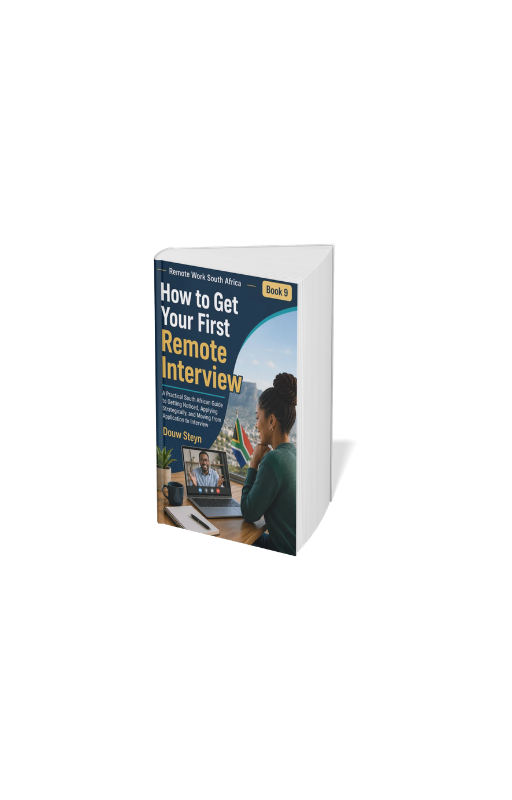
Stop sending more applications without understanding why they are being ignored
Finding remote vacancies is often easier than getting invited to interview for them.
You may find suitable jobs on LinkedIn, recruitment websites, company careers pages and remote job boards. You may submit applications consistently and still receive very little response.
The problem is not always a lack of ability.
In many cases, employers cannot quickly see where you fit, what value you offer or why interviewing you would be worthwhile.
How to Get Your First Remote Interview helps South African job seekers improve the stage between finding a remote vacancy and receiving an interview invitation.
This is not a collection of motivational advice or generic interview questions. It is a practical guide to building a clearer, more credible and more effective remote-job application system.
Why remote applications are often ignored
Remote vacancies can attract applicants from many countries. Recruiters may receive hundreds or even thousands of applications and spend only a short time reviewing each one.
Before offering an interview, an employer is usually trying to establish:
- whether your experience fits the role;
- whether applicants based in South Africa are eligible;
- whether you can communicate clearly;
- whether your claims are supported by evidence;
- whether you appear ready to work remotely;
- whether you followed the application instructions;
- whether inviting you to interview would be a sensible next step.
A general CV, vague LinkedIn profile and generic application message make these decisions more difficult.
This guide shows you how to reduce that uncertainty.
What you will learn
Choose a clear remote-work direction
Stop applying for every vacancy containing the word “remote.”
You will learn how to choose a practical group of related positions, identify alternative job titles and create a professional direction that employers can understand.
Possible role groups include:
- administrative and virtual-assistant work;
- customer support;
- content support;
- sales support;
- research assistance;
- project and operations support;
- online teaching and related digital services.
Translate your previous experience into remote-work value
Many South Africans already have useful remote-work skills but do not describe them in the language employers use.
Experience gained in retail, reception, administration, teaching, logistics, sales, customer service, music, operations and other fields may include valuable transferable skills.
The guide helps you identify and present experience in areas such as:
- customer communication;
- scheduling;
- recordkeeping;
- document preparation;
- order tracking;
- complaint resolution;
- research;
- reporting;
- task coordination;
- independent work;
- digital communication.
Create a stronger remote-work CV
Learn how to improve the sections of your CV that influence the first screening decision.
The book covers:
- choosing a suitable professional title;
- writing a focused professional summary;
- improving first-page relevance;
- describing transferable experience;
- using vacancy keywords honestly;
- presenting digital-tool experience;
- adding evidence links;
- creating role-specific CV versions;
- using professional filenames and clear formatting.
Improve your LinkedIn profile
Your CV and LinkedIn profile should support the same professional direction.
You will learn how to strengthen your:
- LinkedIn headline;
- About section;
- experience descriptions;
- skills;
- location information;
- job preferences;
- Featured section;
- recruiter visibility;
- professional activity.
Build proof before an employer asks for it
Applicants without formal remote-work experience often need another way to demonstrate practical ability.
The guide shows you how to create small, relevant work samples such as:
- customer-response emails;
- escalation notes;
- task trackers;
- calendar-management exercises;
- research summaries;
- meeting notes;
- spreadsheets;
- content plans;
- transcription samples;
- teaching samples.
You will also learn how to label simulated work honestly, remove confidential information and share files through safe, professional links.
Find and evaluate better remote vacancies
Not every remote vacancy is suitable for an applicant in South Africa.
Learn how to check:
- location eligibility;
- time-zone requirements;
- work-authorisation restrictions;
- contractor or employee status;
- salary expectations;
- working hours;
- employer legitimacy;
- experience level;
- vacancy quality;
- application timing.
The book also teaches you to search related job titles because employers may use different names for similar work.
Tailor applications without starting from zero
Tailoring does not mean rewriting your entire CV for every application.
You will learn how to identify the employer’s most important requirements and adjust the sections that influence the decision most strongly.
This includes:
- your CV title and summary;
- selected experience bullets;
- relevant skills;
- keywords;
- work samples;
- application messages;
- screening answers.
Write stronger application messages
Replace vague statements such as “I am hardworking and willing to learn” with focused messages that explain why your background is relevant.
The guide shows you how to communicate:
- the role you are applying for;
- the experience that supports your application;
- the problems you can help solve;
- the evidence you can provide;
- your availability and practical suitability.
Answer screening questions properly
A strong CV can still fail when screening questions are rushed or answered vaguely.
You will learn how to respond professionally to questions about:
- experience;
- skills;
- software;
- equipment;
- location;
- working hours;
- salary;
- availability;
- customer situations;
- independent work;
- problem-solving.
Follow up professionally
Learn when following up may be appropriate, how long to wait and how to send a concise follow-up without appearing demanding or desperate.
Diagnose why interviews are not happening
The book helps you distinguish between different application problems.
For example:
- Applications not viewed may indicate weak vacancy selection, timing, keywords or profile visibility.
- Applications viewed without response may indicate weak relevance, evidence or CV positioning.
- Screening requests that do not become interviews may indicate problems with answers, salary, availability or communication.
- Recruiter conversations that disappear may indicate delayed responses, inconsistency or practical mismatch.
Instead of submitting more identical applications, you will learn how to identify the bottleneck and test a meaningful improvement.
The Remote Interview Shortlist Formula
The guide explains six factors employers commonly consider before offering a remote interview:
- Role fit — Can the employer see a credible connection between your background and the position?
- Clear communication — Does your application show that you can understand and communicate information professionally?
- Relevant evidence — Have you supported important claims with examples or work samples?
- Remote-work readiness — Do you understand the equipment, tools, schedule and independence required?
- Professional reliability — Have you followed instructions and submitted accurate, complete information?
- Low perceived hiring risk — Does the application make interviewing you feel like a sensible next step?
A practical South African approach
The book addresses conditions that matter to South African applicants, including:
- applying for international remote positions;
- country and time-zone restrictions;
- South African English;
- fibre, mobile-data and power-backup planning;
- employee versus contractor arrangements;
- equipment and internet costs;
- VAT and tax considerations where applicable;
- protecting identity and banking information;
- avoiding fake recruiters and upfront-payment scams.
The 30-Day First Interview Plan
The final part of the guide brings the complete process together in a structured 30-day action plan.
You will work through:
- choosing a target role;
- improving your CV;
- updating LinkedIn;
- creating evidence;
- finding suitable vacancies;
- researching employers;
- tailoring applications;
- tracking submissions;
- following up;
- reviewing results;
- improving weak stages.
The objective is not to submit the highest possible number of applications.
It is to submit stronger applications to opportunities where an interview is realistically possible.
Bonus resources
The book includes practical bonus resources to help you apply the process, including tools for:
- checking interview readiness;
- scoring job opportunities;
- tailoring a CV;
- tracking applications;
- preparing professional messages;
- creating work samples;
- auditing twenty applications;
- researching target employers.
Who this book is for
This guide is suitable for:
- South Africans searching for their first remote job;
- job seekers submitting applications without receiving interviews;
- people changing careers;
- applicants without formal remote-work experience;
- unemployed and underemployed job seekers;
- professionals returning to the job market;
- older workers seeking remote opportunities;
- graduates and entry-level applicants;
- freelancers considering structured remote employment;
- people who need a clearer application system.
This book may be especially useful when:
- you are applying regularly but receiving no response;
- your CV is too broad or generic;
- you do not know which remote role to target;
- you have useful experience but cannot explain how it transfers;
- your LinkedIn profile is not attracting recruiters;
- you have no portfolio or work samples;
- you are unsure which vacancies accept South African applicants;
- screening questions are not leading to interviews;
- you need a practical 30-day improvement plan.
Important note
No book, CV, course, application method or work sample can guarantee an interview or employment.
Recruitment decisions remain under the control of employers, recruiters and hiring managers. Outcomes may also be affected by competition, location restrictions, budgets, internal candidates, vacancy cancellations and factors outside the applicant’s control.
This guide is intended to help you improve what you can control: your professional direction, application quality, evidence, communication, preparation and decision-making.
Digital product information
- Author: Douw Steyn
- Edition: First edition
- Publication year: 2026
- Format: Digital eBook
- Language: English
- Delivery: Immediate digital download after successful payment
- Geographic focus: South Africa
- Series: Remote Work South Africa
Remote job searching requires persistence, but persistence should be intelligent.
Choose a role you can support. Present your experience in language employers understand. Build proof before it is requested. Apply where the conditions make sense. Track what happens and improve what the evidence shows.


Reviews
There are no reviews yet.