
Digital Income South Africa
How to Start an Online Art Gallery in South Africa
You do not need expensive premises, a large art-world network or hundreds of artworks to start an online gallery. You do, however, need a clear curatorial focus, dependable artists, professional presentation and a sales process that gives buyers confidence.
- Choose a gallery niche that buyers can understand.
- Build fair, professional relationships with artists.
- Create a website that supports trust and sales.
- Plan pricing, payment, delivery and legal responsibilities.
The opportunity
The traditional art gallery model is no longer the only option
A person who wants to enter the art business may assume that the first step is renting an attractive gallery in Cape Town, Johannesburg, Pretoria or Durban. That route can work, but it brings rent, utilities, security, staffing and foot-traffic risk before the first artwork has been sold.
An online-first gallery changes the starting equation. Instead of paying for permanent wall space, you can build a focused digital collection, represent artists from several locations and make the gallery accessible to buyers at any time.
A collector in Sandton could discover work by an artist in Limpopo. A homeowner in Durban could compare several paintings without travelling. An international buyer interested in contemporary South African art could enquire directly from another country.
This does not make an online gallery effortless. It simply replaces some physical costs with different responsibilities: website management, digital presentation, online marketing, secure payment, buyer communication and delivery coordination.
The practical reality: an online gallery can lower the barrier to entry, but it does not remove the need for good judgement, business structure and buyer trust.
This type of business fits within the wider field of practical digital income opportunities. For broader guidance on choosing and testing an online business model, visit the Digital Income South Africa hub .
Business model
What is an online art gallery?
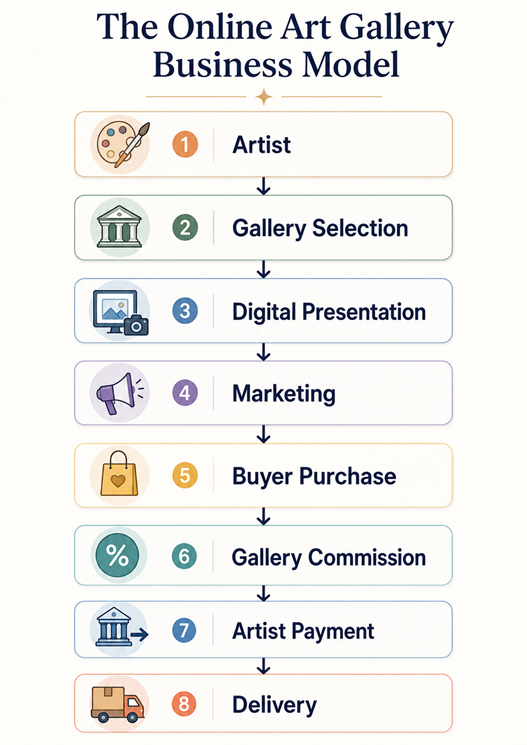
An online art gallery is more than a website containing images of paintings. A professional gallery selects artists, curates work around a clear point of view, presents it to suitable buyers and manages the commercial process around a sale.
A typical online gallery may:
- Select and represent a defined group of artists.
- Curate collections around a style, theme, region or buyer group.
- Photograph or prepare artwork for digital presentation.
- Write artist profiles and artwork descriptions.
- Promote collections through content, email and social platforms.
- Answer buyer questions and manage purchase enquiries.
- Collect payment and calculate artist payouts.
- Coordinate authenticity documents, packaging and delivery.
- Earn a commission or agreed service fee.
The gallery therefore creates value for both sides. Artists receive professional presentation, marketing and access to buyers. Buyers receive selection, context, reassurance and a safer purchasing process.
Key distinction: a marketplace offers selection at scale. A curated gallery earns trust through selection, taste, consistency and service.
Buyer behaviour
Is there a real market for buying art online?
Buyers have become more comfortable researching and purchasing valuable products online. Art remains a considered purchase, but secure payments, better digital photography, social discovery and improved delivery services have reduced some of the barriers that previously kept art sales inside physical galleries.
Online discovery can also make art feel more accessible. Some first-time buyers find traditional galleries intimidating. They may worry about not understanding the terminology, not knowing whether a price is reasonable or feeling pressured to make a decision.
A well-designed digital gallery allows them to browse privately, read about the artist, compare work and return when they are ready.
The hesitation has not disappeared
Before buying, an online art customer may still ask:
- Is this gallery a legitimate business?
- Does the artwork really exist?
- Are the colours represented accurately?
- How large will the piece look in a real room?
- Is it an original or an edition?
- Will I receive a certificate of authenticity?
- Who is responsible if it is damaged in transit?
- Can I return it if it is materially different from the listing?
The real business opportunity is therefore not merely placing art online. It is reducing enough uncertainty for the right buyer to act.
Positioning
Choose a gallery niche buyers can recognise
New gallery owners are often tempted to represent many styles because they fear that focus will reduce sales. In practice, a gallery containing unrelated paintings, photography, sculpture, crafts and digital work can be difficult to understand.
Online visitors make fast decisions. They want to know what the gallery represents, whether the work is relevant to them and why they should trust its selection.
Possible niche by art type
- Contemporary portraiture.
- Urban photography.
- Limited-edition prints.
- Mixed-media work.
- Landscape painting.
- Textile and fibre art.
Possible niche by buyer or context
- First-time collectors.
- Corporate offices.
- Hospitality properties.
- South Africans living abroad.
- Interior designers.
- Buyers seeking work below a set price.
Use a one-sentence positioning statement
Formula: Our gallery curates [specific kind of art] for [specific buyer] who wants [specific result, feeling or value].
Example: Our gallery curates limited-edition prints by emerging South African illustrators for first-time collectors who want meaningful local art at accessible prices.
Before investing heavily in development, test whether people understand and respond to the idea. The GigsZA article Build Proof Before You Build Big explains how to validate an online income concept with smaller, lower-risk experiments.
Customer fit
Define the buyer before selecting the collection
“People who love art” is too broad to guide a useful business decision. Different art buyers have different budgets, concerns and levels of confidence.
First-time buyer
Often wants clear prices, plain-language guidance, reliable delivery and reassurance that there is no “wrong” way to begin collecting.
Developing collector
May care about edition size, the artist’s development, exhibition history, stylistic consistency and early access to new work.
Established or corporate buyer
Usually expects documentation, provenance, personal communication, dependable logistics and a credible curatorial process.
Your chosen buyer affects almost every later decision: the artists you represent, price range, writing style, website structure, payment methods, marketing channels and level of personal service.
For a deeper customer-definition exercise, read How to Identify and Understand Your Customer Before You Build an Offer .
Curation
Find artists who fit the gallery—not merely available art
The artists you represent will define the gallery more clearly than its logo or colour palette. Sourcing should therefore be treated as a curatorial and business decision rather than a race to fill the website.
Where to find potential artists
- Local exhibitions and open-studio events.
- University and college graduate exhibitions.
- Art markets and community creative events.
- Instagram and other portfolio-driven platforms.
- Artist associations and local creative organisations.
- Referrals from artists already known to you.
- A controlled submission process on the gallery website.
What to assess before offering representation
Artistic talent matters, but a working gallery relationship also depends on reliability. Review:
- Consistency across the artist’s body of work.
- Alignment with your curatorial focus.
- The suitability of the work for your target buyer.
- Pricing logic and previous sales evidence.
- Image quality and the ability to supply listing information.
- Communication, reliability and deadline management.
- Packaging and dispatch capability.
- Willingness to use a clear written agreement.
Start deliberately: three to five dependable, well-aligned artists can create a stronger launch collection than twenty artists whose work has no clear relationship.
Professional relationships
Put artist agreements in writing
Informal arrangements may feel friendly at the beginning, but uncertainty becomes dangerous when sales, deadlines, copyright and money are involved. A written artist agreement protects the relationship by setting expectations before a problem appears.
A practical agreement should address:
- Which artworks the gallery may represent.
- Whether representation is exclusive or non-exclusive.
- How retail prices are set and approved.
- The gallery commission or fee structure.
- When and how the artist will be paid.
- Responsibility for storage, packaging and delivery.
- How returns, losses or transit damage will be handled.
- Permission to photograph and promote the work.
- The duration of the relationship.
- How either party may terminate the agreement.
Copyright needs particular attention
Purchasing a physical artwork does not automatically give the buyer or gallery ownership of the artist’s copyright. The gallery should obtain clear permission to use artwork images for listings, email campaigns, social posts, advertising and editorial content.
The South African Government explains that copyright in an original painting or similar creative work generally arises automatically when the work is created. You can review the official South African copyright guidance when developing agreements and website policies.
Important: template agreements are a starting point, not a substitute for legal advice suited to your particular gallery, artists and sales process.
Commercial structure
How does an online art gallery make money?
The most common model is a commission on each completed artwork sale. The commission should reflect what the gallery actually provides, such as photography, website management, marketing, buyer communication, payments, documentation and fulfilment coordination.
Commission model
The gallery earns an agreed percentage of each sale. This aligns the gallery’s income with sales performance but means revenue may be irregular during the early stage.
Listing fee plus commission
Artists pay a defined listing or service fee, while the gallery takes a smaller percentage when the work sells. The value supplied must be clear.
Owned inventory
The gallery buys work and resells it. This creates more pricing control but ties up cash and transfers inventory risk to the gallery.
Additional services
Later income may come from corporate sourcing, commissions, advisory services, limited editions, framing coordination or virtual events.
A basic gallery commission example
Artwork selling price: R10,000
The gallery’s R4,000 share is not automatically profit. Payment-gateway charges, advertising, administration, photography, insurance, packaging or delivery support may still need to be covered.
Work through the full cost structure rather than choosing a commission percentage because it sounds normal. The article How to Price Your Products and Services for Profit in South Africa provides a useful framework for distinguishing sales, costs, margin and actual profit.
VAT and tax must not be treated as an afterthought
South African VAT thresholds and registration rules can change. According to the live SARS guidance, compulsory VAT registration generally applies when taxable sales exceed the current threshold in an uninterrupted 12-month period. The compulsory threshold increased to R2.3 million from 1 April 2026.
Use the current SARS VAT information page rather than relying on an old article or a figure copied from another business.
Ask an accountant how VAT should be treated in your specific artist-gallery arrangement. The answer may depend on who is legally making the sale, how commission is invoiced and whether either party is VAT-registered.
Technology choice
Website, marketplace or hybrid gallery?
Your platform determines how much control you have over presentation, pricing, customer relationships and data. There is no universal answer, but the trade-offs should be understood before you begin.
| Factor | Own website | Third-party marketplace | Hybrid model |
|---|---|---|---|
| Brand control | High. You control the gallery identity and presentation. | Low to moderate. The marketplace brand usually dominates. | High on your site, lower on external platforms. |
| Existing audience | Usually limited at launch. You must create traffic. | Potential access to existing marketplace visitors. | Uses marketplace discovery while building owned traffic. |
| Customer relationship | Direct access to enquiries, buyers and email subscribers. | The platform may limit buyer data or direct communication. | Relationships can gradually move toward owned channels. |
| Setup difficulty | Higher. Requires a website, payment setup and policies. | Lower. Listings may be created quickly. | Highest operational complexity because two channels are managed. |
| Fees | Hosting, development, payment and marketing costs. | Listing fees, marketplace commission or platform charges. | Combination of website costs and marketplace charges. |
| Long-term asset value | Strong. The website, content, list and customer data are yours. | Limited. Visibility depends heavily on the platform. | Strong when the website remains the main gallery destination. |
| Best suited to | Gallery owners building a distinctive long-term brand. | Early testing or artists seeking additional discovery. | Galleries wanting both reach and long-term independence. |
On smaller screens, swipe horizontally to view the full comparison table.
Practical recommendation: marketplaces can support discovery, but your own website should become the gallery’s central brand, trust and customer-relationship asset.
Digital storefront
Build a website that helps people evaluate and buy art
A gallery website should not behave like a decorative brochure. It must help buyers discover work, understand it, trust the seller and complete the next step without confusion.
Core pages
- Homepage with a clear curatorial promise.
- Available artwork or shop page.
- Individual artwork pages.
- Artist biography and portfolio pages.
- About the gallery.
- How buying works.
- Delivery and return information.
- Authenticity and provenance information.
- Contact details.
- Terms, privacy and other required policies.
Every artwork page should answer practical questions
Artwork details
- Title and artist.
- Price.
- Medium and materials.
- Dimensions.
- Year created.
- Edition information.
- Framing status.
Purchase reassurance
- Multiple accurate images.
- Availability status.
- Delivery estimate.
- Return policy.
- Authenticity details.
- Secure payment method.
- Visible enquiry option.
Mobile usability is essential. A prospective buyer may first encounter the gallery through Instagram, Google, Pinterest, LinkedIn or a shared WhatsApp link. Images, text and buttons must remain clear on a small screen.
Digital presentation
Online photography replaces the physical viewing experience
In a physical gallery, buyers can approach the work, observe its scale, examine texture and see how it reacts to light. Online, photography and written information must replace much of that experience.
For each work, aim to provide:
- A straight, full view of the artwork.
- Close-up details showing texture or brushwork.
- A side view where depth or framing matters.
- A clear image of the artist’s signature.
- A room or wall view showing approximate scale.
- Framed and unframed views where appropriate.
- An image of the certificate or edition details where useful.
Use consistent image standards
Lighting, colour treatment, background, cropping and image dimensions should feel consistent across the gallery. Avoid filters that make the artwork more dramatic but less accurate.
Image files should be detailed enough to support buyer evaluation but optimised so that pages load efficiently on mobile data.
Write for interested humans, not only art insiders
A useful artwork description combines factual information with enough context to help a buyer connect with the piece. It should not overwhelm the reader with vague or academic language.
A balanced description can include:
- What the work depicts or explores.
- The artist’s process or intention.
- Relevant cultural or personal context.
- Materials and technique.
- How the work relates to the wider collection.
- Practical scale, framing and care information.
Price confidence
Price artwork consistently and sustainably
Art pricing is sensitive because it affects artist income, gallery positioning and buyer confidence. Prices should neither be invented to create prestige nor discounted so frequently that buyers learn to wait.
Consider:
- The artist’s experience and previous sales.
- Medium, materials and production cost.
- Size and complexity.
- Whether the work is original or part of an edition.
- Edition size and remaining availability.
- Demand for the artist’s work.
- The gallery commission and operating costs.
- Packaging, insurance and delivery responsibilities.
- The gallery’s intended buyer and market position.
Similar work should follow understandable pricing logic. Large unexplained differences make buyers question the process.
Price consistency across channels also matters. An artist should not list the same work at one price on a personal page and a substantially higher price through the gallery unless there is a clear, legitimate reason.
Create accessible entry points without weakening the brand
A gallery can welcome newer collectors through smaller originals, limited-edition prints, staged payment options or carefully defined collections at different price points. Accessibility does not require constant discounting.
The question is not only “What can we charge?” It is also “What complete offer are we giving the artist and buyer?” The GigsZA guide Your First Online Offer: What Can South Africans Sell Online? provides a useful way to think about the value surrounding the product.
Conversion
Build trust before asking someone to purchase
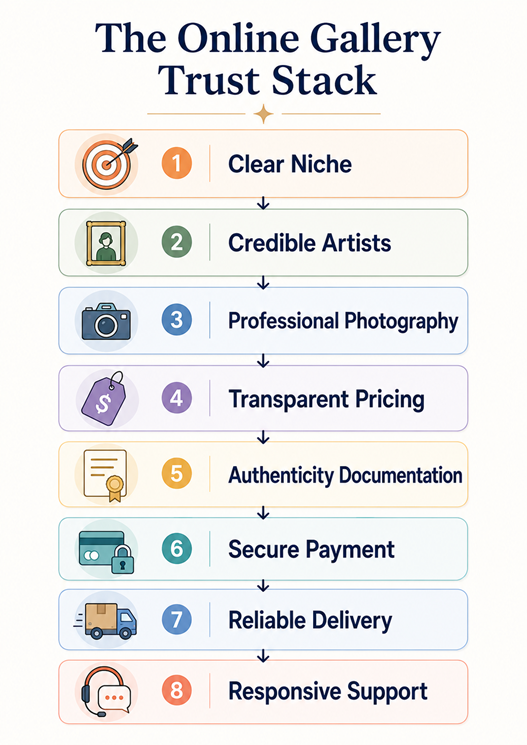
A buyer might spend a few hundred rand online with limited investigation. Spending R8,000, R20,000 or more on an artwork they have not physically inspected requires a much higher level of confidence.
Strong trust signals include:
- Real artist names, biographies and photographs.
- A clear gallery owner or team identity.
- Visible business contact information.
- Transparent prices or a clearly explained enquiry process.
- Secure, recognisable payment options.
- Certificates of authenticity.
- Clear shipping, damage and return procedures.
- Testimonials from genuine buyers or artists.
- Behind-the-scenes studio and curation content.
- Consistent communication across the website and social channels.
Trust also depends on small operational details. Replies should be prompt. Invoices should be professional. Delivery updates should arrive when promised. Artists should be paid according to the agreement.
A useful test: imagine that you are about to transfer R20,000 to a gallery you have never visited. What evidence would you need before feeling comfortable?
Audience growth
Market the gallery through education and storytelling
Posting a stream of artwork images labelled “available now” is not a complete marketing strategy. Buyers may appreciate the work without yet understanding the artist, price, context or reason to act.
Useful gallery content can include:
- Artist interviews.
- Studio visits and process videos.
- The story behind a specific artwork.
- Guides for choosing art for a home or office.
- Advice for first-time collectors.
- Explanations of prints, editions and originals.
- Framing and artwork-care guidance.
- New collection previews.
- Customer installation stories.
- Curatorial explanations of why works belong together.
Use several channels for different jobs
Discovery channels
- Google-search content.
- Instagram and visual short-form content.
- Pinterest.
- Artist collaborations.
- Selected marketplaces.
Relationship channels
- Email newsletters.
- Collector previews.
- Personal enquiries.
- Virtual exhibitions.
- Partnerships with designers and property professionals.
An email list gives the gallery a direct way to tell subscribers about new work, artist releases and private previews without depending entirely on social-platform algorithms.
The guide Building an Email List from Scratch can help you create that owned audience from the beginning.
Galleries working with limited budgets can also consult Low-Cost Marketing for Online Entrepreneurs for practical ways to promote consistently without assuming a large advertising budget.
Operations
Plan packaging, shipping and fulfilment before the first sale
Delivery is not an administrative detail. It is part of the product and part of the buyer’s trust experience. A beautiful artwork delivered late, damaged or without communication can undo months of careful marketing.
Before listing any artwork, confirm:
- Where the artwork is physically stored.
- Who is responsible for packaging it.
- The packed dimensions and weight.
- Which courier can handle the package safely.
- Whether transit insurance is available.
- Who pays for local or national delivery.
- The expected dispatch time.
- What happens when a delivery is delayed or damaged.
- Whether the buyer can return the work.
- Who manages customs documentation for international orders.
Shipping large, fragile or high-value work may require specialist packaging rather than an ordinary parcel service. Test the process before advertising nationwide or international delivery.
Implementation
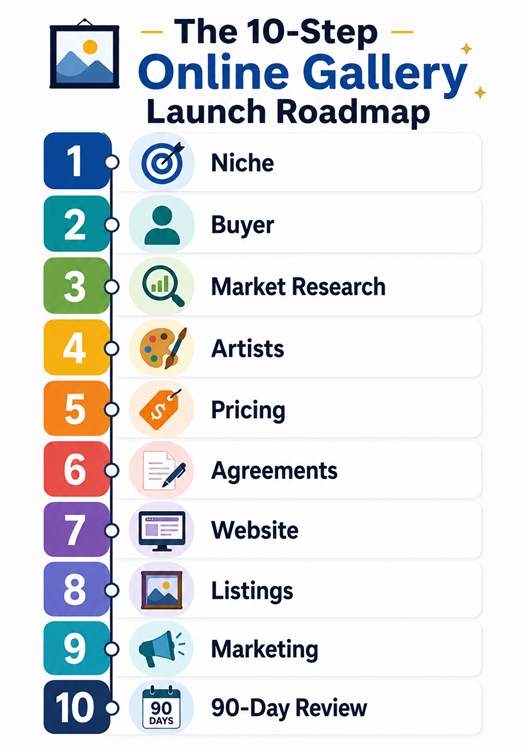
A practical 10-step online gallery starting plan
You do not need to launch with a massive catalogue. Begin with a manageable version that allows you to test the niche, artist relationships, prices and customer journey.
-
Define the gallery niche.
Choose the style, medium, theme, region or buyer focus that gives the collection a recognisable identity. -
Identify the primary buyer.
Describe their budget, motivation, concerns and preferred way of buying. -
Study competing galleries.
Look for gaps in presentation, price point, artist focus, content or service rather than copying the largest platform. -
Select the initial artists.
Start with a small group whose work and professional behaviour support the gallery vision. -
Agree on pricing and commission.
Document how prices are calculated, what the gallery provides and how costs are handled. -
Put written agreements in place.
Clarify rights, responsibilities, image use, payment, delivery and exit terms. -
Build the minimum viable website.
Include the essential artist, artwork, trust, payment and policy pages without unnecessary design complexity. -
Prepare each listing properly.
Gather images, descriptions, dimensions, edition information, authenticity details and delivery costs. -
Launch one focused marketing programme.
Combine useful content with email collection and consistent promotion rather than trying to dominate every platform immediately. -
Measure the first 90 days.
Track traffic, email signups, enquiries, saved artworks, checkout starts, sales, margin and repeat visits.
During the first phase, success may be an enquiry, a subscriber, a repeat visitor or evidence that one artist and price range attracts more attention than another. These signals help you refine the model.
Once the gallery produces its first signs of traction, use From First Digital Income to What Works to decide what to repeat, improve or stop.
Risk reduction
Common mistakes that weaken a new online gallery
Starting too broadly
A collection containing everything may communicate nothing. Focus helps visitors understand why the gallery exists.
Expecting the website to create its own traffic
A gallery without consistent discovery and relationship-building is similar to a shop hidden in an unmarked side street.
Accepting weak images
Poor lighting, inconsistent colour and unclear scale reduce perceived value before the buyer reads the description.
Working without agreements
Verbal assumptions about payment, copyright, exclusivity and delivery are likely to cause conflict later.
Hiding essential information
Missing prices, delivery details or contact information increases uncertainty and discourages first-time buyers.
Confusing sales with profit
Commission income must still cover gateway charges, advertising, administration and operational costs.
Solving shipping after the sale
Unplanned packaging and courier costs can destroy the margin or disappoint the customer.
Scaling before trust is established
More artists and more listings do not automatically create a stronger business. Reliable systems should come first.
Frequently asked questions
Questions about starting an online art gallery
Do I need to be an artist to open an online art gallery?
No. The gallery owner’s role can focus on curation, artist relationships, presentation, marketing, buyer communication and business management. You need enough art knowledge to make credible selections and explain them, but you do not have to produce the work yourself.
Do I need a physical gallery?
No. An online-first gallery can operate without permanent retail premises. You can later add pop-up exhibitions, studio visits or temporary viewing events when they support the business model.
How does an online gallery earn income?
Most galleries earn a commission on completed artwork sales. Other possibilities include listing services, art sourcing, limited editions, corporate advisory work, commissions and events. The revenue model should be transparent to artists and buyers.
How much commission should a gallery charge?
There is no single correct percentage. It depends on the services the gallery provides, the cost structure, the artist relationship and the market. Calculate the real cost of marketing, sales, payment, administration and fulfilment before setting the rate.
Should artwork prices appear on the website?
Visible pricing usually reduces uncertainty, particularly for first-time buyers. Some high-value or bespoke works may use an enquiry process, but the buyer should still receive clear information about how the purchase works.
How many artists should a new gallery represent?
A focused launch with three to five dependable artists is often more manageable than a large catalogue. The correct number depends on how much work you can present, market and administer professionally.
Can a South African gallery sell to international buyers?
Yes, but international payment, foreign exchange, packaging, insurance, customs, export documentation, delivery cost and return arrangements should be investigated before international sales are promoted.
How quickly should I expect the first sale?
There is no guaranteed timeframe. Results depend on the niche, artist demand, pricing, presentation, traffic and trust. Early signs such as enquiries, repeat visits and email subscriptions can help you judge whether the model is gaining traction before sales become consistent.
Final perspective
Build a gallery people can understand and trust
A sustainable online art gallery does not need the largest catalogue. It needs a clear reason to exist, artists who fit that purpose and a buyer experience that reduces uncertainty.
Start with a focused collection. Explain the work honestly. Treat artists as professional partners. Make pricing, payment and delivery clear. Measure how visitors behave and improve the process before expanding.
You do not have to recreate a major international marketplace. Your advantage may be the opposite: a smaller, better-defined gallery that understands a specific buyer and tells the stories of its artists with care.
The central lesson: online art sales are built through clarity, curation, consistency and trust—not by uploading more products and hoping buyers will appear.

About the author
Douw Steyn writes practical guides for South Africans who want to start small businesses, build digital income streams and make better-informed decisions before investing heavily. His work focuses on realistic implementation, local context, risk awareness and building what works step by step.
How this guide was developed
This article was developed from the practical framework used in Opening an Online Art Gallery: A Practical Guide to Building, Marketing, and Selling Art Online . It brings together gallery positioning, customer definition, artist relationships, digital presentation, pricing, fulfilment and trust into a beginner-friendly implementation sequence.
The article has been adapted for South African readers and links to official sources where legal or tax information may change. Business examples are illustrative and should not be treated as guaranteed outcomes.
External references and useful official resources
Disclaimer
This article is provided for general educational and informational purposes. It does not constitute legal, tax, accounting, financial, insurance or other professional advice.
Business registration, VAT, copyright, consumer protection, contracts, customs, payment and delivery requirements may depend on your particular circumstances and may change. Consult an appropriately qualified professional before making decisions that create legal, financial or tax obligations.
No particular level of income, sales or business success is guaranteed. Outcomes depend on factors including your gallery positioning, artists, prices, presentation, marketing, buyer demand, operations and available resources.