
Digital Income South Africa
How to Choose Your First Digital Income Path in South Africa
You do not need to find the perfect online business before you begin. You need one realistic path that fits your skills, time, budget and current level of confidence – and that you can test without wasting months or money.
- Compare six practical starting paths
- Match a path to your real situation
- Choose a small test you can run within 30 days

Start With Clarity
The real problem is not a lack of ideas
Search for ways to earn online in South Africa and you will quickly find freelancing, virtual assistance, digital products, affiliate marketing, online courses, blogging, YouTube, AI services and dozens of other possibilities. The opportunities are not hidden. They are competing for your attention.
Too many options can make beginning harder. One video tells you to sell a service. The next says passive income is the goal. A third recommends an expensive tool, platform or business model before you have spoken to a single potential buyer.
This guide will help you narrow the field. It is part of the Digital Income South Africa pathway and follows one practical principle: start from where you are, choose one small direction and look for proof before building bigger.
Focus First
Why choosing one path matters
Scattered effort feels busy but produces weak feedback. You may spend one week watching affiliate marketing videos, another designing an eBook and the next creating profiles on freelance platforms. Because no path receives enough focused effort, none tells you whether a real person is interested.
Beginners commonly lose momentum by:
- jumping between ideas whenever a new opportunity appears;
- watching endless tutorials without testing anything;
- trying five income models at the same time;
- buying tools before choosing a clear direction;
- copying what influencers promote without checking local fit; and
- starting with a platform instead of a useful offer.
Your first goal is not to identify the opportunity you will pursue forever. It is to choose one realistic path that can give you useful feedback. You can deepen, change or combine paths later.
Know Your Position
Before choosing a path, check your starting point
A sensible digital income path must fit your real life. Work through these five factors before comparing business models.
Your skills
Can you write, organise, design, explain, research, teach or support business owners? Include skills gained through jobs, community work and everyday responsibilities.
Your available time
Do you have evenings only, flexible daytime hours or a reliable weekly block? A path that needs daily content may not suit a person with only two focused hours each weekend.
Your starting budget
Do you need a no-cost test, or can you afford basic tools, hosting or software later? Early spending should support a test, not compensate for missing demand.
Your digital confidence
Are you comfortable with email, WhatsApp, Canva, LinkedIn and Google Docs? Start with tools you can use now before adding a website or more technical systems.
Your need for speed
Do you need the fastest possible route to first income, or can you build slowly for longer-term potential? Services can produce feedback quickly; content assets usually need more patience.
Your first digital income path should fit your real starting point, not someone else’s success story.
Quick Path Selector
Which path fits you?
Path 1
Sell a skill online
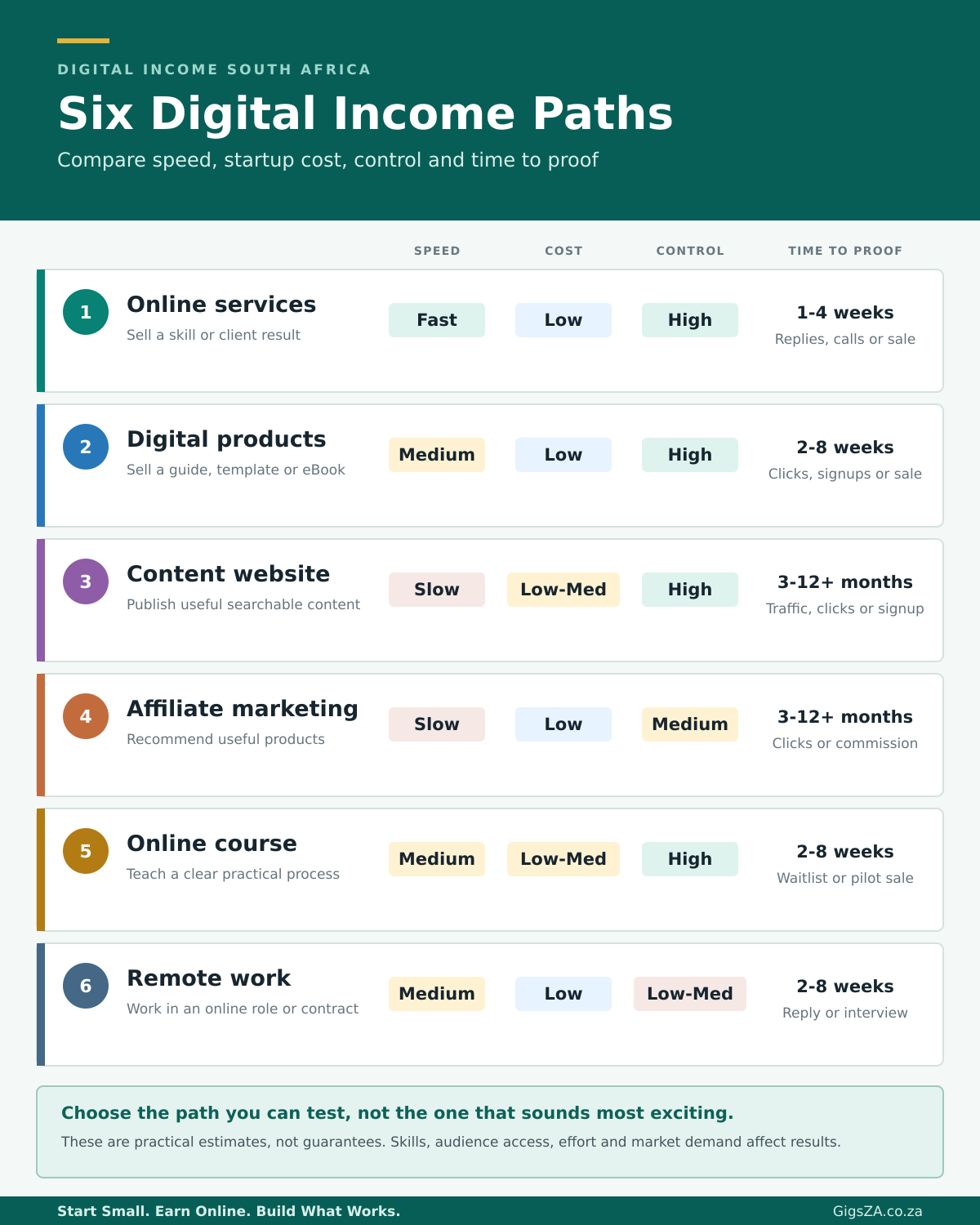
For many beginners, an online service is the quickest practical route to first income because you can start with an ability you already have. Examples include freelance writing, virtual assistance, admin support, basic design, social media support, research, editing, customer support, simple consulting and CV or LinkedIn profile help.
Best for: People with a usable skill, workplace experience or the ability to complete a clear task for someone else.
First proof: A reply, price request, booked call, sample request or payment for a small task.
Advantages
- Low startup cost
- No product needed before selling
- Potentially faster route to first income
- Useful for people with workplace experience
Trade-offs
- You are initially selling time
- Outreach requires confidence
- Early income can be inconsistent
Path 2
Create a simple digital product
A digital product packages useful knowledge or a repeatable process into something people can access online. It could be an eBook, template, checklist, planner, worksheet, guide or small toolkit. The strongest products usually solve one specific problem for one clear audience.
Best for: People who can organise knowledge, experience or a useful process into a practical resource.
First proof: Sample downloads, email signups, product-page clicks, direct requests or a first sale.
Advantages
- Can be sold more than once
- Builds a reusable digital asset
- Works well with content and email
Trade-offs
- Trust and traffic take time
- Validation may be slower
- It is easy to overbuild before testing
Path 3
Build a content website
A niche blog, helpful guide site, comparison site or topic hub can become a long-term digital asset. Useful content can attract search visitors and support eBooks, services, email lists, affiliate offers and other products. This route rewards consistency more than speed.
Best for: People who enjoy writing, researching, explaining and publishing consistently.
First proof: Search impressions, clicks, returning visitors, email signups, product clicks or affiliate clicks.
Advantages
- Builds a long-term owned asset
- Supports several income models
- Can grow authority over time
Trade-offs
- Search growth is usually slow
- Consistent publishing is required
- It is unsuitable for urgent income needs
Path 4
Use affiliate marketing
Affiliate marketing means recommending useful products, tools, services or platforms and earning a commission when someone takes an eligible action through your link. It works best when the recommendation is part of genuinely helpful content, not when links are posted without context or trust.
Best for: People who understand a niche and can create useful content for a defined audience.
First proof: Link clicks, signups, enquiries, affiliate dashboard activity or a commission.
Advantages
- No product required at the start
- Fits websites, email, video and social content
- Useful when you know an audience’s problem
Trade-offs
- Traffic and trust are essential
- Commissions may be small or delayed
- Programs and terms are outside your control
Path 5
Create a simple online course
A course does not have to begin as hours of recorded video. A mini-course, paid workshop, practical tutorial or small training module can test whether people want a specific learning outcome. Courses are usually stronger after you have seen evidence that people need and value what you can teach.
Best for: People who can teach a clear process and have some proof that others want to learn it.
First proof: Training requests, free-session attendance, waiting-list signups or payment for a pilot workshop.
Advantages
- Fits teaching and training strengths
- Can become a higher-value product
- Delivers a clear learning outcome
Trade-offs
- Often overbuilt before demand exists
- Requires trust and structure
- A workshop or guide may be a better first test
Path 6
Remote work and online job income
Digital income does not always mean starting a business. Remote jobs, online admin roles, customer support, content roles, remote sales, tutoring and contract work can offer a more structured route. You earn through a role or contract rather than first building an audience or product.
Best for: People who prefer defined responsibilities, structured work and greater potential stability.
First proof: Profile views, application responses, interview invitations, trial tasks or a first contract.
Advantages
- Clearer work structure
- Can be steadier than a new business
- Builds on existing job experience
Trade-offs
- Applications can be competitive
- Income depends on employer demand
- You have less control than with your own offer
Compare Your Options
Use this simple decision table
| Your situation | Best first path to consider |
|---|---|
| You need income sooner | Online services or freelancing |
| You have useful knowledge to package | eBook, guide, checklist or template |
| You enjoy writing and research | Content website or focused blog |
| You understand certain tools or products | Helpful affiliate content |
| You can teach a clear process | Mini-course or paid workshop |
| You prefer structured work | Remote job or online contract |
| You are unsure and cautious | A small offer test with little upfront cost |
Reduce Early Risk
What path should most beginners avoid starting with?
Be cautious of models that require too much money, traffic, technical setup or confidence before you receive useful feedback. That does not mean these models can never work. It means they may be poor first tests for a person with limited resources.
- Dropshipping without research or budget: product, supplier, delivery and advertising problems can appear before demand is proven.
- Paid ads before validation: advertising can make an unclear offer lose money faster.
- Complex funnels: automation is not useful when you do not yet know what message or offer works.
- An expensive website before testing: a simple conversation, post or landing page may provide the first evidence.
- A large course without audience proof: pilot the outcome through a workshop, checklist or short guide first.
- A full brand before a clear offer: a polished identity cannot replace a useful solution.
- AI side hustles without a buyer problem: the tool is not the offer; the useful result is.
Follow Evidence
Choose based on proof, not excitement
Excitement is useful for starting, but it is unreliable as a business compass. Proof gives you something firmer. A reply shows that your message reached a concern. An enquiry suggests interest. A click, signup or request shows that someone took a small action. A sale is strong proof that a person valued the result enough to pay.
Silence is also feedback. It may mean the audience is wrong, the problem is unclear, the offer is too broad or the message needs work. It does not automatically mean you should abandon digital income. It tells you what to question next.
The best first path is not always the one that sounds most exciting. It is the one you can test with the least waste and the clearest feedback.
This is the idea behind Build Proof Before You Build Big: use real responses to guide what deserves more time and money.
Johan chooses the most testable path
Johan has worked in operations and administration for years. He wants to earn online but keeps moving between affiliate marketing, dropshipping and digital products. Each option sounds promising, yet he never stays with one long enough to learn anything.
After reviewing his starting point, Johan notices that his strongest assets are not an audience, advertising budget or technical setup. They are his ability to organise documents, follow up with clients and turn untidy information into clear process checklists.
He defines a small service for local businesses that need help with basic admin documents and client follow-ups. Instead of building a website, he messages three business contacts and publishes one LinkedIn post. Two people ask what he charges.
The lesson: Johan did not choose the most exciting path. He chose the path he could test using skills and relationships he already had. Two enquiries became his first proof.
Decision Tool
The 5-question path test
Use these questions before committing to your first path:
- 1
Can I explain this path simply in one sentence?
- 2
Can I start testing it without spending much money?
- 3
Do I already have some skill, knowledge or interest connected to it?
- 4
Can I reach at least five people who might care about this?
- 5
Can I measure some form of proof within 30 days?
If your answers are mostly yes, the path may be suitable for a first test. If they are mostly no, simplify the idea. Reduce the audience, shorten the offer or choose a path closer to skills and contacts you already have.
Recommended Guide
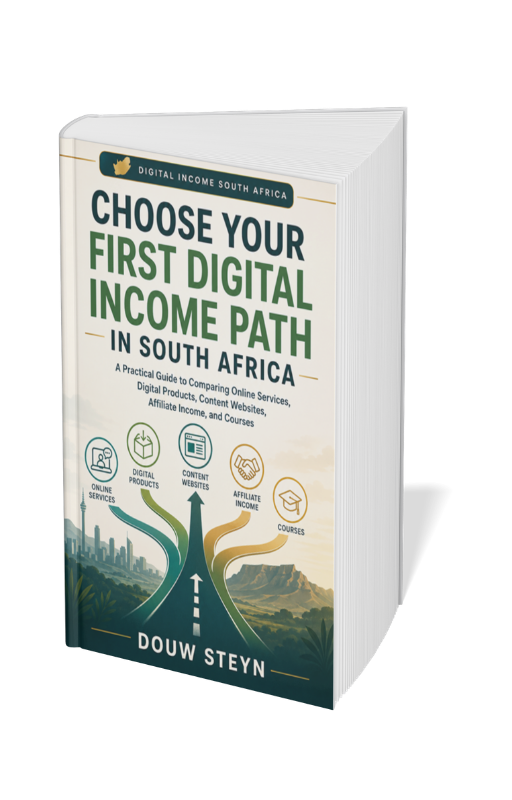
Choose Your First Digital Income Path in South Africa
If this article helped you compare the options, the full guide gives you a more structured way to decide what to start with, what to avoid, and how to choose one realistic path to test first.
- Compare online services, digital products, content websites, affiliate income, courses and remote work.
- Match each path to your skills, time, budget and confidence level.
- Choose a practical next step instead of jumping between ideas.
Take the Next Step
What to do after choosing a path
-
1
Write a one-sentence path statement
Name what you will test instead of describing a broad ambition.
-
2
Define who it is for
Choose a reachable group with a recognisable need.
-
3
Create one small offer
Offer a focused service, resource, workshop or next step rather than a complete business ecosystem.
-
4
Test it with a small audience
Start with five relevant people, one useful post, a simple landing page or a small pilot.
-
5
Track proof and respond
Record replies, clicks, signups, enquiries and sales. Improve, narrow or change the offer based on the response.
“I will test a simple online service for small business owners who need help turning messy notes into clear service descriptions.”
“I will test a downloadable checklist for South Africans who want to compare digital income paths before spending money.”
Once you have chosen a path, the next task is to shape Your First Online Offer and test whether people respond.
Free Practical Resource
Still unsure where to start?
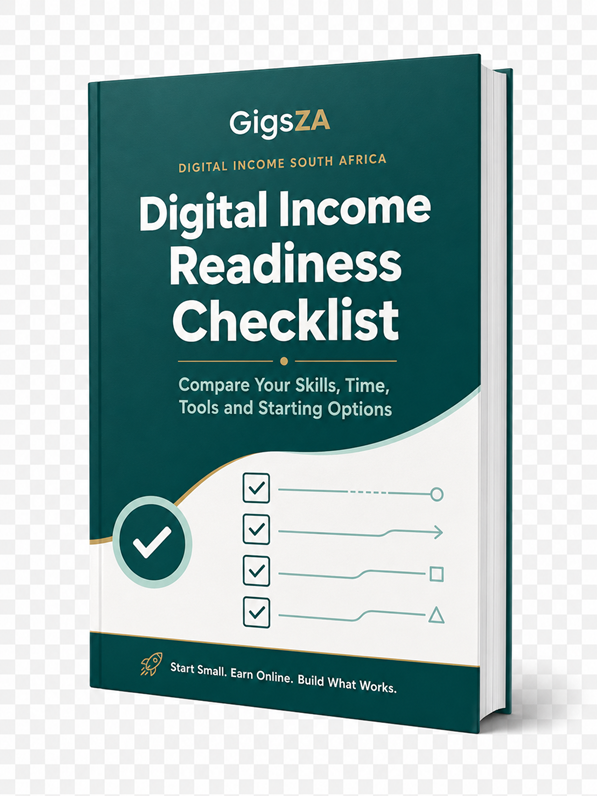
Use the free Digital Income Readiness Checklist to compare your skills, available time, tools, confidence and possible starting options before choosing your first path.
Download the Free ChecklistSimple, practical and designed for South African beginners.
Questions Beginners Ask
FAQs about choosing a digital income path in South Africa
What is the best digital income path for beginners in South Africa?
For many beginners, selling a simple online service is the fastest path to useful feedback because it can start with skills you already have. Digital products, content websites, affiliate marketing and courses can work too, but they usually need more trust, traffic or testing time.
Should I start with freelancing or digital products?
Start with freelancing if you need feedback or income sooner and already have a usable skill. Start with a digital product if you can package a specific problem into a guide, checklist, template or toolkit and you have a way to reach the right audience.
Do I need a website before choosing a digital income path?
No. A website can help later, but your first test can often happen through WhatsApp, LinkedIn, email, a simple PDF, a one-page offer or direct conversations with potential buyers.
How do I know if an online income idea is worth continuing?
Look for proof. Useful proof can include replies, enquiries, downloads, signups, product-page clicks, booked calls or sales. If nobody responds, adjust the audience, offer or message before building more.
Which paths should cautious beginners avoid at first?
Be careful with paths that require large upfront spending, paid ads, complicated funnels, expensive tools or a full brand before you have evidence that people want the offer.

Final Thoughts
Your first path only needs to be testable
Do not choose only because a model is trending, an influencer promotes it or the finished business looks impressive. Choose something you can explain, begin with limited risk and place in front of real people.
Start small. Look for proof. Then use what you learn to deepen the path, improve the offer or move to a better fit. The right Bootstrap guide can help you build once the evidence tells you what deserves building.
Your first digital income path does not need to be perfect. It needs to be clear enough, small enough and realistic enough to test.