Digital Income South Africa

Why Most South Africans Don’t Start Earning Online Even When They Want To

Many South Africans are interested in earning online, but never take the first real step. The problem is often not laziness or a lack of ambition. It is confusion, distrust, financial risk, technical overwhelm, and not knowing which first step is safe.

  • Built for South African beginners
  • Low-risk, practical guidance
  • No instant-income promises
South African beginner comparing realistic online income opportunities while working on a laptop at home.

Written by: Douw Steyn, founder of GigsZA

Updated: June 2026

Reading time: About 12 minutes

Wanting to earn online and knowing how to begin are different things

Many South Africans want to earn online. They read posts, watch videos, save ideas, download guides, and talk about starting. But when it is time to take the first concrete step, many pause.

That pause is easy to misread. From the outside, it may look like procrastination. From the inside, it often feels more complicated: Which option is real? What if I waste money? Do I need a website? What if nobody buys? Am I technical enough? What will people think?

These are not foolish questions. The online income space can be noisy, risky, and difficult to evaluate. A beginner may encounter remote work, freelancing, digital products, affiliate marketing, e-commerce, content creation, and AI services in a single afternoon. Each path can appear promising, but each comes with different skills, costs, timelines, and risks.

The online income dream is attractive, but the first step feels risky

The attraction is understandable. Household budgets are under pressure, traditional employment does not always provide enough security, and many people want more flexibility. Working from home, building a side income, serving international clients, or selling something digital can feel like a practical way to create more options.

There are also more visible pathways than before. A person might offer a service as a virtual assistant, apply for remote work, create an eBook, sell a template, help a small business use AI, or earn commission by recommending useful products.

But attraction does not automatically lead to action. The beginner wants possibility, but also safety. A model can sound exciting while the first move still feels unclear, expensive, or personally exposing.
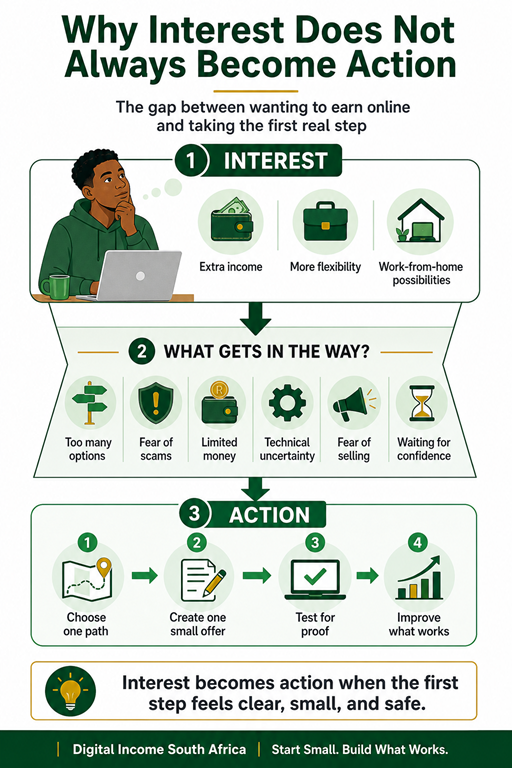
Infographic showing how confusion, scams, financial concerns, technical uncertainty, fear of selling, and low confidence can stop online income interest from becoming action.
Why interest in earning online does not always lead to action.

Seven barriers that stop South Africans from starting

Too many options create confusion

A beginner can choose from freelancing, virtual assistance, eBooks, templates, online courses, affiliate marketing, dropshipping, blogging, YouTube, AI services, digital marketing, or remote work. Having options is useful, but too many options can produce analysis paralysis.

The real question is not which model looks most exciting. It is which path fits your current skills, available time, tools, budget, and confidence. Without a way to compare those factors, research becomes an endless loop rather than preparation for action.

The Digital Income South Africa hub is designed to help beginners understand these paths without treating every option as equally suitable for every person.

Fake-guru hype has damaged trust

Unrealistic income claims, “quit your job” messaging, passive-income promises, flashy screenshots, and AI side-hustle hype have made the online income space difficult to trust. Some advice also ignores South African realities such as local buying power, payment options, data costs, and access to platforms.

The problem is not that South Africans do not believe online income is possible. The problem is that they do not always know whom to trust.

Many cautious people are not negative about digital income. They are trying to avoid being fooled. Good guidance should therefore explain the effort, uncertainty, costs, and limitations alongside the opportunity.

Fear of wasting money is real

When disposable income is limited, paying for software, advertising, a website, a course, or a monthly platform before earning anything can feel irresponsible. The beginner may also worry about buying a course and never completing it, or paying for tools that turn out to be unnecessary.

This is why a low-risk start matters. Your first test should not require a large financial commitment. Begin with the tools you already have where possible, and spend only when a real need or an early sign of demand justifies it.

Learn how to Build Proof Before You Build Big before committing money to a polished system.

Many beginners do not see themselves as “digital entrepreneurs”

People may see themselves as employees, job seekers, parents, retrenched professionals, students, or ordinary side-hustlers. The word “entrepreneur” can feel too large. It may suggest confidence, risk-taking, technical expertise, and a polished public identity that the beginner does not yet have.

You do not need to adopt a grand new identity before you begin. The first shift is smaller: see yourself as someone who can identify a useful problem and test a possible solution.

You do not need to become a guru. You need to become someone who can test a small offer.

Technical uncertainty becomes emotional uncertainty

Websites, payment links, PDFs, product pages, email lists, Canva, online stores, SEO, social media, digital downloads, and AI tools can make a simple idea feel like a major technical project.

Most of these tools are learnable. The deeper problem is that beginners often interpret a temporary skills gap as evidence that they are personally not ready. “I have not learned this yet” becomes “I am not technical enough.” A normal mistake becomes something to fear.

Starting small reduces both technical and emotional pressure. You may need only a clear description of your offer, a way for someone to contact you, and a simple method of delivering the work.

Fear of visibility and selling

Many guides explain how to create a product or service but say little about the emotional difficulty of sharing it. Posting online, asking for money, sending a message, sharing a link, or promoting an offer can make a beginner feel exposed.

Friends, family, and colleagues may see the post. The beginner may fear being judged, ignored, or viewed as desperate. For many people, this is harder than making the product itself.

Online income usually requires some form of visibility. That is why the first offer should be small, clear, and safe enough to share.

Waiting for confidence before taking action

Beginners often wait to feel ready, know enough, find the perfect idea, have more money, or reach a quieter point in life. The waiting feels responsible, but it can continue indefinitely because confidence rarely arrives before experience.

Confidence usually follows a proof point: a reply, an enquiry, a download, a useful conversation, or a first sale. The goal is not to eliminate uncertainty before starting. It is to take a small enough step that uncertainty becomes manageable.

This is the central idea behind Start Before You Feel Ready: action creates the evidence that helps you make a better next decision.

What should South Africans do instead?

You do not need to solve your entire future before you start. You need a small, structured experiment that can teach you something useful without placing too much money, time, or confidence at risk.

The Start Small Pathway

  1. 1
    Choose one path Match it to your current reality.
  2. 2
    Create one small offer Make the value easy to understand.
  3. 3
    Test for proof Look for real signs of interest.
  4. 4
    Improve what works Build around traction, not hype.

Step 1: Choose one realistic path

Do not chase every promising idea. Compare possible paths using your existing skills, weekly time, available tools, budget, confidence, and access to potential customers. A service may suit someone who already has a useful skill and needs income sooner. A digital product may suit someone who can package knowledge but has time to build an audience.

Use Choose Your First Digital Income Path in South Africa to make a more grounded choice.

Step 2: Create a small offer

Your offer could be a focused service, short guide, template, checklist, digital product, or useful resource. It does not need to solve every problem. It needs to help a specific person achieve a clear result. Explore Your First Online Offer for practical starting ideas.

Step 3: Build proof before scale

Proof is broader than a sale. Look for replies, clicks, sign-ups, downloads, enquiries, referrals, conversations, and requests for a quote. These signals help you determine whether people understand the offer and care about the problem.

Step 4: Improve what shows traction

When something receives attention, resist the urge to abandon it for the next new idea. Improve the wording, price, delivery, or audience. A modest idea with evidence is usually more valuable than an exciting idea that has never been tested.
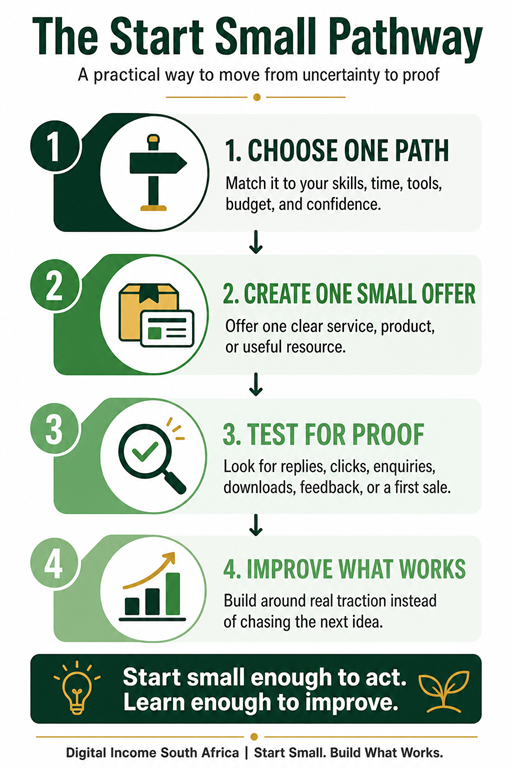
Infographic showing the Start Small Pathway: choose one realistic path, create a small offer, test for proof, and improve what works.
The Start Small Pathway for testing a realistic digital income idea.

Nomsa does not build a full business first

The following is a composite example created to illustrate the method.

Nomsa works full-time but needs extra income. She has useful administrative and writing skills. For months, she watches videos about digital products, affiliate marketing, and AI tools, but the number of options leaves her unsure where to start.

Instead of building a full website or paying for several tools, she chooses one small offer: helping local small business owners turn messy notes into clear service descriptions and short customer PDFs.

She writes a simple explanation of the service and shares it with three business owners she already knows. One asks how much she would charge. That enquiry does not guarantee a successful business, but it gives her something she did not have before: evidence that a real person can understand and value the offer.

Nomsa can now improve the offer, ask better questions, and test again. She did not need a full business first. She needed one small offer and a practical way to test it.

What not to do when you want to earn online

Do not start with expensive tools.

Use simple tools until a real need justifies an upgrade.

Do not buy every course.

Choose learning that supports the step directly in front of you.

Do not chase five ideas at once.

One tested path teaches you more than five unfinished plans.

Do not copy a foreign model blindly.

Check whether the audience, costs, platforms, and payments fit SA.

Do not confuse passive income with beginner income.

Most systems require active work before they become easier to run.

Do not build a large website before testing.

A polished site cannot rescue an offer nobody understands or wants.

Do not wait for perfect confidence.

Use a small test to build experience and reduce uncertainty.

Do not believe every income screenshot.

Revenue images rarely show costs, time, failures, or full context.

Ask a better first question

Instead of asking

“How do I make money online?”

Ask

“What small useful thing can I offer, test, and improve from where I am now?”

The first question is broad enough to send you in a dozen directions. The second question brings the decision back to your skills, circumstances, and the people you may be able to help. It gives you something concrete to test.

Start with the Digital Income Readiness Checklist

Before choosing a platform, business model, or tool, understand your own starting point. The free Digital Income Readiness Checklist for South Africans will help you compare your skills, time, tools, confidence, and possible income paths.

Download the Free Checklist
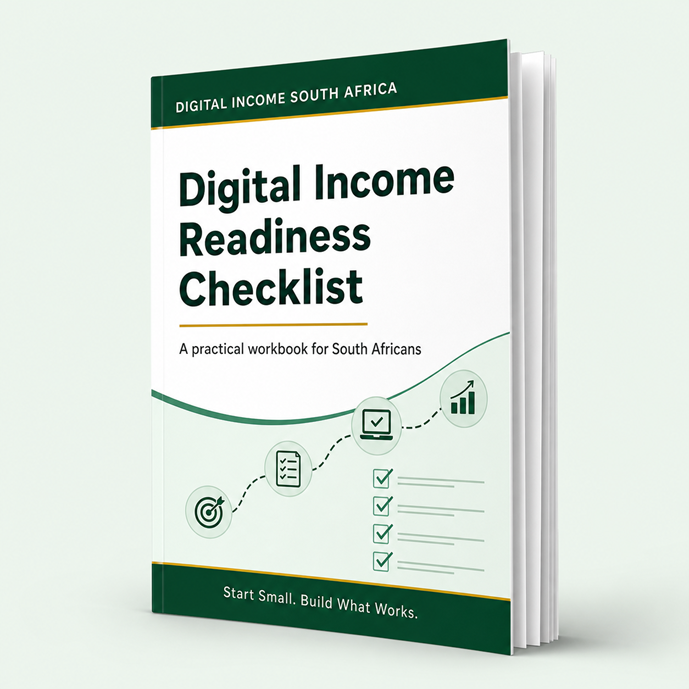
Digital Income Readiness Checklist workbook mockup for South Africans exploring realistic online income opportunities.

Final thoughts

Earning online is possible, but it is not automatic. It takes useful skills, testing, visibility, patience, and a willingness to improve. South African beginners do not need more exaggerated promises. They need local, realistic guidance that makes the first step understandable and proportionate to the risk.

Starting small is safer than overbuilding. Proof is more useful than motivation alone. Your first action should be simple enough to take this week and meaningful enough to teach you what to do next.

You do not need to feel ready to begin. You need one realistic path, one small offer, and one proof point that helps you decide what to do next.

Continue your digital income journey

Recommended next step

Want a Practical Guide to Building Digital Income in South Africa?

Digital Income South Africa is a practical eBook for South Africans who want to explore realistic online income paths without hype, guesswork, or instant-money promises.

  • Understand the main digital income paths available to South Africans
  • Choose a safer first step based on your skills, time, and resources
  • Avoid common mistakes before spending money or building too big
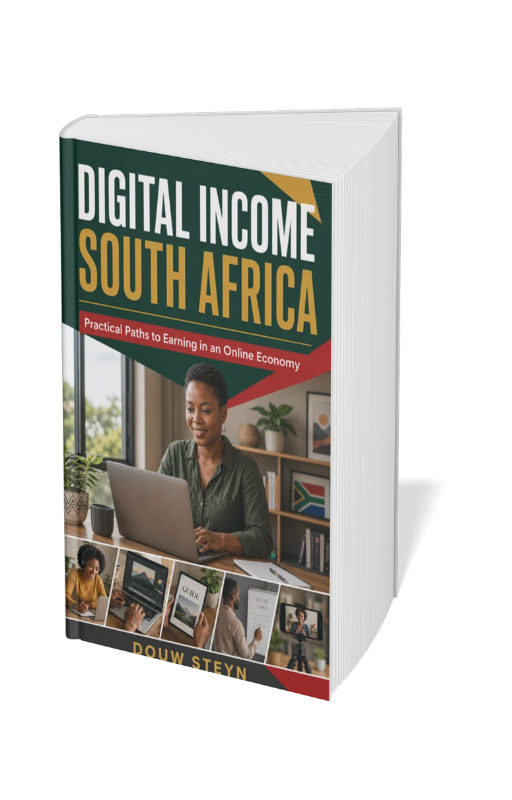
View the eBook
Digital Income South Africa eBook cover mockup

Leave a Comment

Your email address will not be published. Required fields are marked *

Scroll to Top
Gigs ZA
Privacy Overview

This website uses cookies so that we can provide you with the best user experience possible. Cookie information is stored in your browser and performs functions such as recognising you when you return to our website and helping our team to understand which sections of the website you find most interesting and useful.