
Remote Work South Africa
Why Your Remote Work CV Is Not Just a CV Anymore
For South Africans applying for remote jobs, your CV and LinkedIn profile are no longer just application documents. They are your first interview, your first proof of trust, and often the reason you do or do not get noticed.
What this guide helps you understand
Many people can do the work. The problem is that their CV does not show it in a remote-friendly way. This article explains how to turn ordinary South African work experience into a clearer, more credible remote work profile.
Here is the uncomfortable part: many remote job applications do not fail because the person is lazy, unskilled or not serious. They fail because the employer cannot see enough evidence to feel safe saying, “Let us interview this person.”
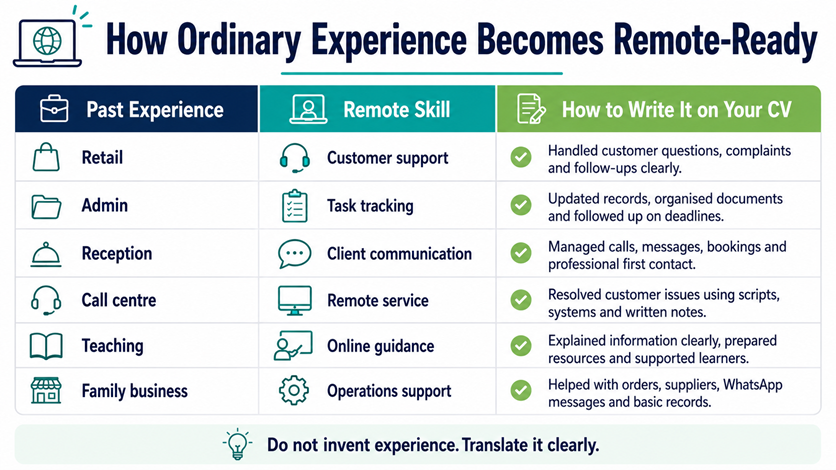
You may have worked in retail, reception, customer service, admin, logistics, teaching, a family business, a church office, a school office, a small shop, or a call centre. You may have handled people, pressure, records, WhatsApp messages, stock lists, spreadsheets, follow-ups and awkward customer questions. That is real experience.
But if your CV only says “hard-working, honest and able to work under pressure”, it hides the useful parts. Remote employers do not have time to guess what you mean. They want clues that you can communicate, follow instructions, use basic tools, manage your time and work without someone standing over your shoulder.
The shift is simple: a traditional CV says where you worked. A remote work CV must show how you work.
The Remote Employer Is Asking a Different Question
In a normal local job, an employer may rely on the interview, a walk-in meeting, a referral, or the fact that you live nearby. In remote hiring, that safety net is thinner. The employer may be in Cape Town while you are in Middelburg. Or in London while you are in Pretoria. Or in Durban while you are working from a small town with good fibre and a quiet desk.
That changes the question behind the application.
The employer is not only asking, “Can this person do admin?” They are asking, “Can this person do admin clearly, online, without confusion, without constant supervision, and without creating risk for my customers or business?”
That is why your CV and LinkedIn profile matter more in remote work. They are not decoration. They are trust signals.
Traditional CV vs Remote Work CV
A remote-friendly CV is not a fancy CV. It is a clearer CV. It removes vague claims and replaces them with useful evidence.
| Traditional CV | Remote Work CV |
|---|---|
| Lists job titles and duties. | Shows skills, tools, outcomes and how the work was done. |
| Uses broad phrases like “hard-working” and “team player”. | Uses specific proof such as “handled customer queries by email and WhatsApp”. |
| Focuses mainly on past employers. | Connects past experience to remote tasks such as inbox support, admin tracking, scheduling and written communication. |
| May use one CV for every application. | Is adjusted for the type of remote role being applied for. |
| LinkedIn profile may be empty or outdated. | LinkedIn confirms the same story as the CV and helps the employer trust the applicant. |
| Relies on qualifications and employment history. | Adds proof, examples, tools, short projects, portfolio links or practical evidence. |
A South African example
Nothing Was Wrong With Lerato’s Experience
Lerato lives in Welkom. For six years she worked as a receptionist and admin assistant at a local engineering company. She answered phones, booked appointments, updated spreadsheets, prepared invoices, followed up with suppliers and handled customer enquiries.
When the company downsized, she decided to look for remote work. She applied for more than forty positions over three months: virtual assistant jobs, customer support jobs and admin assistant jobs.
Almost nobody replied.
The problem was not her work ethic. Her CV described where she had worked, but not what she had actually done.
Old CV wording: “General administration duties.”
That may have made sense to someone who knew the company, but it told a remote employer almost nothing.
Better wording: “Managed email communication, updated customer records, scheduled appointments, prepared documents and maintained spreadsheets.”
Her LinkedIn headline also changed from “Looking for opportunities” to:
Nothing about her experience changed. Only the way it was presented.
Within a few weeks, she began receiving interview invitations. She still had to compete and nothing was guaranteed, but employers could finally see the value she had built through ordinary South African work experience.
Lesson: Do not invent experience. Translate it clearly.
Most South Africans Do Not Need to Invent Experience
This is where many beginners go wrong. They think they must sound more experienced than they are. That usually creates a strange CV: too many big words, too many claims, and not enough believable detail.
You do not need to pretend. You need to translate.
If you worked in retail, you may have customer communication, stock accuracy, point-of-sale experience, problem-solving and complaint handling. If you worked as a receptionist, you may have scheduling, inbox handling, telephone etiquette, client follow-up and record keeping. If you helped in a family business, you may have handled orders, supplier messages, invoices, WhatsApp enquiries or basic admin.
None of that is small. It only becomes small when your CV describes it badly.
Your LinkedIn Profile Is Where the Employer Checks the Story
LinkedIn does not need to make you look like a motivational speaker. It does not need daily posts, dramatic personal stories or fake confidence. For remote work, LinkedIn has a simpler job: it must confirm that you are a real, focused, professional person.
If your CV says you want remote customer support work, your LinkedIn headline should not only say “Looking for opportunities”. That sounds passive and unclear. A stronger version might be: “Customer Support and Admin Assistant | Email, WhatsApp and Client Communication | Remote Work Ready”.
That one line already tells a better story.
Your CV and LinkedIn profile should pass what I call the same-person test. If an employer reads your CV and then opens your LinkedIn profile, they should feel that both belong to the same focused applicant.
The Same-Person Test
Before applying for remote jobs, check whether your CV and LinkedIn profile agree on these points:
- Your target role or direction is clear.
- Your strongest skills appear in both places.
- Your work history does not contradict itself.
- Your contact details are professional and consistent.
- Your LinkedIn About section sounds like a real person, not a copied template.
- Your skills match the type of remote work you want.
- Your profile photo, headline and activity do not create unnecessary doubt.
Proof Is Becoming More Important Than Promises
The World Economic Forum’s Future of Jobs Report 2025 highlights how work is being reshaped by technology, AI and changing skills needs. That matters for South Africans because remote work is often part of this wider shift. Employers are looking for people who can adapt, communicate clearly and use digital tools with confidence.
This does not mean you need to become a software developer. It means you must show evidence that you can function in a digital workplace.
For a beginner, proof can be simple:
- A clean one-page CV written for a specific remote role.
- A LinkedIn profile with a clear headline, About section and skills.
- A small admin tracker you created in Google Sheets or Excel.
- A sample customer support reply written in a professional tone.
- A short portfolio page with examples of tasks you can do.
- A certificate connected to a real skill, not just a random course.
- A short LinkedIn post explaining what kind of remote role you are preparing for.
Important: proof does not always mean paid experience. Proof means the employer can see something concrete before they take a chance on you.
Stop Applying Like You Are Apologising
Many new remote work applicants write messages that sound like an apology before the employer has even responded.
They write: “I do not have experience, but I am willing to learn. Please give me a chance.”
The honesty is good. The positioning is weak.
A better message sounds calm and useful:
I have experience in customer communication, admin follow-up and working with written instructions. I am interested in remote support roles where accuracy, reliability and clear communication matter.
That version does not pretend. It does not beg. It gives the employer something to work with.
A Better Way to Rewrite Ordinary Experience
Here are examples of how to move from vague wording to remote-friendly wording:
Instead of this
Responsible for admin duties.
Write this
Managed daily admin tasks including customer records, follow-ups, document filing and basic spreadsheet updates.
Instead of this
Worked with customers.
Write this
Handled customer questions by phone and WhatsApp, explained product information clearly and followed up on unresolved queries.
Instead of this
Helped with office work.
Write this
Supported office operations by organising records, updating lists, preparing documents and communicating with clients and suppliers.
A 7-Day Remote CV and LinkedIn Upgrade Plan
You do not need to fix everything in one night. Use one week and make steady improvements.
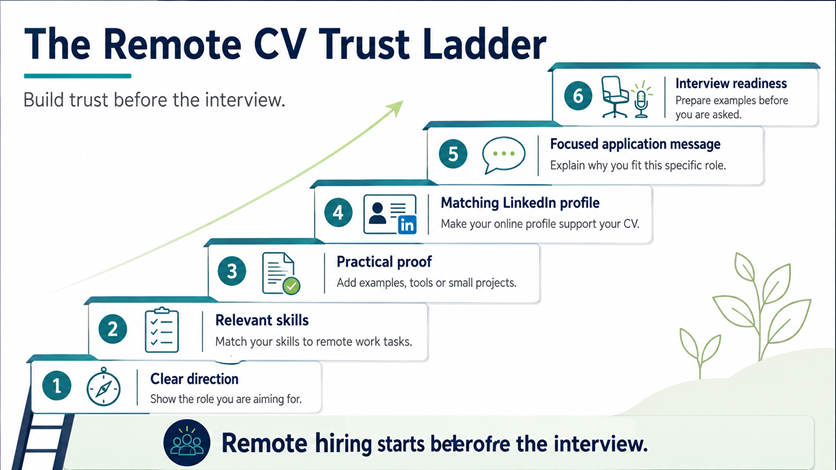
- Day 1: Choose one remote work direction, such as admin support, customer support, virtual assistant work, content support or research support.
- Day 2: Rewrite your CV summary so it speaks to that direction.
- Day 3: Translate your past duties into remote-relevant skills.
- Day 4: Add proof, examples, tools or small projects.
- Day 5: Update your LinkedIn headline and About section.
- Day 6: Check that your CV and LinkedIn profile tell the same story.
- Day 7: Apply to fewer jobs, but write better applications for each one.
Where This Fits Into Your Remote Work Journey
If you are still exploring remote work, start with the Remote Work in South Africa hub. If you are new and unsure where to begin, read the beginner reality check and the guide on remote work without experience in South Africa.
Once you know the kind of work you want, your CV and LinkedIn profile become your next serious step. They help you move from “I am interested in remote work” to “Here is what I can do, and here is why you can trust me.”
Practical guide
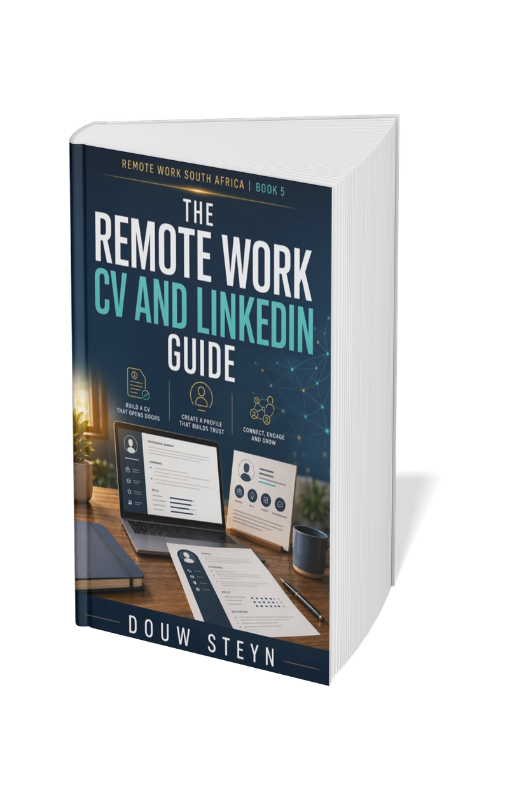
The Remote Work CV and LinkedIn Guide
If you want a step-by-step guide built for South Africans, this book helps you choose a remote work direction, rewrite your CV, improve LinkedIn, create proof when you have no remote experience, and apply with more confidence.
View the GuideFrequently Asked Questions
What makes a remote work CV different from a normal CV?
A remote work CV must show how you communicate, manage tasks, use digital tools and work independently. It should connect your past experience to the type of remote role you want.
Do I need remote work experience before applying?
No. But you do need proof that you can handle remote-style tasks. This can include admin examples, customer communication, spreadsheet work, short projects, training or portfolio samples.
Should South Africans use LinkedIn for remote jobs?
Yes. LinkedIn helps employers check whether your CV story is credible. A clear headline, About section, skills list and work history can make your application feel more trustworthy.
Can I use the same CV for every remote job?
You can use the same base CV, but you should adjust the summary, skills and examples for each type of role. A virtual assistant CV should not read exactly like a customer support CV.
What if I only have retail, admin or call centre experience?
That experience can still be useful. The key is to translate it into remote-relevant language, such as customer communication, follow-ups, scheduling, record keeping, problem-solving and written communication.