
Pricing & Profit South Africa
How to Price Your Products and Services for Profit in South Africa
Many South African small business owners are busy, but still have too little money left at the end of the month. This guide helps you calculate your real costs, protect your margins, and price your products or services with more confidence.
Written for South African freelancers, side hustlers, service providers, product sellers, and small business owners.
The real problem
A South African pricing story
Nomsa Was Fully Booked, But Still Broke
Nomsa runs a small home-based baking business in Pretoria. Her WhatsApp is busy every week. She makes birthday cakes, office cupcakes, and small platters for family events. People love her work because she is reliable, friendly, and always willing to help.
For a while, it looked like the business was growing. Orders were coming in. Friends were referring her. Some weekends she worked late into the night to finish everything on time.
But when she checked her bank account at the end of the month, the money was not there. She had bought ingredients, packaging, electricity, data, petrol for deliveries, and extra supplies when clients changed their minds. She had also spent hours on WhatsApp confirming colours, flavours, delivery times, and last-minute requests.
On paper, she was making sales. In reality, she was not charging enough to cover the full cost of doing the work. Her price included flour, sugar, and eggs, but not her time, packaging, admin, delivery, risk, or profit.
The problem was not that Nomsa needed to work harder. She was already working hard. The problem was that her pricing made every new order feel like progress while quietly draining her cash.
This is why pricing matters. A business can look busy from the outside and still be weak underneath. Until the numbers are clear, more customers can simply mean more pressure.
Being Busy Is Not the Same as Being Profitable
Many small business owners price by guessing. They look at what competitors charge, pick a number that “feels fair,” and hope there will be enough money left after the work is done.
That is where the damage starts. If you forget petrol, WhatsApp time, packaging, payment fees, admin, revisions, delivery, risk, and your own time, you can make sales while quietly losing profit.
More sales at the wrong price do not fix the business. They can make the problem worse because every new order brings more work, more pressure, and more hidden costs.
Pricing basics
What Should You Include When Pricing a Product or Service?
Direct costs
Materials, stock, packaging, ingredients, labour, fuel for a specific job, or anything clearly linked to one sale.
Indirect costs
Data, airtime, tools, software, advertising, bank fees, accounting, admin, and the costs that keep the business running.
Your own time
Your labour has value, even if you are not paying yourself a formal salary yet.
Delivery and travel
Petrol, parking, courier fees, vehicle wear, and the time spent getting work or products to the customer.
Payment fees
Card, payment gateway, EFT, banking, and platform fees must be included somewhere in your pricing.
VAT where applicable
If VAT applies to your business, remember that VAT collected is not the same as profit.
Profit margin
Profit is what allows the business to survive, improve, replace equipment, and grow.
Risk and rework
Mistakes, complaints, revisions, late changes, replacements, and redo work must be priced into the model.
Deposits and late payments
Payment terms protect cash flow and stop your business from financing other people’s delays.
South African context
Why Pricing Is Different in the South African Small Business Reality
South African entrepreneurs often deal with costs that do not appear in simple pricing formulas: petrol, local delivery, load-shedding backup, mobile data, WhatsApp communication, EFT delays, late payers, bank fees, and customers asking for discounts.
If you use Yoco, PayFast, SnapScan, Ozow, card payments, couriers, delivery drivers, mobile data, paid software, or your personal vehicle, those costs belong in your pricing thinking. If you ignore them, they come out of your pocket.
Featured guide
About the Book: How to Price Your Products and Services for Profit
This practical guide helps South African entrepreneurs move from guesswork to structured pricing. It explains how to calculate real costs, work out break-even, price products and services, raise prices, handle discounts, create a price sheet, and communicate pricing without panic or apology.
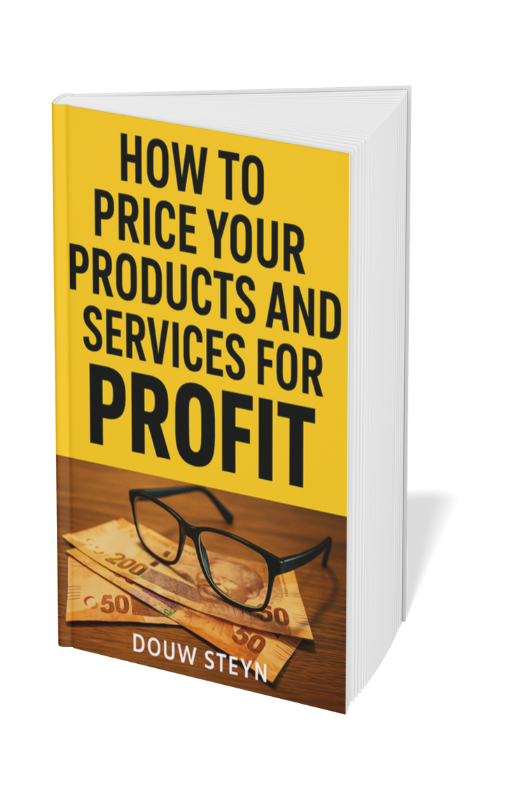 ZAR 179
Inside the guide
What You’ll Learn Inside the Guide
- How to calculate the real cost of doing business
- Why your time must be included in your price
- How to calculate break-even
- How to price physical products
- How to price services and creative work
- How to compare competitors without becoming the cheapest
- How and when to raise prices
- How to use discounts without destroying profit
- How to explain your price to clients
- How to create a simple price sheet
Audience
Who This Pricing Guide Is For
Practical tools
Practical Pricing Tools Included
Cost and margin calculator
Work out what a job or product really costs before you set the selling price.
Break-even calculator
See how many sales, clients, or packages you need to cover your monthly costs.
Starter price sheet
Create a clearer document to send to clients instead of quoting casually.
WhatsApp quote script
Respond to price questions and objections without dropping your price too quickly.
Annual price review checklist
Review fuel, suppliers, workload, demand, and positioning before prices become outdated.
30-day cash flow tracker
Track real money in and out so pricing decisions are based on reality.
FAQ
Pricing Questions South African Business Owners Ask
How do I price my products in South Africa?
Start by calculating your direct costs, indirect costs, time, payment fees, delivery costs, VAT if applicable, and target profit margin.
How do I price a service business?
Include your time, skill, travel, admin, client communication, revisions, tools, risk, and profit margin.
Should I charge hourly or package pricing?
Hourly pricing can work in some cases, but many service providers benefit from structured packages because the client understands the outcome more clearly.
How do I know if I am undercharging?
If you are always busy but still have little money left, struggle to pay expenses, avoid taking time off, or cannot afford help, your pricing may be too low.
How often should I raise my prices?
Review your prices at least once a year, or sooner if fuel, supplier costs, workload, rent, software, or demand increases.
Explore more
Related GigsZA Resources
Next step
Ready to Stop Guessing Your Prices?
If your business is getting enquiries, sales, or clients but the money still feels too thin, this guide will help you see the numbers more clearly and price with more confidence.
Get How to Price Your Products and Services for Profit