

Is Making Money Online in South Africa Actually Real?
A grounded, myth-busting guide for ordinary South Africans trying to separate legitimate online opportunity from internet hype.
Thabo finished high school two years ago.
Like many young South Africans, finding permanent work hasn’t been simple.
He lives with his mother in Soweto. He has a smartphone. There’s free Wi-Fi nearby, so data isn’t always the biggest barrier.
What he does have is time, curiosity, and the same question millions of people have asked:
So he searches.
- how to make money online South Africa
- online jobs from home
- ways to earn money with a phone
The results are overwhelming.
One website promises passive income.
Another says anyone can make thousands working from home.
A video claims you can start with no skills.
A WhatsApp-style advert says your income can be “guaranteed” if you just pay a registration fee.
Someone on TikTok flashes payment screenshots.
Someone else claims they made more in a week than most people earn in a month.
After a while, it all starts sounding the same.
Different people. Different platforms. The same promise.
Fast money. Easy money. Secret systems. Limited-time opportunities.
Eventually, skepticism takes over.
Thabo starts thinking what many South Africans think:
And honestly?
That’s not an unreasonable conclusion.
Because if your only exposure to making money online is scammy ads, fake urgency, and social media bait, of course the whole idea starts to feel dishonest.
But here’s the important distinction:
Every day, ordinary people earn legitimate income online by freelancing, selling digital products, offering services, building content businesses, generating leads, consulting, and using the internet as a practical business tool—not a magic money machine.
The problem is that the loudest voices online are often the least trustworthy.
So this article asks a simple question:
Is making money online in South Africa actually realistic for ordinary people—or is it mostly hype?
Let’s separate myth from reality.
Why South Africans Are So Skeptical About Making Money Online
Thabo keeps scrolling.
One ad says:
Classic bait examples
“Earn R500 a day from your phone.”
“Immediate approval.”
“Inbox me for the secret method.”
At first, it almost feels exciting.
Maybe there really is something here.
Maybe everyone else figured something out.
Maybe he’s late to the party.
But then the patterns start repeating.
Different names. Same promises.
Different websites. Same countdown timers.
Different mentors. Same pressure.
- Pay first
- Register now
- Limited spots
- Guaranteed income
- No experience needed
- No risk
And slowly, curiosity turns into suspicion.
When “Opportunity” Starts Looking Like a Trap
Maybe it was someone in the neighbourhood who joined a forex group.
Maybe a cousin paid money into some “investment platform.”
Maybe somebody posted screenshots showing profits that later turned out to be fake.
In South Africa, stories like these spread quickly.
And they leave scars.
After enough stories, making money online stops sounding like entrepreneurship.
It starts sounding like trouble.
That matters.
Because once trust is broken, legitimate opportunities get thrown into the same pile as scams.
Freelancing? Probably fake.
Selling online? Sounds suspicious.
Remote work? Must be a scam.
Digital business? Maybe just another buzzword.
Social Media Made the Problem Worse
Thabo opens TikTok.
A man in designer clothes talks about financial freedom.
Another shows luxury cars.
Someone flashes payment notifications.
One creator claims he made more money in a week than most working South Africans earn in a month.
No explanation.
No business model.
No details.
Just performance.
And that’s the problem.
Social media rewards spectacle.
Not transparency.
The loudest people online are often not the most credible.
The people quietly making legitimate income through online business usually aren’t posting fake screenshots every afternoon.
They’re working.
So Why Do So Many People Still Fail Online?
By now, Thabo feels something he hasn’t felt in a while:
Not hype.
Not fantasy.
Just possibility.
Maybe the internet isn’t the scam.
Maybe he’s simply been looking in the wrong places.
But then another thought arrives.
If legitimate online income is real… why do so many people still fail?
It’s a fair question.
Because for every real success story, there seem to be dozens of abandoned attempts.
- Dead TikTok side hustles
- Half-built websites
- Unused Canva templates
- Courses never finished
- Domain names bought in excitement and forgotten weeks later
Mistake #1: Chasing Fast Money Instead of Real Opportunity
Thabo types:
That single mindset sends many people in the wrong direction.
Because urgency changes judgment.
Fast-money thinking creates vulnerability.
- Miracle systems
- Fake investment schemes
- Shady remote work offers
- Expensive vague mentorships
- Recycled “secret methods”
Legitimate businesses usually sound less exciting.
Mistake #2: Jumping From One Business Model to Another
Monday: Dropshipping.
Wednesday: Affiliate marketing.
Next week: AI agency.
Then crypto.
Then print-on-demand.
The internet always has a new “best opportunity.”
Momentum comes from focus—not constant switching.
Mistake #3: Confusing Watching With Working
Thabo spends three hours watching YouTube videos about online business.
He learns terminology.
He takes notes.
He compares ideas.
It feels productive.
But nothing has changed.
- No offer created
- No client contacted
- No product built
- No real test launched
Mistake #4: Refusing to Learn Selling
Many readers hate the word selling.
Pushy. Manipulative. Desperate.
But every legitimate business sells something.
- A service
- A skill
- A solution
- A product
- Trust
If Thabo becomes a freelance writer, he must convince someone to hire him.
No selling = no business.
Mistake #5: Quitting Before Reality Has Time to Work
The first few weeks are often quiet.
No traction.
No sales.
No validation.
That silence can feel brutal.
This is often where people say:
Often, the truth is simpler:
Mistake #6: Buying Tools Before Building a Business
Thabo gets excited.
He buys:
- Premium AI tools
- Hosting
- Domains
- Email software
- Subscriptions
- Design tools
Before earning a single rand.
Buying tools can feel productive.
Sometimes it’s just expensive procrastination.
How to Spot an Online Scam Before It Costs You Money
Now Thabo understands something important.
Legitimate online income exists.
Which creates a new problem:
Red Flag #1: Guaranteed Income
No legitimate business can promise guaranteed income to strangers.
Business involves uncertainty.
Scammers remove uncertainty because certainty sells.
Red Flag #2: Pay First to Unlock Income
Thabo sees:
- Registration fee required
- Activation payment needed
- Small joining fee before earning
Courses can be legitimate.
Paying for vague income promises is different.
Red Flag #3: No Clear Business Model
Ask simple questions:
- How is money made?
- Who pays?
- What value is exchanged?
- What problem is solved?
If the explanation is vague, that’s a warning sign.
Red Flag #4: Extreme Urgency
- Only 5 spots left
- Offer expires in 10 minutes
- Act now
- Don’t miss out
Artificial panic is a classic manipulation tactic.
Red Flag #5: Selling the Dream
Ask:
Red Flag #6: Fake Social Proof
Screenshots can be edited.
Testimonials can be invented.
Comments can be coordinated.
Trust should come from clarity—not visual noise.
Red Flag #7: No Real Skill, Product, or Service
If you remove the marketing language, what remains?
- A skill?
- A product?
- A deliverable?
- A service?
If nothing concrete remains, something is wrong.
Legit Ways South Africans Can Actually Make Money Online
For the first time, Thabo stops thinking about scams.
And starts thinking about possibilities.
Not fantasy.
Actual possibilities.
1. Freelancing
One of the most realistic starting points.
- Writing
- Design
- Virtual assistance
- Research
- SEO support
- Social media support
Low startup cost. Fast validation.
2. Selling Digital Products
- CV templates
- Guides
- Prompt packs
- Planners
- Toolkits
Create once. Sell multiple times.
3. Affiliate Marketing
The legitimate version depends on trust.
Not spam links.
Real recommendations. Real content. Real audience building.
4. Social Media Services
Small businesses need help.
- Posting content
- Replying to messages
- Promotions
- Basic design
5. Lead Generation
Businesses always need customers.
Helping them get leads creates value.
6. AI-Assisted Services
AI didn’t remove opportunity.
It changed workflows.
Businesses still need execution.
7. Online Education
If you know something useful, knowledge can become a business.
But value must come first.
So What Does It Actually Cost to Start?
Thabo has heard the phrase his whole life:
And in some situations, that’s true.
You cannot open a supermarket with R200.
You cannot launch a logistics company with pocket change.
But online business is different.
Not free. Different.
That distinction matters.
Because one of the biggest myths keeping people stuck is the assumption that every online opportunity requires serious capital.
Some Businesses Require Almost Nothing to Start
Take freelancing.
If Thabo learns a useful skill and finds a client, what does he really need?
- Internet access
- A communication tool
- Time
- Basic learning resources
A smartphone alone can be enough to begin certain service-based work.
Not ideal forever.
But enough to start.
Other Models Need Small Investment
Digital products might need:
- Basic design tools
- A storefront
- Delivery systems
- Payment setup
But beginners often overbuild far too early.
The Dangerous Spending Trap
Thabo gets excited.
Suddenly he buys:
- Premium AI subscriptions
- Hosting
- Domains
- Business email
- Automation tools
- Online courses
Within days, he has spent money—but still has no business.
Buying tools can feel like progress.
Rough Startup Reality Check
Freelancing
Startup cost: Very low
Biggest investment: Time + skills
Digital Products
Startup cost: Low to moderate
Biggest investment: Creation + marketing
Affiliate Marketing
Startup cost: Low to moderate
Biggest investment: Patience
Lead Generation
Startup cost: Moderate
Biggest investment: Learning + consistency
Which Online Business Model Actually Fits Someone Like Thabo?
By now, Thabo understands something important.
Online business is not one thing.
It’s an ecosystem.
Which creates a different problem:
If Thabo Needs Money Sooner Rather Than Later
Service-based models make more sense.
- Freelance writing
- Admin support
- Virtual assistance
- Social media support
- Research assistance
These models create faster paths to revenue because value is exchanged directly.
- You need income sooner
- You’re willing to work with clients
- You’re open to learning a skill
If Thabo Likes Creating Useful Things
Digital products become interesting.
- Templates
- Guides
- Toolkits
- Prompt packs
- Downloads
- You enjoy creating
- You think in systems
- You can tolerate slower traction
If Thabo Is Comfortable Building Trust Publicly
Affiliate marketing and content businesses depend heavily on trust.
- You enjoy content
- You communicate clearly
- You’re patient
If Thabo Notices Problems Businesses Have
This is entrepreneurial thinking.
Instead of asking:
He starts asking:
This leads toward:
- Lead generation
- Agency services
- Consulting
- Automation support
What If Thabo Has No Experience, No Portfolio, and No Confidence?
This is where reality bites.
Because understanding opportunity and believing you can participate are very different things.
Thabo starts thinking:
No clients.
No portfolio.
No testimonials.
No formal experience.
The “I’m Not Ready” Trap
This trap sounds responsible.
Safe.
Professional.
But often, preparation becomes indefinite delay.
Thabo thinks:
- I’ll start when I know more
- I’ll start when I feel confident
- I’ll start when I have the right setup
Months pass.
Nothing changes.
Nobody Starts With Proof
Every freelancer once had zero clients.
Every creator once had no audience.
Every consultant once had no case studies.
That’s not failure.
That’s the beginning.
What a Portfolio Actually Means
At the beginning, portfolio can simply mean examples.
- Practice work
- Mock campaigns
- Sample writing
- Demonstrations
Movement matters.
Confidence Usually Comes After Action
People often think confidence unlocks action.
More often:
Not instantly.
Gradually.
Start Smaller Than Your Fear
- Learn one skill
- Create one sample
- Contact one potential client
- Study one business problem
That feels manageable.

If Thabo Started Today, What Would His First 30 Days Look Like?
At this point, Thabo feels something unfamiliar.
Not hype.
Not blind confidence.
Just clarity.
That matters.
If Thabo decided today that he wanted to pursue legitimate online income, what might his first month actually look like?
Not fantasy.
A realistic version.
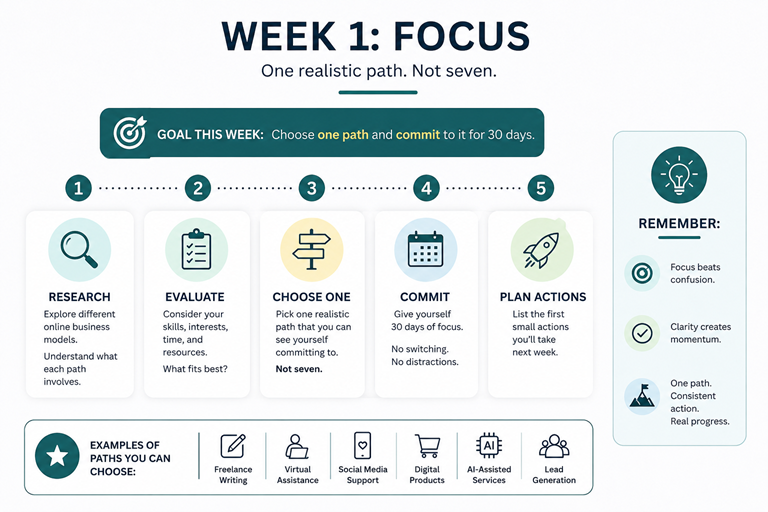
Week 1: Stop Hunting for Magic. Pick One Direction.
This is where most people get lost.
- Too many creators
- Too many promises
- Too many “best opportunities”
- Too much noise
So the first job is not making money.
It’s choosing focus.
Maybe:
- Freelance writing
- Virtual assistance
- Social media support
- Digital products
- AI-assisted services
- Lead generation
Week 2: Learn Enough to Become Useful
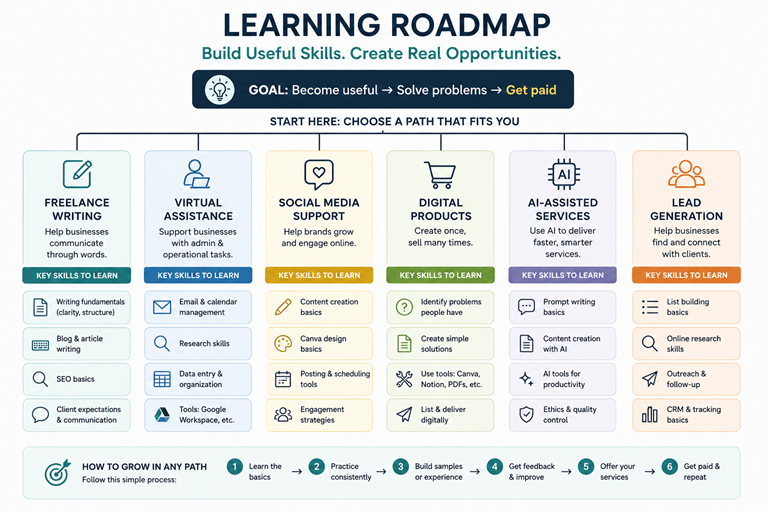
The goal is usefulness.
Not perfection.
If Thabo chooses freelance writing:
- How blog content works
- Business content basics
- Writing structure
- Client expectations
If social media support:
- Posting basics
- Simple design workflows
- Engagement principles
Week 3: Build Something Real
This is where confidence starts shifting.
Because ideas become visible.
If Thabo chose writing:
He writes sample articles.
If social media:
He creates mock content.
If digital products:
He builds a simple useful resource.
If AI services:
He tests workflows.
If lead generation:
He researches niches.
Week 4: Put It in Front of Real People
This is where things become uncomfortable.
And real.
- Contact potential clients
- Publish content
- Share an offer
- Ask for feedback
- Start conversations
Will rejection happen?
Probably.
Will silence happen?
Possibly.
That’s normal.
What Probably Won’t Happen in 30 Days
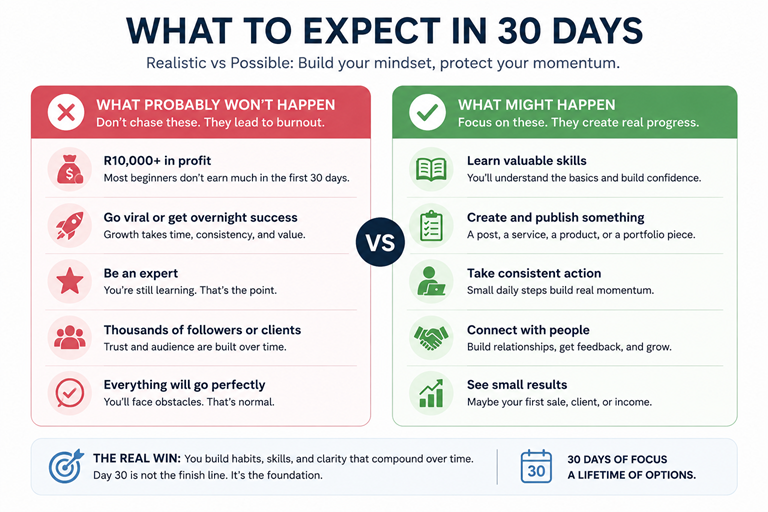
Unrealistic expectations destroy good beginnings.
- Replacing a full salary
- Going viral
- Passive income freedom
- Premium clients instantly
- Scaling a full business
That’s not failure.
That’s reality.
What Might Happen in 30 Days
- Clarity
- Basic skills
- Initial confidence
- First conversations
- Market feedback
- First small opportunity
- Useful rejection
The Real Difference Between People Who Keep Looking and People Who Actually Start
Thabo has spent hours searching.
Maybe days.
Maybe longer.
At first, the internet felt like noise.
Now the picture is clearer.
Legitimate opportunities exist.
Scams can be filtered out.
Skills can be built.
Momentum can be created.
So what happens now?
The Difference Is Rarely Intelligence
Thabo does not need:
- Secret insider knowledge
- Fancy tools
- A business degree
- Tech genius status
What separates builders from spectators is simpler:
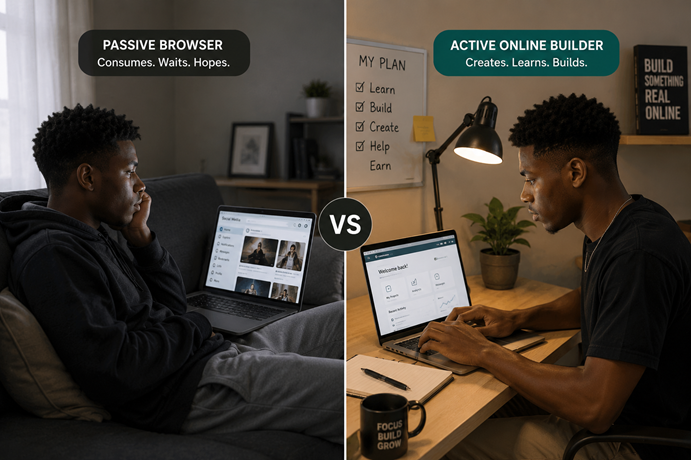
The Internet Rewards Builders, Not Browsers
The internet is full of people consuming business content.
- Watching
- Saving videos
- Comparing ideas
- Planning endlessly
- Researching without action
Meanwhile, quieter people are:
- Testing offers
- Learning skills
- Creating products
- Building trust
- Improving systems
Final Verdict: Is Making Money Online in South Africa Actually Real?
Yes.
For ordinary people.
Not because it’s easy.
Not because the internet is magical.
Not because there’s a secret method.
Thabo may still fail.
That’s possible.
But now he would fail attempting something real—not being manipulated by something fake.
That’s a far better place to begin.
What Next?
If you’re like Thabo, the hardest part may not be finding opportunity.
It may be filtering noise.
That’s exactly why GigsZA exists.
Explore Practical Online Business Opportunities
No fake urgency. No fantasy screenshots. Just grounded digital opportunity guidance for South Africans.
Explore More AI & Digital Business Guides
Discover practical business opportunities, AI-powered income ideas, and scalable digital business strategies.
AI Isn’t Replacing Content Services
Learn why AI is creating entirely new agency opportunities instead of replacing service businesses.
Read ArticleStart an AI Resume Writing Business
A practical South African guide to launching a profitable AI-assisted writing service.
Read ArticleStart a Digital Template Business
Learn how to create and sell downloadable digital products in South Africa.
Read ArticleAI Chatbot Strategy for Small Business
Explore strategy, implementation risks, and practical chatbot deployment insights.
Read ArticleStill Have Questions About Remote Work?
Explore our complete guide covering the most common questions South Africans ask about remote work, work-from-home jobs, international opportunities, freelancing, equipment, salaries, scams, taxes, interviews, and more.
Read: Remote Work in South Africa – 50 Questions Answered →
Start an Online Business with Almost No Money
Learn how to start a practical online business without needing large amounts of capital. This step-by-step guide explains how to choose a business model, find your first customers, use free online tools, and build a...
About the Author
Founder of GigsZA
Douw Steyn is the founder of GigsZA, a platform that helps South Africans find legitimate online work opportunities, digital business ideas, and practical ways to earn money online safely. His content focuses on realistic income strategies, avoiding scams, and navigating the local online economy.
Pingback: Remote Work in South Africa: Opportunities, Risks & Reality (2026 Guide)